
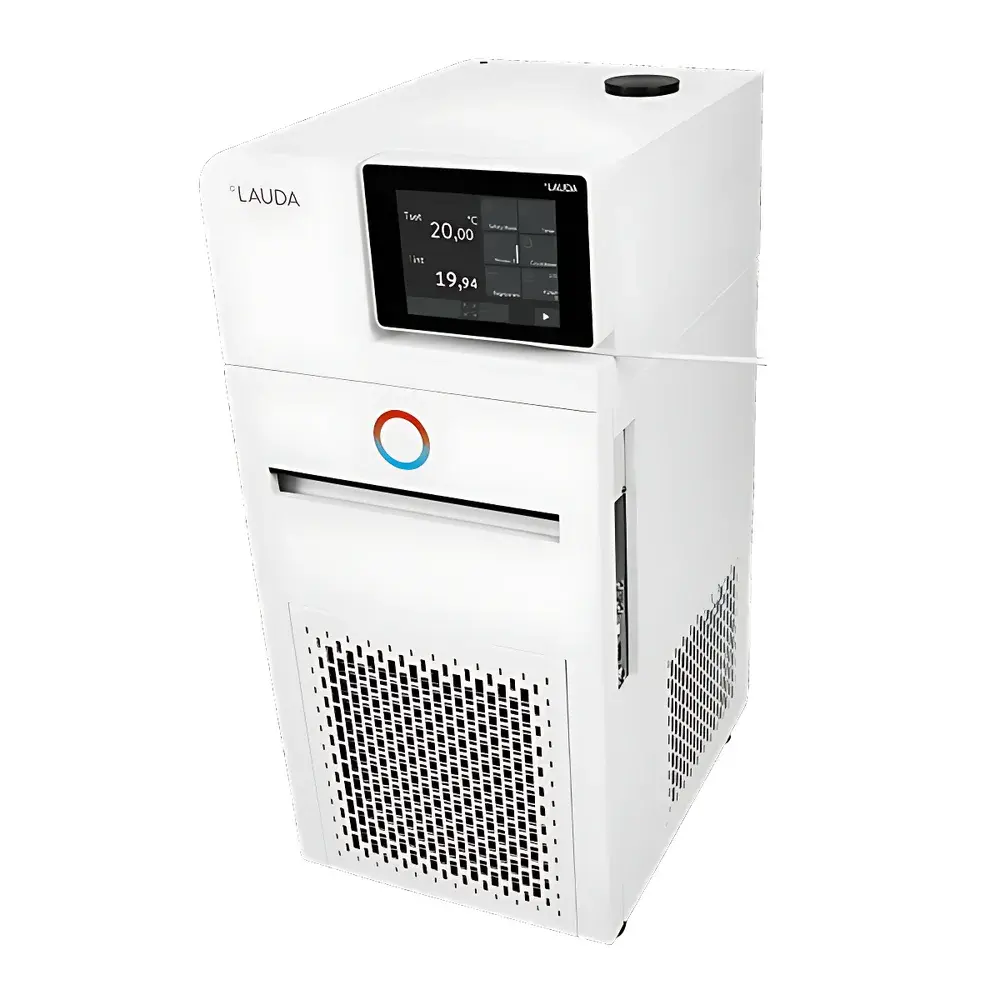
LAUDA PRO RP 240 EC External Circulating Temperature Controller for Reactors (-40 to 200 °C)
| Brand | LAUDA |
|---|---|
| Origin | Germany |
| Model | RP 240 EC |
| Instrument Type | Integrated Circulating Chiller |
| Cooling Method | Hybrid (Air- and Water-Cooled) |
| Temperature Range | -40 to 200 °C |
| Cooling Capacity | 600 W at 20 °C |
| Temperature Stability | ±0.05 K |
| Pump Pressure | 0.68 bar |
| Pump Flow Rate | 22 L/min |
| Reservoir Volume | 2.4–4.4 L |
| Internal Fill Volume | Minimal (Optimized for Rapid Thermal Response) |
| Refrigerant | R-449A (GWP 1397, compliant with EU Regulation (EU) No 517/2014) |
| Power Supply | 230 V, 50 Hz |
| Max. Power Consumption | 3.7 kW |
| Dimensions (W×D×H) | 300 × 430 × 675 mm |
| Weight | 40 kg |
| Compliance | DIN 12876 Class I |
Overview
The LAUDA PRO RP 240 EC is a high-performance, integrated external circulating temperature controller engineered for precise, dynamic thermal management of laboratory reactors, jacketed vessels, and other externally connected process equipment. Operating across an exceptionally wide temperature range of –40 °C to +200 °C, it employs a hybrid cooling architecture—capable of switching between air-cooling and water-cooling modes—to ensure stable operation under variable ambient conditions and demanding thermal loads. Its compact tower design minimizes footprint while housing a low internal fluid volume reservoir (2.4–4.4 L), enabling rapid heating and cooling response times critical for exothermic/endothermic reaction control, crystallization studies, and material testing protocols. The unit integrates a Varioflex dual-mode pump (pressure/suction, 8-stage adjustable), full electronic PID control for both internal bath and external loop regulation, and SmartCool digital compressor management to optimize energy efficiency without compromising thermal fidelity.
Key Features
- 5.7-inch multi-touch color display with intuitive HMI; detachable for remote operation
- Onboard programmable controller supporting up to 100 user-defined programs, each with 50 segments
- User management for up to 20 accounts with role-based access control
- Self-diagnostic system with guided troubleshooting assistant and real-time status monitoring
- Integrated timer and countdown functions for automated start/stop sequencing
- Stainless steel insulated reservoir with overflow protection, drain valve, and corrosion-resistant fittings
- PowerAdapt technology dynamically adjusts heater output to maximize utilization of available electrical supply capacity
- Low-setpoint overtemperature protection with audible alarm, certified for use with flammable and non-flammable heat transfer fluids
- Dual communication interface standard: USB 2.0 and Ethernet (TCP/IP); optional field-upgradable modules for RS-232/485, Profibus, EtherCAT, analog I/O, or dry-contact control
- Compliant with DIN 12876 Class I safety requirements for laboratory temperature control equipment
Sample Compatibility & Compliance
The RP 240 EC is compatible with a broad spectrum of heat transfer media—including water, water-glycol mixtures, silicone oils, and synthetic heat transfer fluids—enabling safe and stable operation across its full –40 °C to +200 °C range. Its sealed refrigeration circuit uses R-449A, a low-GWP (1397) hydrofluoroolefin (HFO)-blended refrigerant fully compliant with EU F-Gas Regulation (EU) No 517/2014. All electrical and mechanical components meet CE marking requirements under the Machinery Directive 2006/42/EC and Low Voltage Directive 2014/35/EU. For regulated environments, the device supports audit-ready operation: event logs, parameter change history, and user activity records are timestamped and stored locally, facilitating GLP/GMP traceability. While not inherently 21 CFR Part 11 compliant out-of-the-box, its Ethernet interface enables integration with validated LIMS or SCADA systems that enforce electronic signature and data integrity controls.
Software & Data Management
Data exchange is natively supported via USB mass storage mode (for configuration export/import and log file retrieval) and TCP/IP Ethernet (for real-time monitoring and remote control using LAUDA’s proprietary LabView-compatible drivers or third-party OPC UA clients). Logged parameters—including setpoint, actual bath and outlet temperatures, pump speed, compressor status, and error codes—are stored in CSV format with millisecond-resolution timestamps. Firmware updates are performed via USB stick, ensuring version control and reproducibility across instrument fleets. Optional LAUDA Connect software provides centralized fleet monitoring, alarm notification (email/SMS), and trend analysis for preventive maintenance scheduling. All communication protocols adhere to ISO/IEC 8859-1 character encoding and support UTF-8 metadata tagging for multilingual lab environments.
Applications
- Precise temperature control of glass or stainless-steel jacketed reactors during synthesis, polymerization, and hydrogenation
- Thermal conditioning of calorimeters, viscometers, and spectroscopic cells requiring stable external heat exchange
- Environmental stress testing of electronic components and PCBs across extreme thermal cycles
- Controlled crystallization and polymorph screening in pharmaceutical development
- Calibration of temperature-sensitive sensors and transducers against NIST-traceable references
- Supporting ASTM D2570 (viscosity-temperature dependence), ISO 2812-3 (coating drying behavior), and USP <1031> (thermal analysis of drug substances)
FAQ
What heat transfer fluids are recommended for operation at –40 °C?
For sustained operation below –20 °C, LAUDA recommends silicone-based or specialized low-temperature synthetic heat transfer fluids (e.g., Therminol LT, Marlotherm SH). Water-glycol mixtures are unsuitable below –15 °C due to increased viscosity and risk of phase separation.
Can the RP 240 EC be integrated into a PLC-controlled production line?
Yes—via optional Profibus DP or EtherCAT modules, the unit accepts analog setpoint inputs (0–10 V or 4–20 mA) and provides real-time process variable outputs, enabling seamless integration into industrial automation architectures.
Is the internal reservoir volume adjustable?
No—the reservoir volume is fixed at 2.4–4.4 L depending on installed accessories; however, the minimal internal fill volume (2.4 L nominal) is engineered to reduce thermal inertia and accelerate ramp rates.
Does the unit support continuous unattended operation for 72+ hours?
Yes—designed for 24/7 laboratory duty, it features redundant safety systems including dual temperature sensors, pressure-switched compressor cutoff, and automatic leak detection logic. Routine maintenance intervals are specified at 12 months or 2000 operating hours.
How is calibration traceability maintained?
The RP 240 EC includes factory calibration certificates traceable to DAkkS-accredited laboratories. Users may perform field verification using external PT100 probes; deviation logs are automatically recorded and exportable for quality audits.



