
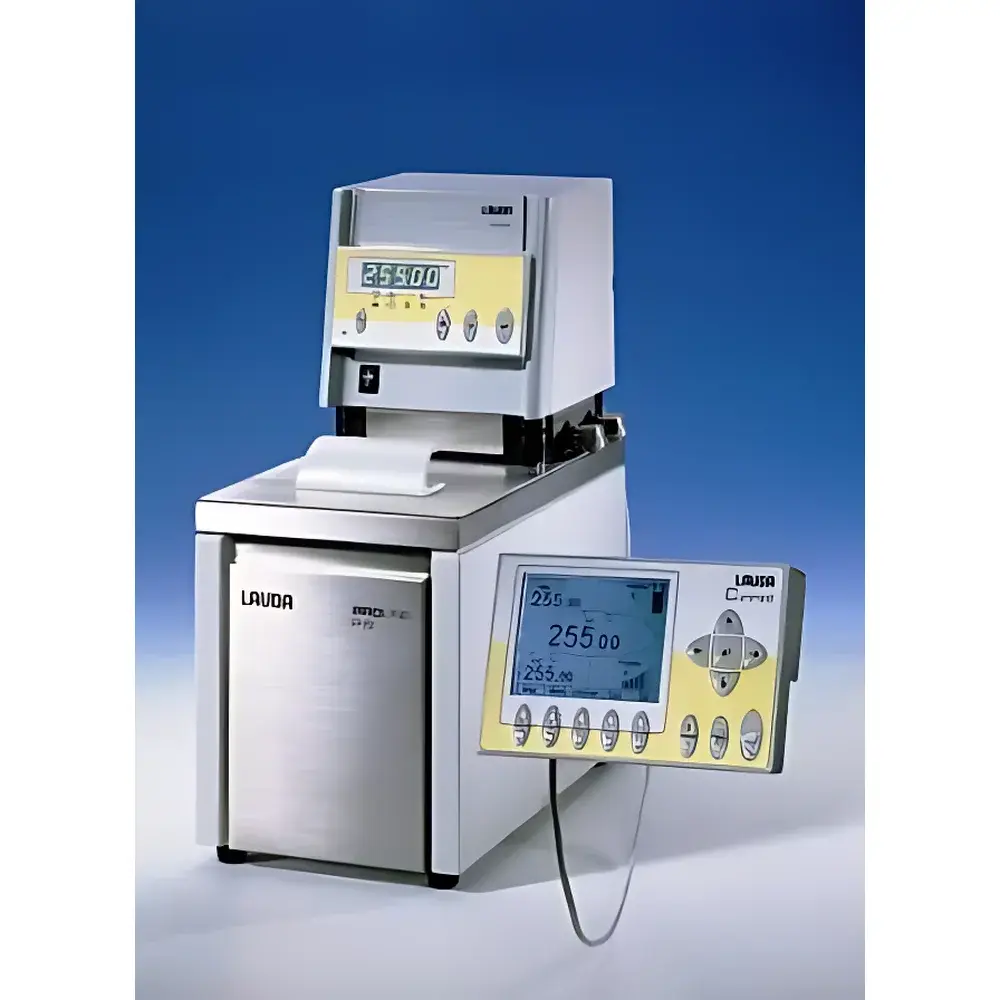
LAUDA Proline-X Advanced Circulating Temperature Bath
| Brand | LAUDA |
|---|---|
| Origin | Germany |
| Model | Proline-X |
| Type | Circulating Temperature Bath |
| Temperature Range | -90 °C to +200 °C |
| Temperature Stability | ±0.01 °C |
| Heating Power | 3.5 kW |
| Pump Pressure Head | 0.7–1.1 bar |
| Pressure Pump Flow Rate | 25 L/min |
| Suction Pump Flow Rate | up to 23 L/min |
| Bath Volume Options | 15 L, 24 L, 36 L, or custom external bath compatibility (310–500 mm width) |
Overview
The LAUDA Proline-X Advanced Circulating Temperature Bath is a high-precision, dual-mode (heating/cooling) thermal management system engineered for demanding laboratory and industrial applications requiring exceptional temperature uniformity, dynamic response, and long-term stability. Based on LAUDA’s proven Proline platform—designed and manufactured in Germany—the Proline-X employs a robust closed-loop circulation architecture grounded in thermodynamic control principles. It utilizes a combination of triple independent heating elements, digitally regulated refrigeration, and dual intelligent pumping systems (pressure and suction) to maintain setpoint accuracy within ±0.01 °C across its full operational range of –90 °C to +200 °C. Unlike conventional baths with fixed-volume reservoirs, the Proline-X supports both internal bath operation and external temperature-controlled loops—making it suitable for jacketed reactors, spectroscopic cells, material testing fixtures, and calorimetric setups where thermal load varies significantly over time.
Key Features
- Wide operational temperature range: –90 °C to +200 °C, enabled by optimized refrigerant circuit design and high-efficiency compressor staging
- Dual-circulation capability: Simultaneous pressure and suction pumping (up to 25 L/min pressure flow; up to 23 L/min suction flow) ensures stable heat transfer even under high back-pressure conditions
- Triple-zone heating system: Independently controlled heating elements provide rapid ramp rates and precise spatial thermal distribution
- Smart refrigeration management: Algorithm-driven cooling output adapts in real time to thermal load changes—reducing energy consumption and extending compressor service life
- Modular control architecture: Equipped with either Master (basic PID) or Command (advanced programmable) controller options; includes plug-and-play expansion slot for future upgrades (e.g., Ethernet communication, GLP audit trail module)
- Enhanced safety framework: Multi-layer protection including dry-run detection, overtemperature cutoff, low-level fluid alarm, and real-time error logging with descriptive diagnostic codes
- Ergonomic accessibility: Rear and side-mounted dual external circulation ports; rear-panel sensor input for remote probe feedback; tool-free maintenance access to pumps and heat exchangers
Sample Compatibility & Compliance
The Proline-X accommodates a broad spectrum of sample configurations through flexible bath integration: stainless-steel internal tanks (15 L, 24 L, 36 L), transparent-window variants for visual process monitoring, and direct coupling to external vessels up to 500 mm wide. Its construction complies with IEC 61010-1 (Safety Requirements for Electrical Equipment for Measurement, Control, and Laboratory Use) and meets CE marking requirements for electromagnetic compatibility (EMC Directive 2014/30/EU). When configured with the Command controller and optional audit trail module, the system supports 21 CFR Part 11-compliant data integrity protocols—including electronic signatures, user access levels, and immutable event logs—enabling use in regulated environments governed by FDA, EMA, or ISO/IEC 17025 standards.
Software & Data Management
The Proline-X integrates seamlessly with LAUDA’s PC-based software suite (LaudaLab v4.x), supporting real-time temperature profiling, multi-step program scheduling, and automated calibration validation. Data export is available in CSV and XML formats for traceability and LIMS integration. The Command controller provides built-in data logging (≥10,000 timestamped entries), USB and RS232 connectivity, and optional Ethernet/Wi-Fi modules for networked lab infrastructure. All controller firmware updates are digitally signed and delivered via secure LAUDA portal—ensuring version control and cybersecurity compliance per NIST SP 800-53 guidelines.
Applications
- Calibration of temperature-sensitive instrumentation (e.g., IR detectors, RTDs, thermocouples) per ASTM E74 and ISO 17025 requirements
- Thermal conditioning of viscometers, rheometers, and DSC sample stages
- Process simulation for pharmaceutical freeze-drying cycles and bioreactor jacket control
- Material science testing: coefficient of thermal expansion (CTE) measurements, polymer crystallization kinetics, and elastomer hysteresis analysis
- Environmental stress screening in electronics reliability labs (MIL-STD-810G, JEDEC JESD22-A119)
- Chemical synthesis support: precise exotherm suppression during Grignard or lithiation reactions
FAQ
What external bath sizes are compatible with the Proline-X?
The Proline-X supports external baths ranging from 310 mm to 500 mm in width, with optional PBD/PBDC pump configurations optimized for high-flow, high-head applications.
Does the Proline-X meet GLP/GMP documentation requirements?
Yes—when equipped with the Command controller and audit trail module, it provides full 21 CFR Part 11 compliance, including electronic signatures, role-based access, and tamper-evident data logs.
Can the system operate without an internal bath?
Absolutely. The Proline-X is designed for both standalone internal bath use and fully external circulation loops—ideal for integration into custom reactor or test chamber systems.
Is refrigerant type specified for low-temperature operation?
The unit uses environmentally compliant R-513A refrigerant, selected for low global warming potential (GWP = 631) and ASHRAE A1 safety classification.
How is temperature uniformity verified across the bath volume?
LAUDA performs volumetric mapping per DIN EN ISO/IEC 17025:2017 using calibrated Pt100 probes at nine defined positions; typical uniformity is ≤ ±0.02 °C at steady state.



