
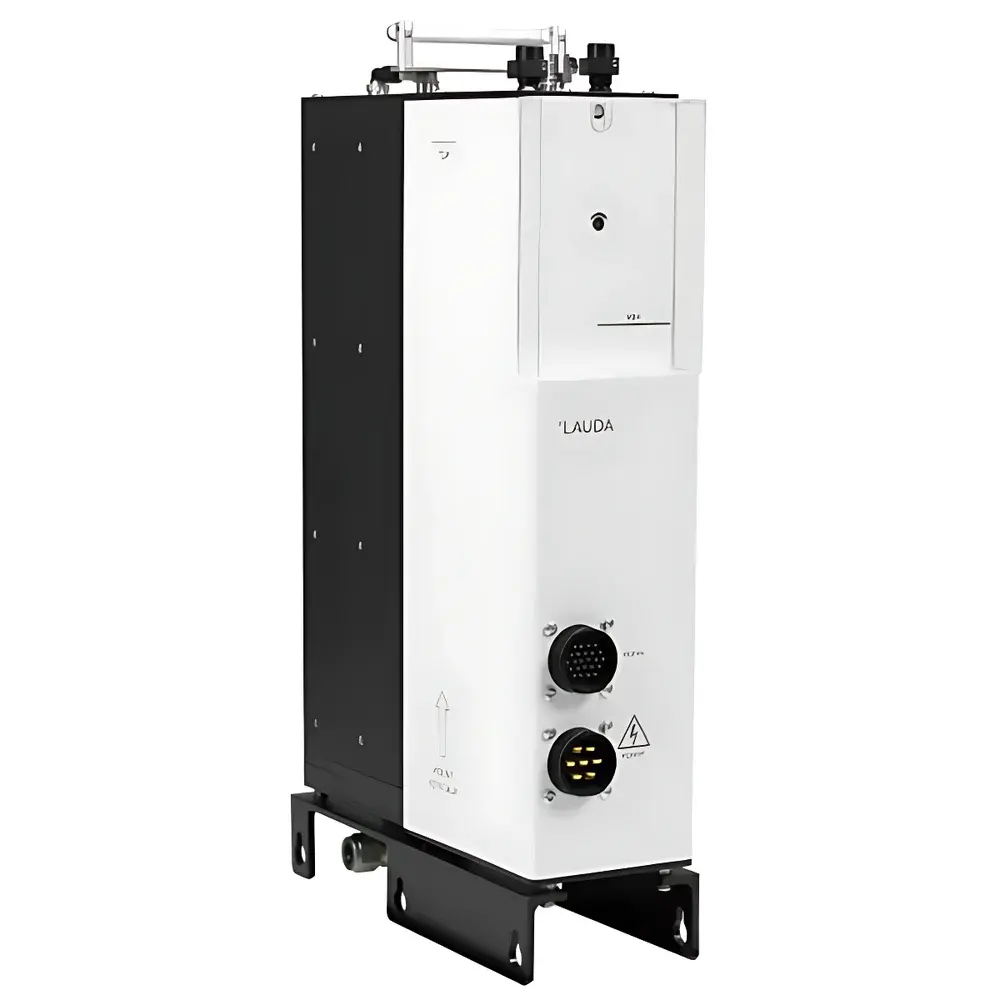
LAUDA Semistat S 2400 Peltier-Based Temperature Control System for Plasma Etching Applications
| Brand | LAUDA |
|---|---|
| Origin | USA |
| Model | Semistat S 2400 |
| Instrument Type | Split-System |
| Cooling Method | Water-Cooled |
| Temperature Range | -20 °C to 90 °C |
| Cooling Capacity | 2.45 kW |
| Temperature Stability | ±0.1 °C |
| Circulating Pump Pressure | 2.8 bar |
| Circulating Pump Flow Rate | 22 L/min |
| Reservoir Volume | 1.60 L |
| Operating Mode | Continuous Water Cooling |
| Heating Power (Min) | 6 kW |
| Minimum Fill Volume | 1.25 L |
| Maximum Fill Volume | 1.6 L |
| Dimensions (W×D×H) | 116 mm × 300 mm × 560 mm |
| Weight | 25 kg |
Overview
The LAUDA Semistat S 2400 is a compact, split-system, Peltier-based temperature control system engineered specifically for high-precision thermal management of electrostatic chucks (ESCs) in plasma etching processes. Unlike conventional compressor-driven chillers, the Semistat S 2400 leverages thermoelectric (Peltier) heat transfer technology to deliver rapid, bidirectional temperature regulation—capable of both active cooling and heating—with exceptional dynamic response and minimal thermal overshoot. Its design targets semiconductor front-end fabrication environments where nanoscale process fidelity depends on sub-0.1 °C thermal stability at the ESC interface. By decoupling temperature control from mechanical refrigeration cycles, the system eliminates compressor noise, vibration, and refrigerant handling—critical advantages in vibration-sensitive cleanroom installations and metrology-critical etch chambers.
Key Features
- Peltier-based thermoelectric architecture enabling energy savings up to 90% versus equivalent compressor-based systems
- Split-system configuration with remote controller unit and compact main unit (116 mm × 300 mm × 560 mm), optimized for under-floor or tool-integrated mounting in ISO Class 1–5 cleanrooms
- High-precision temperature stability of ±0.1 °C across the full operating range (−20 °C to +90 °C), verified under dynamic load conditions typical of pulsed plasma discharge cycles
- Integrated clean dry air (CDA) purge port to suppress condensation formation on cold surfaces—essential for maintaining particle-free operation in vacuum-adjacent zones
- Low fluid inventory design (1.25–1.6 L fill volume) minimizing thermal mass and enabling faster ramp rates; no DI filters, deionizers, or maintenance-intensive consumables required
- Water-cooled condenser with 22 L/min flow capacity and 2.8 bar pressure rating, compatible with standard fab-grade chilled water infrastructure (e.g., 7–12 °C supply)
Sample Compatibility & Compliance
The Semistat S 2400 interfaces directly with standard 300 mm and 200 mm wafer processing tools via industry-standard fluid manifolds and analog/digital I/O (0–10 V, 4–20 mA, Modbus RTU). It supports thermal coupling to electrostatic chucks using low-viscosity, non-corrosive heat transfer fluids compliant with SEMI F57 and ASTM D1384 specifications. The system meets CE marking requirements per EU Machinery Directive 2006/42/EC and Low Voltage Directive 2014/35/EU. Its control firmware supports audit-trail logging and user-access level management, facilitating alignment with GMP/GLP documentation practices and internal quality system requirements for qualified semiconductor manufacturing lines.
Software & Data Management
The integrated LAUDA SmartControl software provides real-time monitoring of setpoint tracking, fluid temperature, pump status, and CDA purge activation. Logged data—including timestamped temperature profiles, power consumption, and alarm history—is exportable in CSV format for integration into MES platforms such as Siemens Opcenter Execution Semiconductor or Applied Materials EnduraTrack. Optional Ethernet/IP or PROFINET modules enable direct PLC-level synchronization with tool controllers, supporting recipe-driven temperature sequencing and automated fault recovery protocols. All configuration changes are timestamped and attributable to operator ID, satisfying basic traceability requirements aligned with FDA 21 CFR Part 11 principles for electronic records.
Applications
The Semistat S 2400 is deployed in advanced plasma etch applications including reactive ion etching (RIE), inductively coupled plasma (ICP) etching, and capacitively coupled plasma (CCP) processes used for patterning silicon dioxide, silicon nitride, and high-k dielectrics. Its precision thermal regulation ensures consistent ion energy distribution and radical density at the wafer surface—directly influencing critical parameters such as etch rate uniformity, selectivity, anisotropy, and sidewall profile control. It is routinely specified for logic node development (7 nm and below), 3D NAND stack fabrication, and advanced packaging processes requiring <±0.5 nm CD variation control over full-wafer exposure.
FAQ
What distinguishes the Semistat S 2400 from conventional compressor-based chillers?
It uses solid-state Peltier elements for heat transfer—eliminating moving parts, refrigerants, oil contamination risk, and mechanical vibration—while achieving superior dynamic response and energy efficiency.
Can the system operate continuously at −20 °C ambient inlet water temperature?
Yes, when supplied with chilled water within the specified range (typically 7–12 °C), the unit maintains full cooling capacity and stability across its entire temperature span, including deep sub-zero ESC setpoints.
Is the fluid reservoir accessible for routine maintenance?
The 1.6 L reservoir is sealed and factory-primed; no scheduled fluid replacement or filtration is required during normal operation per LAUDA’s validated service interval guidelines.
Does the system support integration with factory automation networks?
Standard Modbus RTU is included; optional industrial Ethernet protocols (PROFINET, EtherNet/IP) are available for seamless integration into semiconductor tool-level control architectures.
How is thermal stability verified under actual plasma load conditions?
LAUDA provides application-specific validation reports documenting temperature deviation under simulated pulsed RF load profiles, referenced to PT100 sensors embedded in representative ESC mock-ups.



