
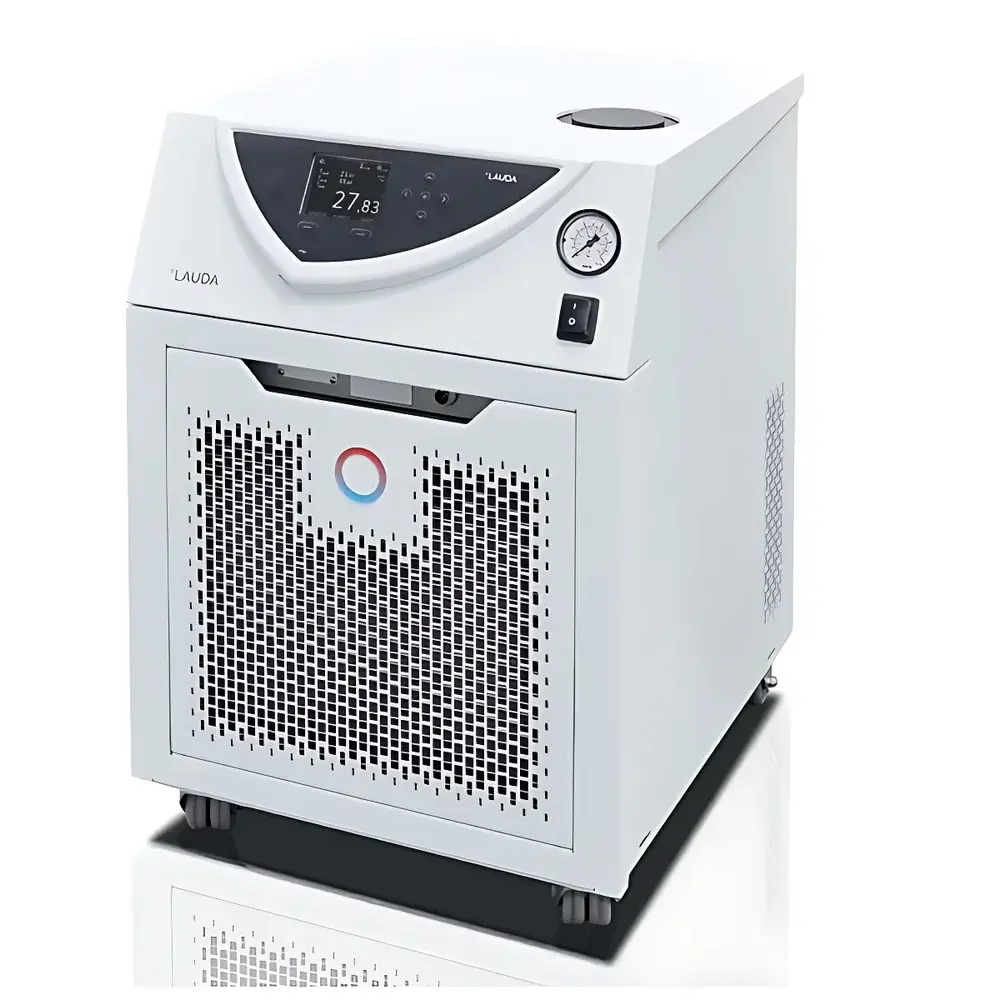

LAUDA Variocool VC1200 Circulating Chiller
| Brand | LAUDA |
|---|---|
| Origin | Germany |
| Instrument Type | Integrated Circulating Chiller |
| Cooling Method | Water-Cooled |
| Temperature Range | −20 to 80 °C |
| Refrigeration Capacity | 1200 W at 20 °C |
| Temperature Stability | ±0.05 K (−20 to 40 °C) |
| Heating Power | 2.2 kW |
| Max. Pump Pressure | 0.9 bar |
| Pump Flow Rate | 28 L/min |
| Reservoir Volume | 15 L |
| Working Mode | Closed-Loop Cooling Water Circulation |
Overview
The LAUDA Variocool VC1200 is a high-precision, integrated circulating chiller engineered for stable thermal management in demanding laboratory and pilot-scale industrial applications. Based on vapor-compression refrigeration with digital inverter-driven compressor control, the system delivers precise temperature regulation across a wide operating range of −20 to 80 °C—achieving exceptional stability of ±0.05 K within the critical −20 to 40 °C interval. Its compact footprint and front-access interface make it suitable for benchtop integration with analytical instruments (e.g., HPLC column ovens, spectrophotometer detectors), laser systems, vacuum pumps, and small-scale reactors. The VC1200 operates as a closed-loop cooling fluid circulator, using water or water-glycol mixtures to extract heat from external devices via a thermally insulated supply/return circuit.
Key Features
- Digitally controlled inverter compressor enabling energy-efficient, stepless refrigeration output and extended component lifetime
- Integrated programmable controller with 150 total segments distributed across 5 independent temperature programs—supporting complex ramp-hold-cool sequences
- High-resolution color TFT display with intuitive icon-based navigation and real-time visualization of setpoint, actual temperature, flow rate, pressure, and reservoir level
- Electronic liquid level monitoring with audible/visual low-level alarm and automatic shutdown to prevent dry-run damage
- Front-mounted bypass valve for fine-tuning system pressure and flow distribution—optimizing thermal coupling with diverse external loads
- Top-fill port and rear-mounted drain valve for safe, spill-free fluid maintenance and system decontamination
- Standard USB interface plus optional communication modules (RS485, Ethernet, analog I/O) for integration into centralized lab automation or SCADA environments
- Factory-configurable alarm contact outputs for interlocking with safety-critical equipment or building management systems
Sample Compatibility & Compliance
The VC1200 is compatible with a broad spectrum of heat-exchanging devices requiring regulated coolant delivery—including chromatography systems, X-ray diffractometers, plasma etchers, and photolithography stages. It supports both aqueous and glycol-based heat transfer fluids (up to 30% ethylene or propylene glycol), with corrosion-resistant wetted materials (stainless steel reservoir, EPDM seals, brass fittings). The unit complies with EU directives EN 61000-6-3 (EMC emission) and EN 61000-6-2 (immunity), carries CE marking, and meets RoHS 2011/65/EU requirements. Its control architecture supports audit-ready operation under GLP and GMP frameworks when paired with validated software and electronic log configurations per FDA 21 CFR Part 11 guidelines.
Software & Data Management
The embedded controller logs temperature, pressure, flow, and operational status at user-defined intervals (1 s to 60 min resolution), storing up to 10,000 data points internally. Data export is supported via USB mass storage mode (CSV format) or real-time streaming through optional Ethernet/RS485 interfaces. LAUDA’s optional PC software—ThermoChill Suite—enables remote monitoring, multi-device synchronization, automated report generation (PDF/Excel), and trend analysis with statistical process control (SPC) overlays. All parameter changes, alarm events, and manual interventions are timestamped and stored with operator ID fields to fulfill traceability requirements in regulated environments.
Applications
- Temperature stabilization of HPLC/UHPLC detector cells and autosampler trays to minimize baseline drift and retention time variability
- Cooling of high-power LED arrays and laser diodes in optical metrology setups where thermal lensing must be suppressed
- Heat removal from rotary evaporator condensers and short-path distillation systems operating under vacuum
- Process cooling in small-batch synthesis reactors equipped with jacketed temperature control
- Thermal conditioning of mass spectrometer ion sources and vacuum pump oil coolers to maintain consistent sensitivity and vacuum integrity
- Supporting ASTM D5276 (impact testing) and ISO 6721 (dynamic mechanical analysis) protocols requiring tightly controlled environmental temperatures
FAQ
What is the minimum allowable coolant temperature for continuous operation?
The VC1200 is rated for continuous operation down to −20 °C using a 30% propylene glycol/water mixture. Pure water is not recommended below 5 °C due to freezing risk.
Can the unit be operated without external load connected?
Yes—the internal bypass loop allows safe no-load operation; however, prolonged zero-flow conditions should be avoided to prevent localized overheating of the pump head.
Is the reservoir volume sufficient for typical HPLC cooling applications?
With 15 L capacity and 28 L/min flow rate, the system maintains stable thermal inertia for single-instrument cooling; for multi-device daisy-chaining, LAUDA recommends the VC2000 or higher-capacity models.
Does the VC1200 support 21 CFR Part 11 compliance out-of-the-box?
The hardware includes essential features (audit trail logging, user access levels), but full Part 11 compliance requires validation of the ThermoChill Suite software and associated SOPs per organizational quality system requirements.
How often does the refrigerant require servicing or recharging?
Under normal use and proper installation, the sealed R-410A refrigerant circuit requires no scheduled maintenance over the 10-year design life; leak detection is continuously monitored via pressure transducer diagnostics.



