
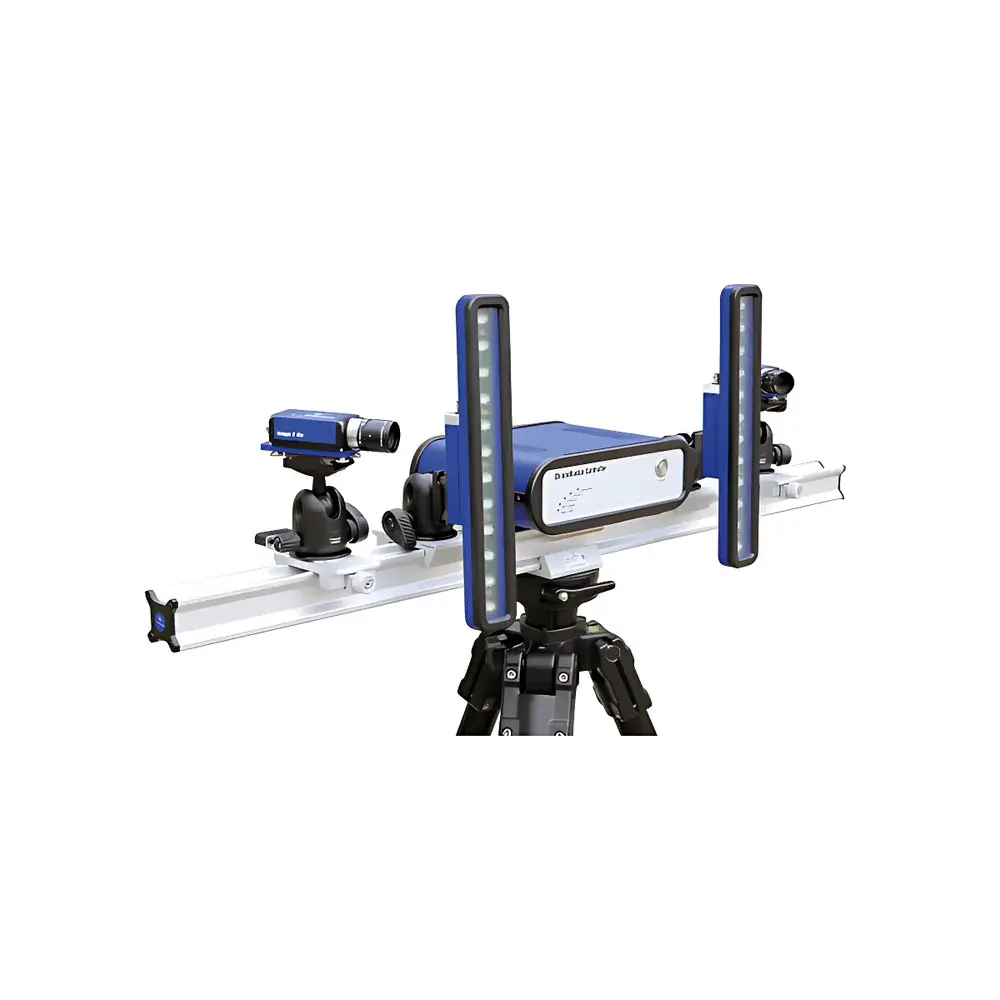
LaVision StrainMaser Full-Field Strain Measurement System Components
| Brand | LaVision GmbH |
|---|---|
| Origin | Germany |
| Manufacturer Type | Authorized Distributor |
| Origin Category | Imported |
| Model | StrainMaser Components |
| Pricing | Available Upon Request |
Overview
The LaVision StrainMaser Full-Field Strain Measurement System Components constitute a modular, high-precision optical instrumentation platform engineered for non-contact, full-field deformation and strain analysis in materials science, mechanical engineering, and structural testing laboratories. Built upon digital image correlation (DIC) principles, the system captures synchronized stereo image pairs from high-speed or high-resolution cameras and computes displacement fields with sub-pixel accuracy across the entire specimen surface. Unlike point-based strain gauges, StrainMaser delivers spatially resolved, two-dimensional strain tensor maps—including εxx, εyy, and γxy—enabling quantitative evaluation of localized yielding, crack propagation, buckling onset, and heterogeneous material response under static, quasi-static, or dynamic loading conditions. Its architecture is designed for integration into existing test frames (e.g., servo-hydraulic, electromechanical, or thermal-mechanical rigs), supporting both laboratory-scale validation and industrial R&D environments requiring traceable, repeatable, and standards-aligned measurement workflows.
Key Features
- Modular component architecture enabling flexible configuration for specific application requirements—from low-speed fatigue to ultra-high-speed impact testing
- High-precision calibration plates with certified fiducial patterns traceable to national metrology institutes (e.g., PTB), ensuring geometric and photogrammetric accuracy per ISO 12232 and ASTM E2754
- Device Control Unit X (DCU-X): A universal synchronization hub featuring integrated 16-bit analog-to-digital conversion (ADC), programmable trigger logic, and deterministic timing resolution down to 100 ns for precise coordination of cameras, actuators, load cells, and environmental chambers
- DIC-optimized illumination systems—including pulsed LED arrays and continuous broadband sources—engineered to minimize motion blur and maximize contrast uniformity across diverse surface textures and reflectivity profiles
- Optical subsystems comprising telecentric lenses, polarization optics, and narrowband spectral filters to suppress ambient interference and enhance speckle pattern fidelity
- High-Temperature Solution module: Blue LED illumination combined with IR-blocking filters enables reliable DIC acquisition on surfaces exceeding 800 °C, mitigating thermal emission artifacts without requiring active cooling or opaque coatings
Sample Compatibility & Compliance
StrainMaser components support specimens ranging from microscale metallic foils (<1 mm thick) to large composite panels (>2 m²), provided appropriate speckle patterning and optical access are maintained. The system is compatible with standard tensile, compression, shear, and torsion fixtures, as well as custom-designed jigs for specialized geometries. All hardware and firmware comply with CE marking requirements and electromagnetic compatibility (EMC) Directive 2014/30/EU. Software modules adhere to audit-trail and data integrity provisions aligned with FDA 21 CFR Part 11 for regulated environments, while DIC algorithms follow the validation framework outlined in ISO/IEC 17025:2017 for testing laboratories. Calibration procedures are documented per ISO/IEC 17025 Annex A.2 and support GLP/GMP-compliant reporting.
Software & Data Management
The StrainMaster DIC software suite provides end-to-end workflow control—from real-time camera setup and calibration verification to post-processing strain tensor derivation, visualization, and export. It supports batch processing of multi-sequence datasets, ROI-based statistical analysis, and automated report generation in PDF or Excel formats. Raw image data is stored in lossless TIFF or HDF5 format with embedded metadata (exposure time, lens parameters, calibration ID, timestamp). Version-controlled software updates are delivered via secure authenticated channels, and source code documentation is available under NDA for internal QA validation. Integration with MATLAB, Python (via API), and LabVIEW enables custom algorithm development and closed-loop control interfacing.
Applications
- Mechanical characterization of advanced composites under thermo-mechanical cycling
- Crack tip strain field mapping in fracture mechanics studies (J-integral, CTOD validation)
- Validation of finite element models (FEM) in automotive crash simulation and aerospace component certification
- In-situ monitoring of additive manufacturing processes (e.g., residual stress evolution during laser powder bed fusion)
- Biomechanical testing of soft tissues and biomaterials under physiological loading regimes
- Quality assurance of weld joints and adhesive bonds in energy infrastructure components
FAQ
What distinguishes StrainMaser components from turnkey DIC systems?
StrainMaser is a component-level offering intended for integration into user-defined experimental setups; it does not include pre-assembled enclosures or proprietary test frames.
Is calibration traceability provided with each calibration plate?
Yes—each plate is supplied with a certificate of calibration issued by an ISO/IEC 17025-accredited laboratory, specifying uncertainty budgets for pitch, orthogonality, and thermal expansion coefficients.
Can the DCU-X synchronize with third-party data acquisition systems?
Yes—the unit features TTL-compatible trigger I/O, Ethernet-based command interface (TCP/IP), and support for IEEE 1588 Precision Time Protocol (PTP) for nanosecond-level cross-platform synchronization.
Does the High-Temperature Solution require special surface preparation?
No—unlike phosphor-based thermographic methods, the blue-LED/IR-filter approach works directly on native oxidized or bare metal surfaces without coating or emissivity correction.
Is DIC software validation documentation available for regulatory submissions?
Yes—validation protocols, IQ/OQ/PQ test scripts, and raw verification data sets are provided under confidentiality agreement for inclusion in regulatory dossiers.



