
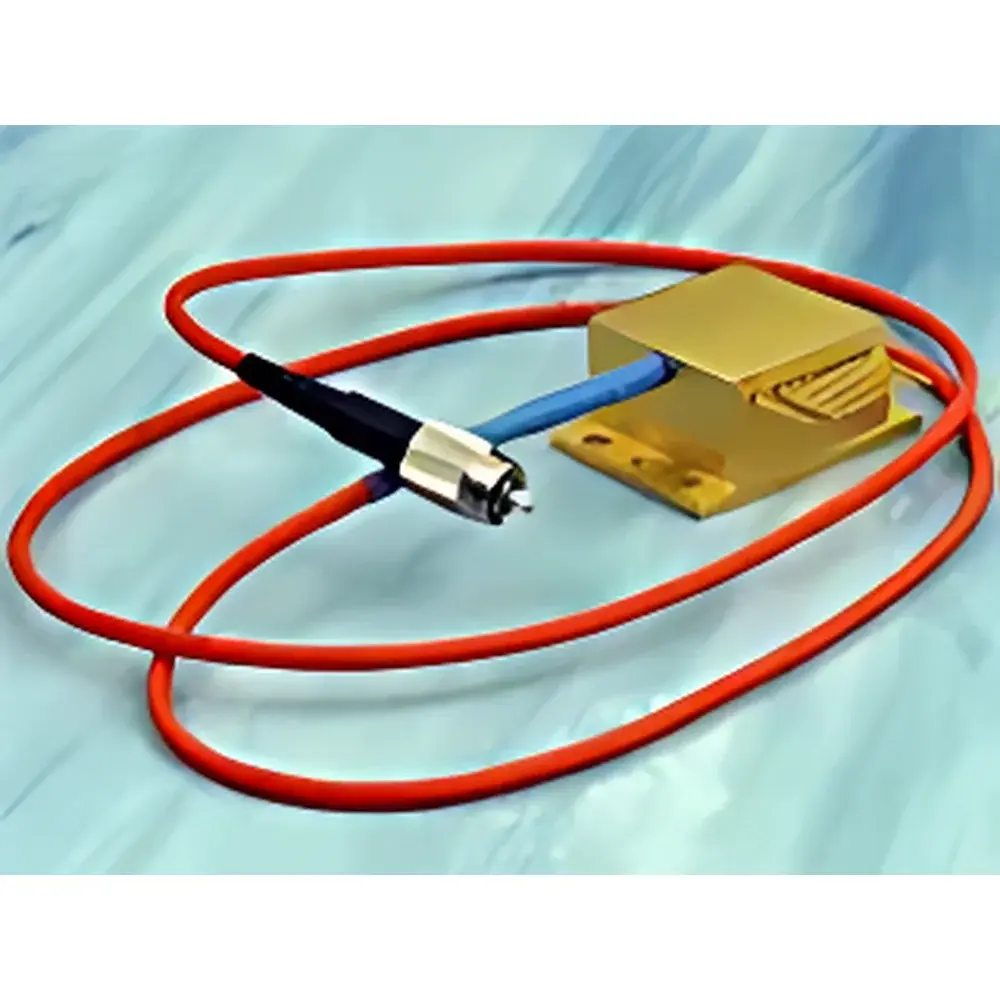
LDX Optronics newopto Fiber-Coupled Laser Diode
| Brand | LDX Optronics |
|---|---|
| Origin | USA |
| Model | newopto |
| Wavelength Range | 445–1850 nm |
| Output Power | up to 10,000 mW (fiber-coupled) |
| Fiber Core Diameters | 100–800 µm |
| Numerical Aperture | NA 0.22 |
| Package Types | 9 mm SMA, 14-pin Butterfly, 9-pin HHL |
| Cooling | Passive (conduction-cooled) |
Overview
The LDX Optronics newopto Fiber-Coupled Laser Diode is a high-brightness, conduction-cooled semiconductor laser source engineered for stable, long-lifetime operation in demanding industrial and scientific applications. Based on edge-emitting diode technology, these devices integrate precision optical coupling into multimode fibers using optimized lensing and alignment techniques to achieve high coupling efficiency (>70% typical) across a broad spectral range from 445 nm (blue) to 1850 nm (short-wave infrared). Unlike actively cooled modules, the newopto series relies on robust thermal management via low-thermal-resistance mechanical packaging—enabling compact form factors without fans or TECs. This architecture supports continuous-wave (CW) operation with excellent power stability (<±2% over 8 hours, under constant current and temperature conditions) and low noise performance (RMS intensity noise <0.3% in 10 Hz–10 MHz bandwidth), making it suitable for pump applications requiring high spatial brightness and temporal coherence.
Key Features
- Wide wavelength coverage: 445 nm to 1850 nm in discrete, factory-calibrated bands with tight tolerances (e.g., ±3 nm at 635 nm; ±10 nm at 445 nm and 1064 nm)
- High fiber-coupled output power: Up to 10,000 mW from an SMA-terminated 400 µm core fiber (LDX-4103-808-FC); scalable power options available per wavelength and fiber size
- Standardized hermetic packages: 9 mm TO-can (SMA), 14-pin Butterfly, and 9-pin HHL configurations—each qualified to MIL-STD-883 for mechanical shock, vibration, and thermal cycling
- Passive thermal design: Aluminum nitride submounts and copper-tungsten heat spreaders ensure reliable conduction cooling at ambient temperatures up to +40 °C (derating required above)
- Consistent beam quality: All models maintain NA ≤ 0.22 at the fiber output, enabling efficient launch into double-clad fibers, bulk optics, or free-space collimation systems
- Long operational lifetime: >20,000 hours MTTF (mean time to failure) demonstrated under rated operating conditions per Telcordia GR-468-CORE reliability testing
Sample Compatibility & Compliance
The newopto series is compatible with standard silica-based multimode fibers (graded-index and step-index) with core diameters of 100 µm, 150 µm, 200 µm, 300 µm, 400 µm, and 800 µm—supporting both low- and high-power delivery architectures. Each device undergoes individual burn-in and electro-optical characterization prior to shipment, with full traceability to NIST-traceable power meters and calibrated spectrometers. The lasers comply with IEC 60825-1:2014 Class 3B or Class 4 safety requirements depending on output level; appropriate labeling, interlock provisions (on Butterfly/HHL variants), and user-accessible emission indicators are integrated per OEM integration guidelines. For regulated environments, the devices support integration into FDA 21 CFR Part 11-compliant systems when paired with validated drivers and software control interfaces.
Software & Data Management
While the newopto diodes operate as analog-controlled CW sources (requiring external constant-current drivers), LDX Optronics provides comprehensive driver compatibility documentation—including recommended models from Wavelength Electronics (QCL series), ILX Lightwave (LDC-37xx), and Thorlabs (LDCxx series). Digital control is enabled via TTL/RS-232 interfaces on optional driver add-ons, supporting remote power modulation (0–10 V analog input), fault monitoring (TEC status, photodiode feedback), and logging of operational parameters (current, case temperature, output power estimates). All test data—including L-I-V curves, spectral FWHM, far-field divergence, and coupling efficiency—are delivered in CSV and PDF formats with unique serial-number traceability. Firmware-upgradable drivers may be configured to enforce hard limits aligned with ISO 13406-2 eye-safety thresholds during system commissioning.
Applications
- Fiber laser pumping: High-brightness 915 nm, 940 nm, and 980 nm variants serve as primary pump sources for Yb-doped, Er/Yb-codoped, and Tm-doped fiber amplifiers and oscillators
- Diode-pumped solid-state (DPSS) lasers: 808 nm and 885 nm models enable efficient Nd:YAG, Nd:YVO₄, and Nd:GdVO₄ excitation with minimal thermal lensing
- Materials processing: 780–1064 nm high-power modules (up to 7 W coupled into 400 µm fiber) support seam welding, brazing, and cladding in automotive and aerospace manufacturing
- Biomedical instrumentation: 635 nm, 660 nm, and 850 nm wavelengths are used in flow cytometry illumination, optogenetics light delivery, and photodynamic therapy light engines
- Sensing and spectroscopy: Narrow-linewidth 1470 nm and 1550 nm sources feed tunable diode laser absorption spectroscopy (TDLAS) and cavity ring-down systems for gas detection
- Research-grade testbeds: Broad spectral availability enables multi-wavelength comparative studies in nonlinear frequency conversion, photoacoustic imaging, and ultrafast amplifier seeding
FAQ
What is the maximum allowable case temperature for continuous operation?
The recommended maximum case temperature is +40 °C for full-rated output; derating curves are provided in the datasheet for operation up to +55 °C.
Can these lasers be modulated at kHz frequencies?
Yes—when driven by low-inductance, fast-response current sources (e.g., Wavelength Electronics QCL1000), modulation bandwidth exceeds 100 kHz for most models (limited by junction capacitance and package parasitics).
Is polarization-maintaining (PM) fiber coupling available?
Standard configurations use non-PM multimode fiber; PM coupling is available as a custom option (minimum order quantity applies) with extinction ratio >20 dB.
Do you provide spectral width (FWHM) data for each wavelength variant?
Yes—full spectral characterization is performed per unit; typical FWHM ranges from 1.5 nm (635 nm) to 5 nm (1550 nm), depending on structure and operating current.
Are RoHS and REACH compliance documents available?
All newopto modules are RoHS 2011/65/EU and REACH SVHC-compliant; declarations of conformity and material content reports are supplied upon request.




