
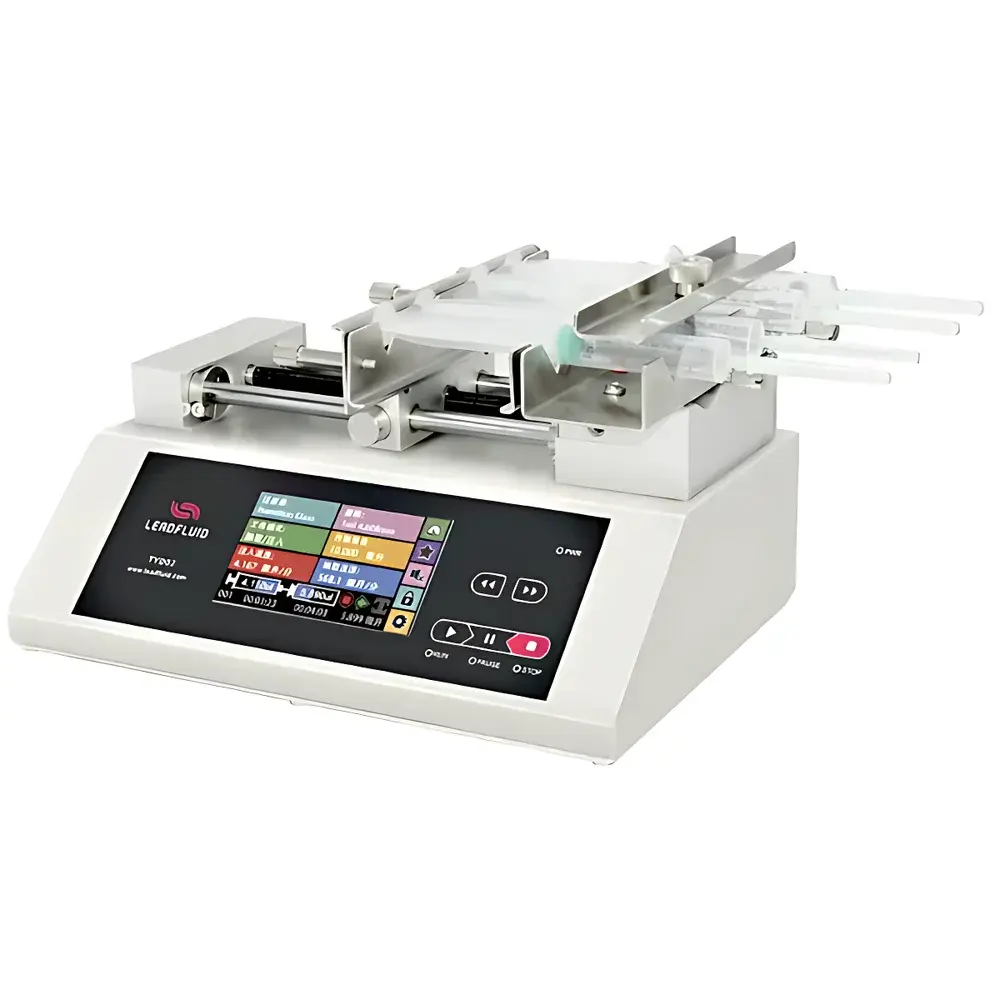
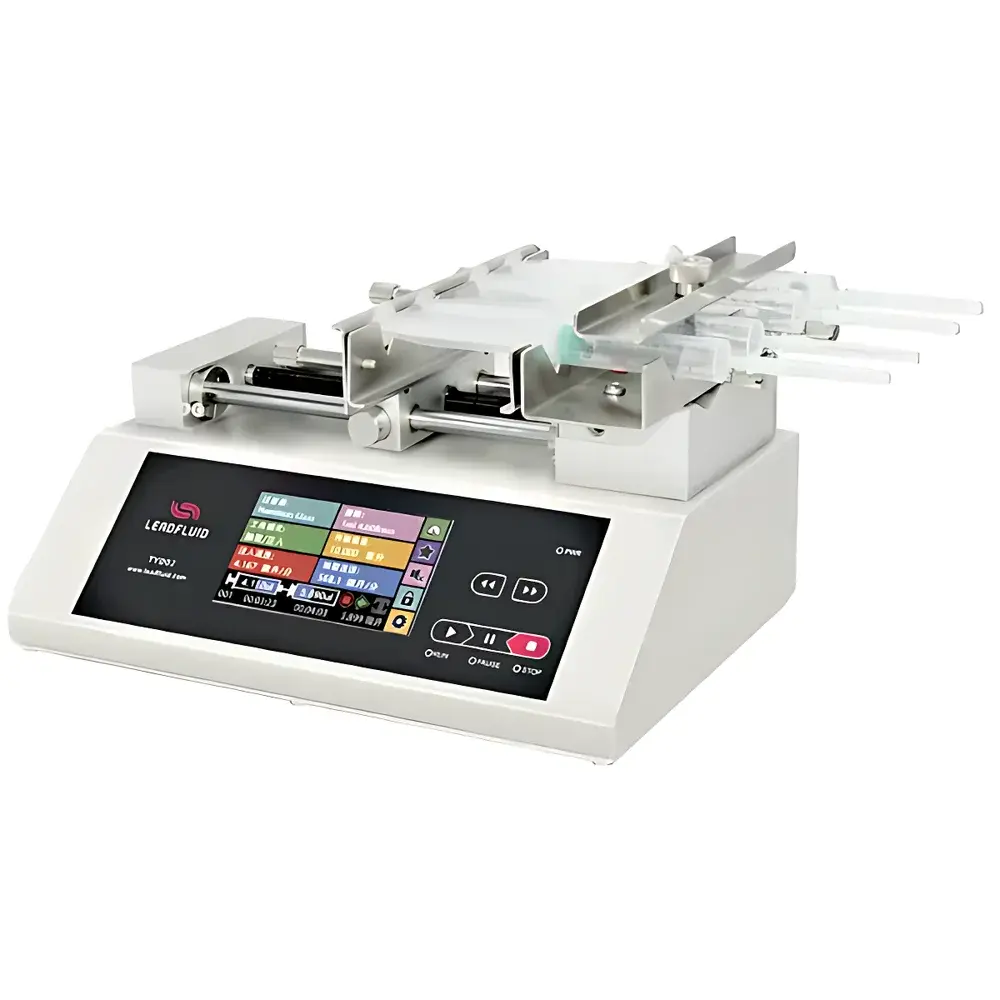
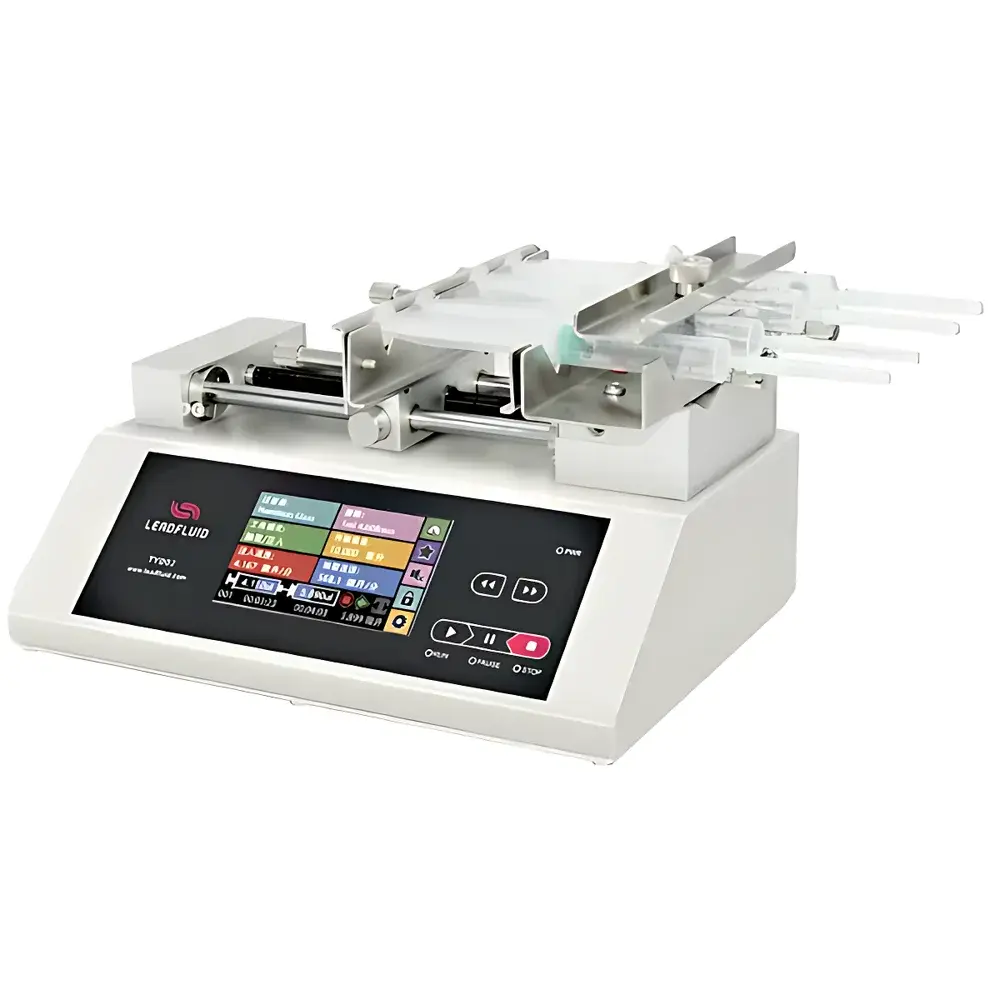
LeadFluid TYD02-04 Four-Channel Laboratory Syringe Pump
| Brand | LeadFluid |
|---|---|
| Origin | Hebei, China |
| Model | TYD02-04 |
| Instrument Type | Micro-syringe Pump |
| Flow Rate Range | 0.001 µL/min to 200 mL/min |
| Accuracy | ≤ ±0.5% |
| Repeatability | ≤ 0.1% |
| Syringe Capacity Support | 10 µL – 10 mL |
| Display | 4.3-inch HD capacitive touchscreen |
| Communication Interface | RS485 with Modbus RTU protocol |
| Mechanical Precision (Stroke Control) | < ±0.35% |
| Bearing System | High-strength aerospace-grade angular contact bearings |
| EMI Resistance | Rated for continuous operation in high-voltage electrostatic fields |
| Power Input | Wide-range AC/DC input |
| Enclosure | All-metal housing with anti-static and corrosion-resistant coating |
Overview
The LeadFluid TYD02-04 is a four-channel benchtop syringe pump engineered for precise, repeatable, and programmable fluid delivery in research laboratories, analytical instrumentation integration, and process development environments. It operates on the principle of linear displacement actuation—converting rotary motion from a stepper motor into highly controlled axial movement of syringe plungers via precision-ground lead screws. This electromechanical architecture ensures deterministic volumetric output without reliance on pressure feedback or flow sensing, making it ideal for applications where pulseless, low-shear, and contamination-free delivery is critical—such as microfluidics, electrophysiology, chromatography sample introduction, catalyst dosing, and controlled reagent addition in reaction kinetics studies.
Key Features
- Four independent channels support simultaneous operation of up to four syringes—compatible with standard plastic disposable syringes (10 µL–10 mL) and borosilicate glass syringes with Luer-lock or fixed-nipple fittings.
- Ultra-broad flow range spanning six orders of magnitude: 0.001 µL/min (nanoliter-per-hour precision) to 200 mL/min—enabling both ultra-trace dosing and high-throughput liquid handling within a single platform.
- High-fidelity mechanical design featuring aerospace-grade angular contact ball bearings for lead screw support—eliminating backlash, minimizing wear, and extending service life beyond 10,000 hours under continuous duty.
- 4.3-inch capacitive touchscreen interface with intuitive icon-driven navigation, real-time graphical display of flow profiles, and on-device parameter validation—reducing setup time and operator error.
- Comprehensive safety and operational safeguards: automatic stall detection, occlusion alarm with configurable pressure thresholds, plunger position monitoring, and hardware-enforced emergency stop.
- Industrial-grade electromagnetic compatibility (EMC): certified for stable performance in environments with >20 kV/m electrostatic fields—validated per IEC 61326-1 Class A requirements for laboratory equipment.
Sample Compatibility & Compliance
The TYD02-04 accommodates a wide range of chemically inert and temperature-stable syringes—including polypropylene, PTFE-lined, and glass variants—supporting aqueous, organic, and mildly corrosive solvents (pH 2–12). Its all-metal enclosure employs electrostatically applied epoxy-polyester hybrid coating, meeting ISO 9227 salt-spray resistance standards (72 h neutral salt fog). While not classified as a medical device, the pump complies with CE marking directives (2014/30/EU EMC and 2014/35/EU LVD), RoHS 2011/65/EU, and supports audit-ready operation when integrated into GLP- or GMP-aligned workflows through traceable parameter logging and Modbus register mapping.
Software & Data Management
The pump natively supports Modbus RTU over RS485, enabling seamless integration with SCADA systems, PLCs (e.g., Siemens S7, Allen-Bradley CompactLogix), and custom LabVIEW or Python-based control suites. LeadFluid provides open register documentation and a Windows-compatible configuration utility for offline method creation, batch scheduling, and firmware updates. All operational parameters—including target volume, flow rate, acceleration profile, and channel enable status—are stored in non-volatile memory with timestamped change logs. When deployed in regulated environments, the system supports 21 CFR Part 11-compliant electronic records via third-party middleware that enforces user authentication, audit trails, and electronic signatures.
Applications
- Controlled infusion in preclinical pharmacokinetic studies requiring multi-analyte co-delivery.
- Automated calibration and standard addition in ICP-MS and HPLC-ICP-MS hyphenated systems.
- Sequential reagent injection in stopped-flow spectrophotometry and enzyme kinetics assays.
- Microscale synthesis platforms where stoichiometric precision at sub-microliter increments is essential.
- Integration into modular lab-on-a-chip test benches for pressure-independent fluid actuation.
- Long-duration environmental simulation experiments involving slow-release nutrient or inhibitor dosing.
FAQ
What syringe types and sizes are supported?
The TYD02-04 accepts standard Luer-lock and Luer-slip syringes ranging from 10 µL to 10 mL capacity—including glass, polypropylene, and PTFE-coated variants. Custom syringe geometry can be added via user-defined diameter calibration.
Does the pump support gradient or multi-step flow programming?
Yes—each channel supports up to 100 programmable steps with independent ramp rates, dwell times, and direction reversal, enabling complex temporal delivery profiles without external scripting.
Is remote monitoring possible without a PC?
While no built-in Ethernet or Wi-Fi is provided, the RS485 interface allows connection to industrial HMIs or embedded gateways for local network visibility and alarm relay outputs.
How is accuracy maintained across the full flow range?
Accuracy is preserved through factory-calibrated step-to-volume conversion tables, temperature-compensated motor current regulation, and closed-loop position verification using high-resolution optical encoders on each drive axis.
Can the pump operate unattended for extended periods?
Yes—the system includes watchdog timers, thermal shutdown protection, and non-volatile memory retention for power-loss recovery, supporting uninterrupted operation over 72+ hours under typical lab conditions.



