
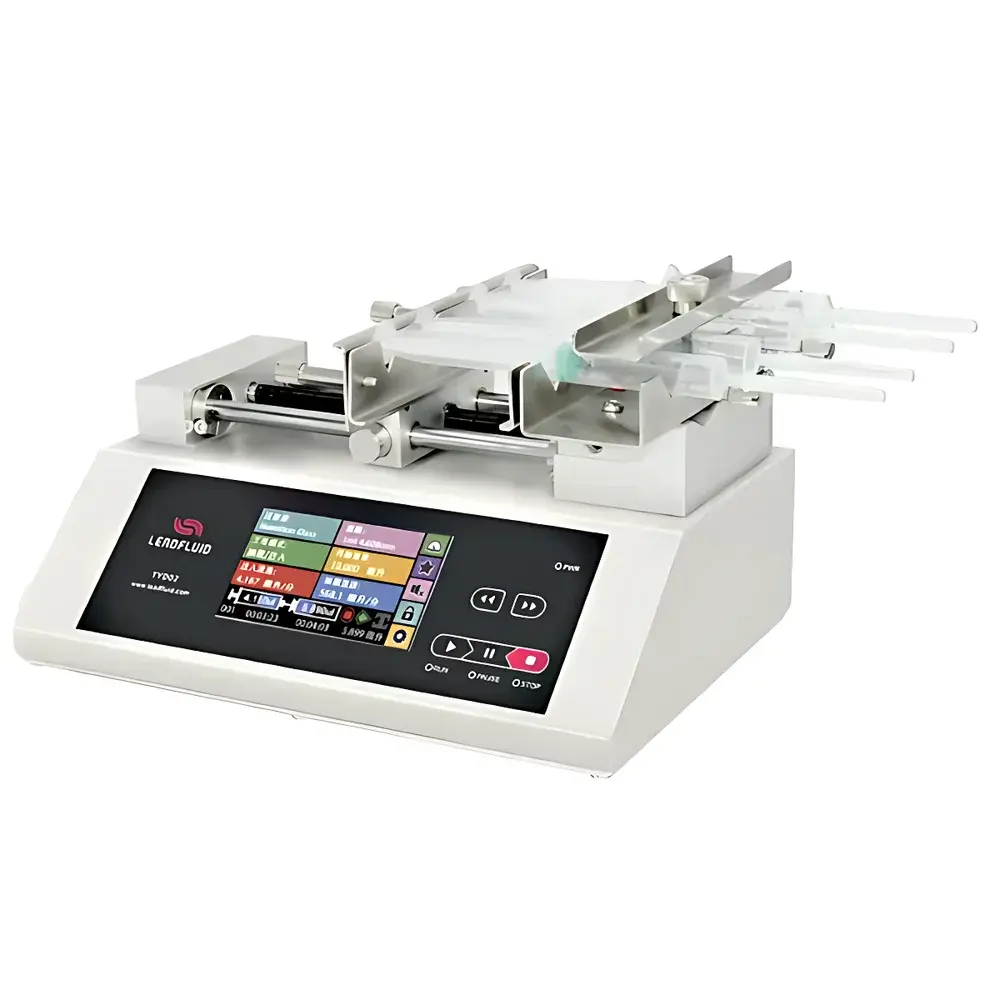
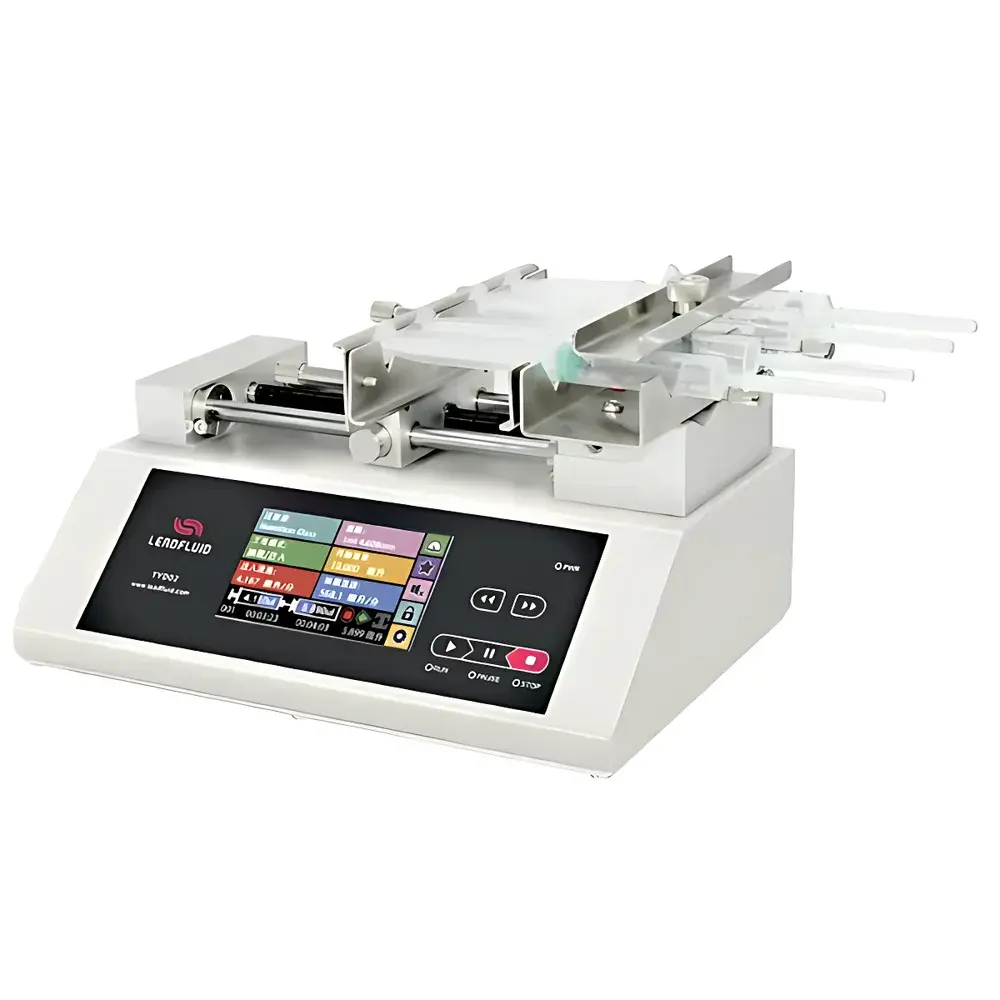
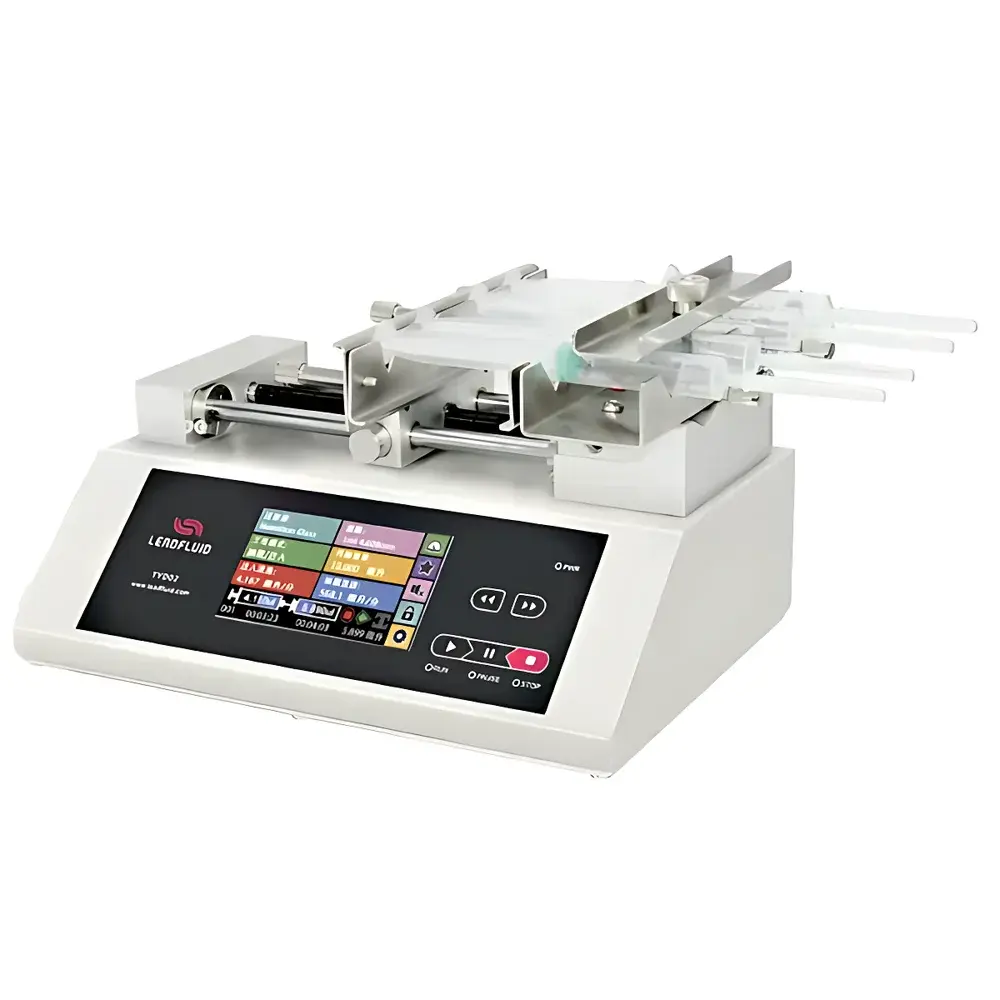
LeadFluid TYD02-10 Benchtop Multi-Channel Syringe Pump
| Brand | LeadFluid |
|---|---|
| Origin | Hebei, China |
| Model | TYD02-10 |
| Instrument Type | Microfluidic Syringe Pump |
| Flow Rate Range | 0.184 nL/min to 24.520 mL/min |
| Accuracy | < ±0.35% |
| Repeatability | < ±0.35% |
| Syringe Capacity | 10 µL to 10 mL |
| Channels | 4 independent syringe drivers |
| Communication Interface | RS485 with Modbus RTU protocol |
| Display | 4.3-inch capacitive touchscreen |
| Power Input | Wide-range AC input (100–240 VAC, 50/60 Hz) |
| Enclosure | All-metal ESD-protected and corrosion-resistant powder-coated housing |
Overview
The LeadFluid TYD02-10 is a high-precision, four-channel benchtop syringe pump engineered for reproducible microfluidic delivery in analytical laboratories, pharmaceutical R&D, microreactor studies, and automated sample introduction systems. It operates on the principle of linear displacement via precision lead-screw actuation coupled with closed-loop stepper motor control—ensuring deterministic volumetric output without reliance on fluidic feedback sensors. Each channel independently drives standard Luer-lock syringes (10 µL to 10 mL), enabling simultaneous or staggered infusion/extraction across multiple reagents, standards, or calibration solutions. Its design prioritizes metrological integrity under variable backpressure conditions typical in HPLC pre-column derivatization, electrophoresis buffer delivery, or nanoliter-scale cell culture media perfusion. The pump meets fundamental mechanical stability requirements for GLP-compliant method development and is routinely deployed in applications where volumetric fidelity below 1 µL per minute must be sustained over extended operational cycles.
Key Features
- Four independent, synchronized syringe drive channels—each supporting plastic or glass syringes from 10 µL to 10 mL capacity
- Ultra-wide flow range: 0.184 nL/min (nanoliter-per-minute resolution) up to 24.520 mL/min, calibrated using deionized water at ambient temperature and atmospheric pressure
- High-accuracy motion control: < ±0.35% volumetric accuracy and repeatability, achieved through aerospace-grade angular contact ball bearings replacing conventional bronze bushings—reducing axial play and thermal drift
- 4.3-inch capacitive touchscreen interface with intuitive icon-based navigation, screen lock function, silent keypress operation, and LED status indicators for real-time mode and fault monitoring
- Robust electromagnetic compatibility (EMC): validated continuous operation in environments with ≥30 kV/m electrostatic fields, suitable for integration near mass spectrometers or high-voltage electrophoresis apparatus
- Industrial-grade communication architecture: RS485 physical layer with native Modbus RTU protocol support—enabling seamless integration into PLC-controlled lab automation frameworks, SCADA systems, or custom Python/LabVIEW host software
- All-metal enclosure with electrostatic-dissipative (ESD-safe) and acid/alkali-resistant powder coating—compliant with ISO 14644-1 Class 7 cleanroom handling protocols
Sample Compatibility & Compliance
The TYD02-10 accommodates industry-standard syringes conforming to ISO 7886-1 (single-use medical syringes) and ASTM D3748 (plastic syringe dimensional specifications). Users may configure custom syringe geometry parameters—including inner diameter, plunger travel length, and material compliance (e.g., borosilicate glass, polypropylene, or PTFE-lined barrels)—via the onboard calibration utility. While not certified to IEC 61010-1 for in vitro diagnostic use, its construction adheres to general-purpose laboratory equipment safety guidelines. For regulated environments, audit trails can be generated externally via Modbus register logging; however, native 21 CFR Part 11 electronic signature functionality requires third-party middleware integration.
Software & Data Management
No proprietary PC software is bundled; instead, the pump exposes a documented Modbus RTU register map (holding registers 40001–40120) covering flow rate setpoints, elapsed volume, run status, error codes, and syringe ID metadata. This enables direct scripting in Python (via pymodbus), MATLAB (Instrument Control Toolbox), or Node-RED for time-series data capture, conditional triggering, or multi-pump coordination. All operational parameters are retained in non-volatile memory during power loss. Firmware updates are performed via USB-C port using signed binary files—ensuring traceability and version control per ISO/IEC 17025 Clause 5.9.
Applications
- Controlled reagent addition in kinetic enzyme assays and stopped-flow spectroscopy
- Gradient solvent delivery in preparative chromatography and affinity purification setups
- Long-duration perfusion of 3D organoid cultures with programmable pulsatile flow profiles
- Automated calibration standard injection in ICP-MS and GC-MS systems requiring sub-microliter precision
- Synchronized multi-syringe dispensing for combinatorial library synthesis and microarray spotting
- Low-flow mobile phase delivery in capillary electrophoresis and nano-LC configurations
FAQ
What syringe sizes are officially supported?
Standard support covers 10 µL, 25 µL, 50 µL, 100 µL, 250 µL, 500 µL, 1 mL, 5 mL, and 10 mL syringes—both plastic and glass—with inner diameters ranging from 0.485 mm to 14.427 mm.
Is the flow rate accuracy valid across all syringe sizes and media?
The stated 10 cP or compressible gases require empirical recalibration; accuracy degrades predictably above 3 bar system pressure.
Can the pump operate unattended for 72+ hours?
Yes—thermal management and bearing longevity have been validated for continuous operation exceeding 120 hours at ≤50% of maximum rated torque, provided ambient temperature remains between 15–30 °C and relative humidity stays below 70% RH.
Does it support analog input for external flow modulation?
No analog input is provided; however, digital TTL-level start/stop and direction control signals are available via opto-isolated GPIO pins (pinout defined in Hardware Integration Manual v2.3).
How is firmware updated and verified?
Firmware binaries are cryptographically signed by LeadFluid. Updates are applied via USB-C connection using the included DFU utility; post-update CRC32 verification ensures bit-for-bit integrity before reboot.



