
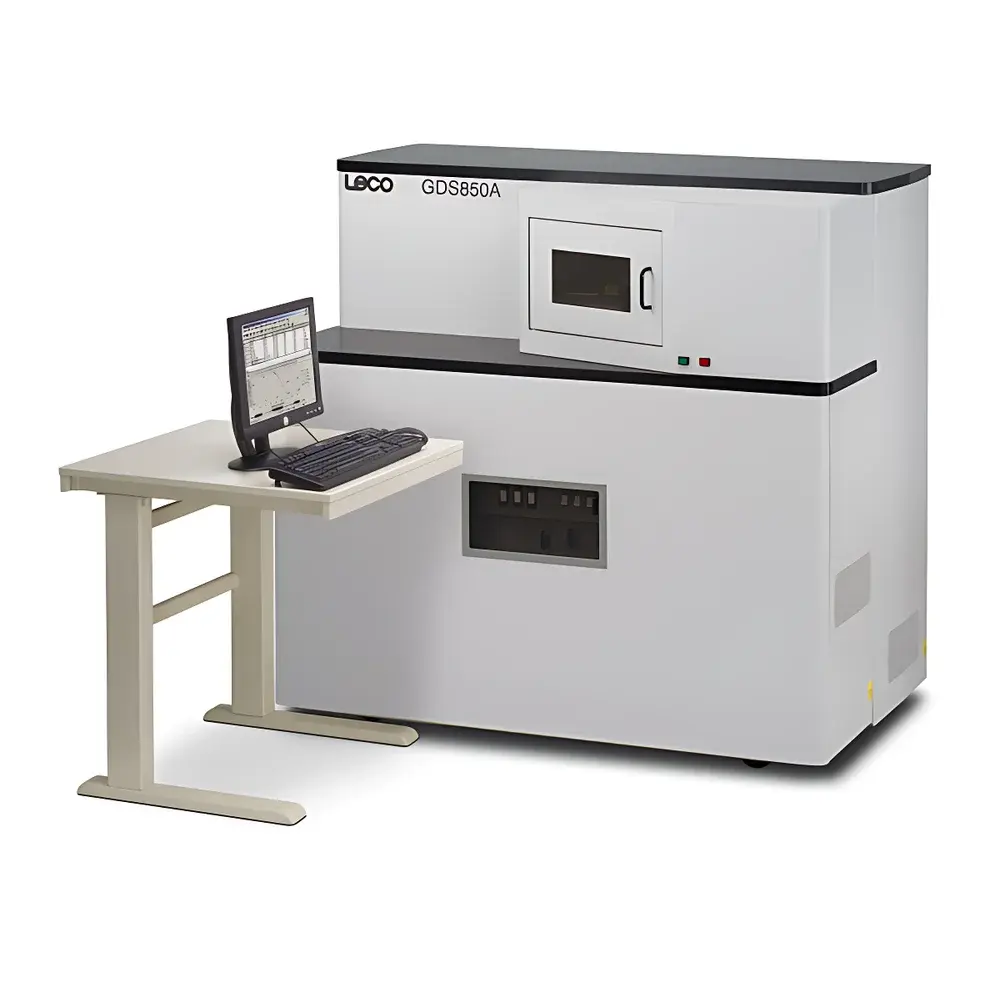
LECO GDS-850 Glow Discharge Spectrometer
| Brand | LECO |
|---|---|
| Origin | USA |
| Manufacturer Type | Original Equipment Manufacturer (OEM) |
| Import Status | Imported |
| Model | GDS-850 |
| Pricing | Upon Request |
Overview
The LECO GDS-850 Glow Discharge Spectrometer is a high-performance, direct solid analysis instrument engineered for quantitative elemental depth profiling and bulk matrix analysis of conductive and semi-conductive materials. It operates on the principle of glow discharge optical emission spectroscopy (GD-OES), where a low-pressure argon plasma is sustained between a cathode (sample) and anode under controlled DC or pulsed RF excitation. This cold, non-thermal plasma uniformly sputters atoms from the sample surface at rates ranging from sub-nanometer to several nanometers per second—enabling true layer-by-layer ablation without thermal degradation. Emitted photons from excited neutral and ionic species are dispersed via a Paschen-Runge mount spectrometer with fixed multi-channel photomultiplier tube (PMT) detection, covering a spectral range from 120 nm to 800 nm. With up to 58 simultaneously monitored analytical channels, the GDS-850 delivers high-resolution, high-reproducibility compositional data across depth gradients—critical for quality assurance in coated metals, thin-film devices, PVD/CVD layers, and advanced metallurgical research.
Key Features
- DC and optional RF glow discharge source for universal applicability—including non-conductive coatings on conductive substrates (e.g., oxides on steel, nitrides on aluminum)
- Paschen-Runge optical system with thermally stabilized mounting and sealed vacuum optics for long-term wavelength stability and minimal drift
- Up to 58 fixed-wavelength PMT channels enabling simultaneous multi-element detection with sub-ppm detection limits for most metallic and selected non-metallic elements (e.g., C, N, O, S, P)
- High-precision sample stage with motorized Z-axis control and programmable sputtering rate modulation for reproducible depth resolution down to ~0.5 nm per data point
- Low argon consumption design (< 0.8 L/min during analysis), optimized gas flow management for stable plasma ignition and extended operational uptime
- Automatic inter-analysis chamber purge and electrode cleaning cycle ensuring consistent sputter yield and eliminating cross-contamination or memory effects
- Modular hardware architecture supporting field-upgradable detectors, auxiliary gas inlets (e.g., He for enhanced N/O sensitivity), and external vacuum interlocks
Sample Compatibility & Compliance
The GDS-850 accepts flat, disk-shaped, or cylindrical solid samples up to 50 mm in diameter and 25 mm in height, including metals (Fe, Al, Cu, Ti, Ni alloys), coated steels (galvanized, aluminized, chromated), semiconductor wafers, hard disk platters, and ceramic substrates with conductive underlayers. Sample preparation is minimal—typically requiring only mechanical polishing to remove surface oxides or contaminants; no dissolution or dilution is needed. The system complies with ASTM E415 (Standard Test Method for Determining Chemical Composition of Steel by GD-OES), ASTM E1009 (Standard Practice for Conducting Interlaboratory Studies), ISO 14707 (Metallic and other inorganic coatings – Glow discharge optical emission spectrometry), and supports GLP/GMP-aligned audit trails when used with SMARTLINE remote diagnostics and 21 CFR Part 11-compliant software configurations.
Software & Data Management
Controlled via LECO’s proprietary GDS Analysis Suite, the instrument provides intuitive method setup, real-time sputter rate calibration, dynamic background correction, and automated quantification using matrix-matched reference standards. Depth profile data are exported in ASCII, CSV, or XML formats compatible with third-party visualization tools (e.g., MATLAB, OriginLab). Statistical analysis modules support repeatability assessment (RSD < 2% for major elements over 10 replicate runs), limit-of-detection calculation per element, and uncertainty propagation modeling. All raw spectra, acquisition logs, and user actions are timestamped and stored with immutable audit trails—meeting requirements for regulated environments requiring traceability and electronic signature validation.
Applications
- Depth-resolved quantification of Zn, Al, Cr, and Fe in galvanized and aluminized steel sheets (ASTM A653, EN 10346)
- Interface analysis of PVD-deposited TiN, CrN, or DLC coatings on automotive components
- Characterization of native oxide thickness and stoichiometry on polished stainless steel or aluminum substrates
- Quantitative mapping of dopant distribution (e.g., B, P, As) in silicon wafers and compound semiconductors
- Validation of diffusion barriers in multilayer thin-film stacks used in display and photovoltaic manufacturing
- Corrosion product layer composition and growth kinetics studies on aerospace-grade nickel superalloys
- Reference material certification (e.g., NIST SRM 2135c) and inter-laboratory round-robin participation
FAQ
What sample types are compatible with the GDS-850?
Conductive metals, alloys, and coated conductive substrates (e.g., oxide layers on steel) are directly analyzable. Non-conductive bulk samples require conductive coating or RF source configuration.
How is depth resolution achieved and verified?
Depth resolution depends on sputter rate uniformity, crater geometry, and instrumental line broadening. It is routinely verified using certified layered reference materials (e.g., Si/SiO₂, Fe/Cr multilayers) and cross-checked against SIMS or XPS results.
Does the GDS-850 support quantitative analysis without matrix-matched standards?
Yes—relative sensitivity factors (RSFs) enable semi-quantitative screening, but certified matrix-matched standards are required for ISO/IEC 17025-compliant reporting.
Can the system analyze light elements such as oxygen, nitrogen, and carbon?
Yes—using vacuum UV optics and optimized argon plasma conditions, with detection limits of 10–50 ppm depending on matrix and sputter rate.
Is remote maintenance and diagnostics supported?
Yes—the optional SMARTLINE module enables secure, encrypted remote access for firmware updates, spectral diagnostics, and real-time performance monitoring under ITAR-compliant protocols.




