
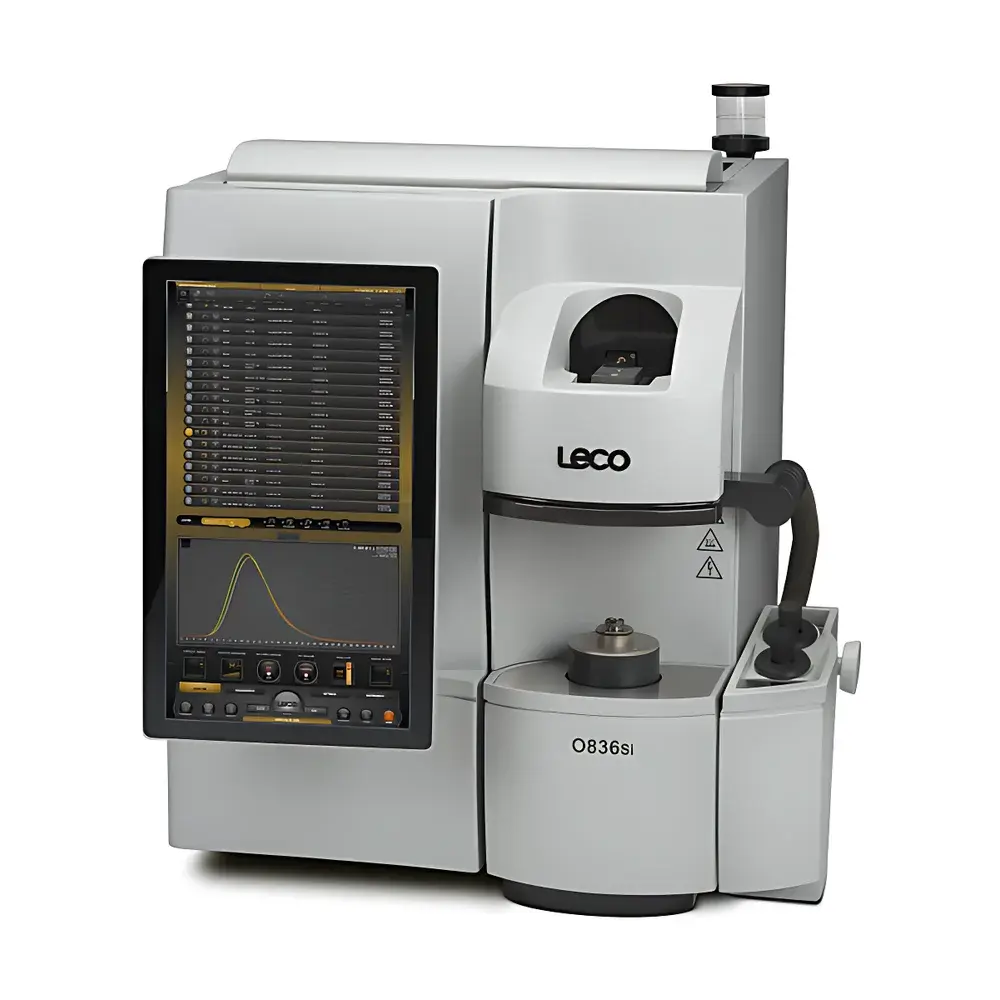
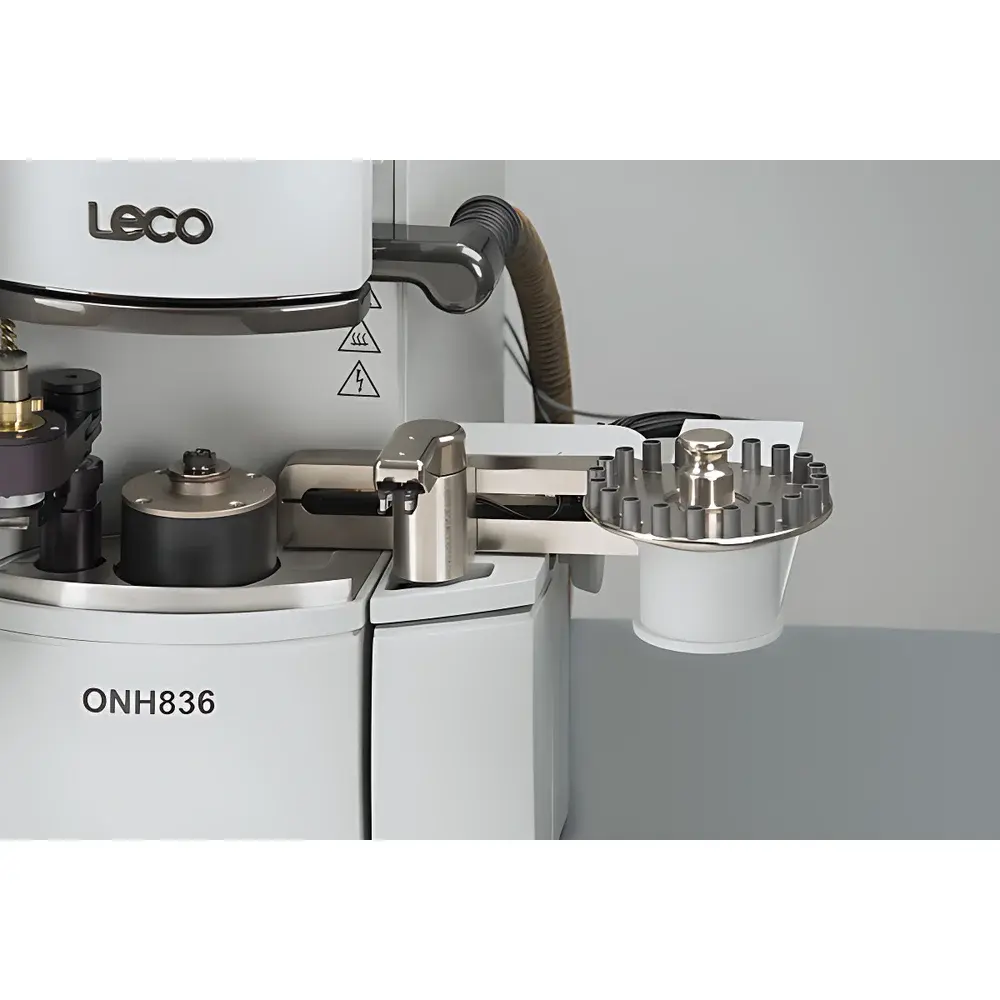
LECO ONH836 Oxygen-Nitrogen-Hydrogen Analyzer
| Brand | LECO |
|---|---|
| Origin | USA |
| Manufacturer Type | Original Equipment Manufacturer (OEM) |
| Product Category | Imported Instrument |
| Model | ONH836 |
| Analysis Range | 0.00005–50 mg |
| Instrument Type | Oxygen-Nitrogen-Hydrogen Analyzer |
| Method | Inert Gas Fusion (Graphite Crucible, Pulse Heating) |
Overview
The LECO ONH836 Oxygen-Nitrogen-Hydrogen Analyzer is a high-precision inert gas fusion elemental analyzer engineered for the simultaneous quantitative determination of oxygen (O), nitrogen (N), and hydrogen (H) in solid inorganic materials. Based on the principle of high-temperature pulse furnace fusion under ultra-pure helium or argon atmosphere, the instrument thermally decomposes sample matrices—such as ferrous and non-ferrous metals, superalloys, refractory metals, carbides, ceramics, and sintered powders—releasing interstitial and lattice-bound gases as CO, N₂, and H₂. These gaseous species are then separated via selective gas chromatography and quantified using dual infrared (IR) absorption cells for carbon monoxide/carbon dioxide (for oxygen) and thermal conductivity detection (TCD) for nitrogen and hydrogen. The system achieves trace-level sensitivity down to 0.05 µg (50 ng) with high reproducibility across multi-mg sample masses (0.00005–50 mg), meeting the metrological requirements of ISO 14284, ASTM E1019, and JIS G 1211.
Key Features
- Inert gas fusion with programmable graphite crucible pulse heating up to 3,000 °C, ensuring complete liberation of interstitial O, N, and H from refractory matrices
- Dual IR detection architecture: three independent IR cells (two for CO/CO₂ ratio-based oxygen calculation, one for CO₂-only calibration verification) coupled with high-stability TCD for N₂ and H₂
- Dynamic Flow Compensation (DFC) system maintaining constant carrier gas flow and pressure at the detector inlet, eliminating baseline drift during long-duration analyses
- Thermally isolated, temperature-controlled IR cell housing with long-life IR source and zero-drift analog electronics for extended calibration stability (>6 months typical)
- Modular furnace head assembly with LED illumination, tool-free dust filter replacement, and quick-release oxygen/water trap with auto-bypass valve
- Enhanced cooling subsystem: dual DC-powered fans + high-efficiency internal recirculating water chiller, insensitive to line voltage fluctuations
- Redesigned electrode-based pulse furnace head optimized for thermal transfer efficiency and reduced crucible consumption
Sample Compatibility & Compliance
The ONH836 accommodates a broad spectrum of conductive and semi-conductive solids—including low-alloy steels, stainless steels, titanium alloys, nickel-based superalloys, silicon nitride, tungsten carbide, and rare-earth magnets—without requiring matrix-specific calibrations. Sample introduction is performed manually or via optional 20- or 100-position autosamplers with integrated vacuum dust extraction that evacuates particulates directly to an external collector, preventing cross-contamination and preserving laboratory air quality. All hardware and software modules comply with GLP/GMP documentation requirements; Cornerstone software supports full 21 CFR Part 11 compliance including electronic signatures, audit trails, user access levels, and immutable raw data archiving. Routine operation adheres to ISO/IEC 17025 method validation guidelines and satisfies reporting needs for ASTM E1447 (hydrogen), E1133 (oxygen), and E1409 (nitrogen).
Software & Data Management
Cornerstone™ Software serves as the unified control, diagnostics, and reporting platform for the ONH836. Its touchscreen-optimized interface organizes functionality into four core modules: Analyze, Diagnose, Setup, and Instrument. Real-time environmental monitoring (flow, pressure, temperature, detector signals) is visualized alongside dynamic system schematics. Batch grouping and replicate handling automate standard deviation, RSD%, and confidence interval calculations per ASTM E691. Calibration curves support multi-point linear and quadratic regression with residual error mapping. Diagnostic tools include embedded digital service manuals, interactive maintenance simulations with annotated imagery, and automated leak-check protocols. Data export supports CSV, XML, PDF, and LIMS-compatible formats (ASTM E1382, ANSI/NIST ITL 100-3); report templates are fully customizable per QA/QC or regulatory submission requirements.
Applications
The ONH836 is routinely deployed in metallurgical R&D labs, foundry QC departments, aerospace material certification facilities, and powder metallurgy production lines. Typical use cases include: verifying oxygen content in Ti-6Al-4V aerospace billets per AMS 2249; quantifying hydrogen embrittlement risk in high-strength steels per ASTM F1038; certifying nitrogen levels in duplex stainless steels per ASTM A959; monitoring hydrogen pickup during hot isostatic pressing (HIP) of ceramic matrix composites; and validating oxygen impurity limits in sputtering targets used in semiconductor manufacturing. Its ability to resolve sub-ppm H in zirconium alloys and detect 0.1 ppm O in single-crystal nickel superalloys makes it indispensable for nuclear-grade material qualification per ASME BPVC Section II.
FAQ
What detection technologies does the ONH836 employ for each element?
Oxygen is measured via dual-wavelength infrared absorption of CO and CO₂ generated during combustion; nitrogen and hydrogen are quantified by thermal conductivity detection following gas chromatographic separation.
Is the instrument compliant with FDA 21 CFR Part 11?
Yes—Cornerstone software provides role-based user authentication, electronic signatures, comprehensive audit trails, and secure raw data storage required for regulated environments.
Can the ONH836 analyze non-metallic samples such as ceramics or graphite?
Yes—its inert fusion method and graphite crucible compatibility enable accurate analysis of oxides, nitrides, carbides, and borides without catalytic interference.
What maintenance intervals are recommended for the IR cells and TCD?
IR cells require no routine optical servicing due to sealed, thermally stabilized design; TCD filaments are rated for >2 years under normal operating conditions. Full preventive maintenance is recommended every 12 months per LECO Service Bulletin SB-ONH-003.
Does the system support remote diagnostics?
Yes—optional Remote Diagnostic Module enables encrypted, firewall-compliant connection for real-time technical support, firmware updates, and performance benchmarking.




