
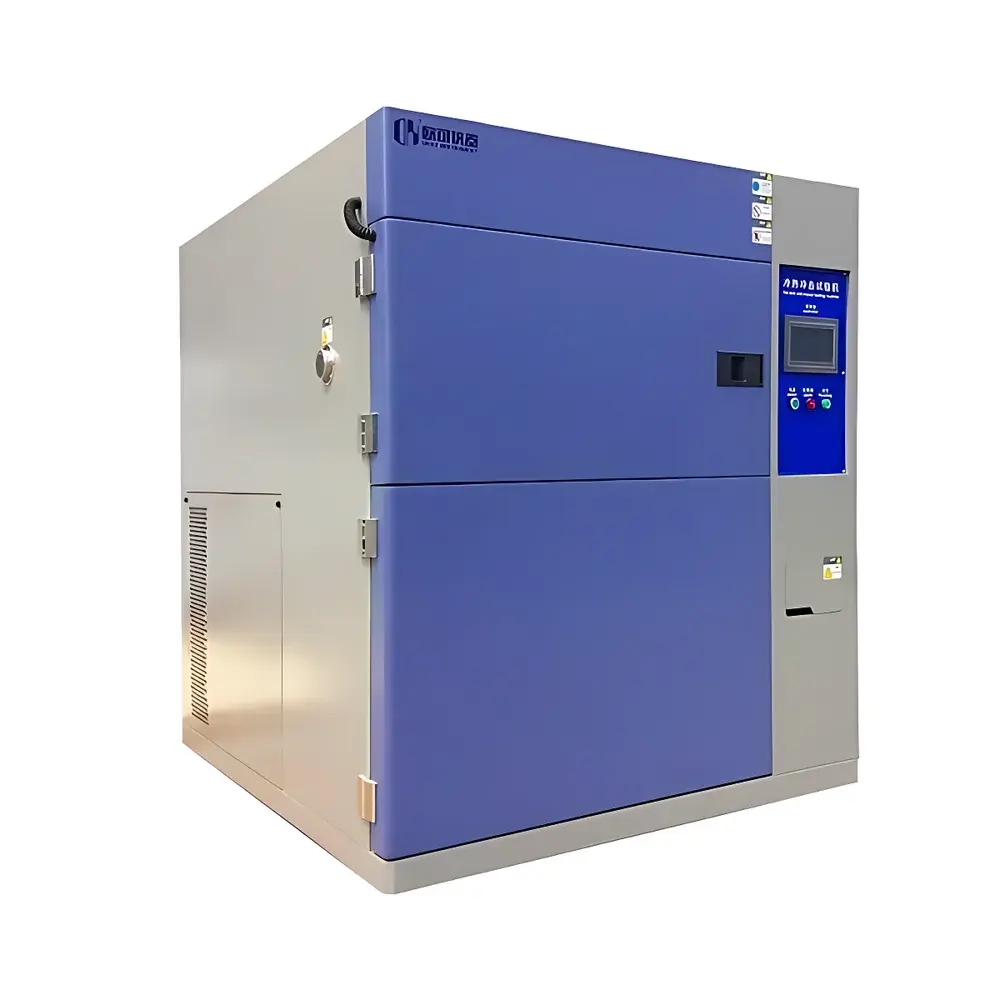
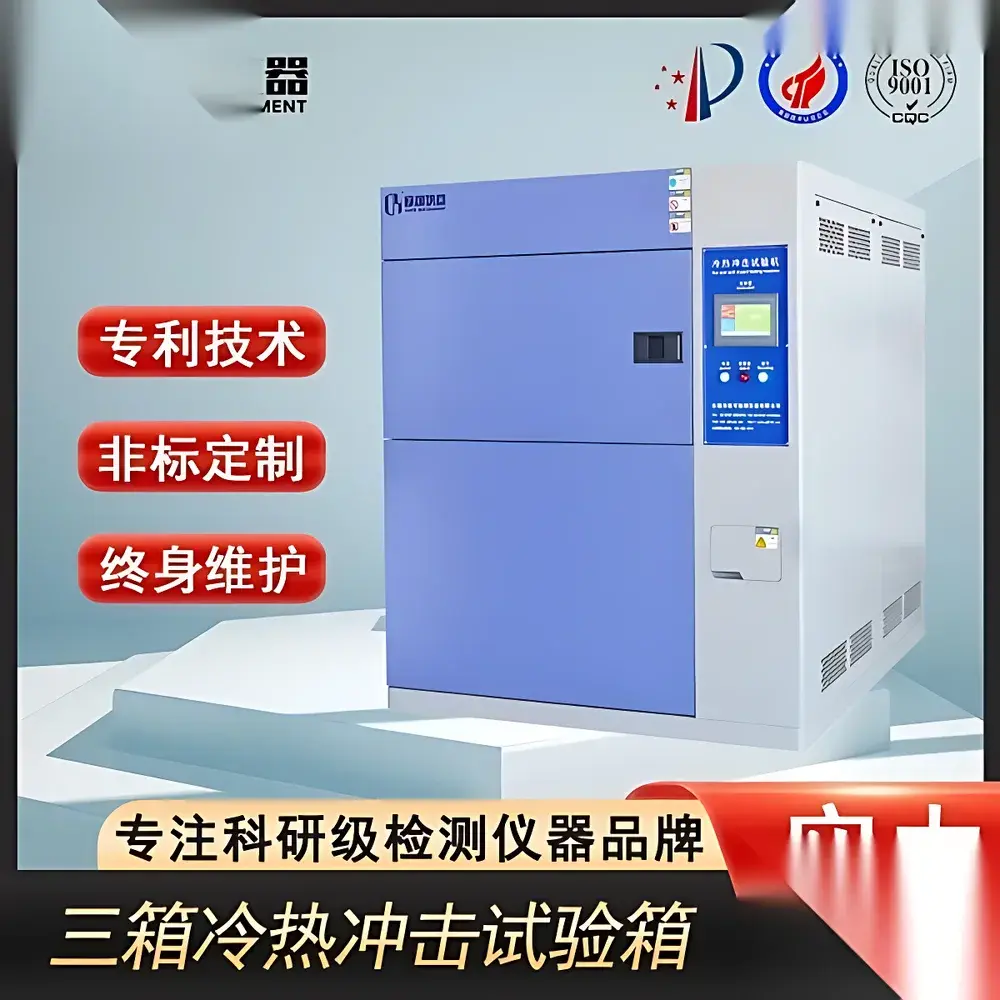
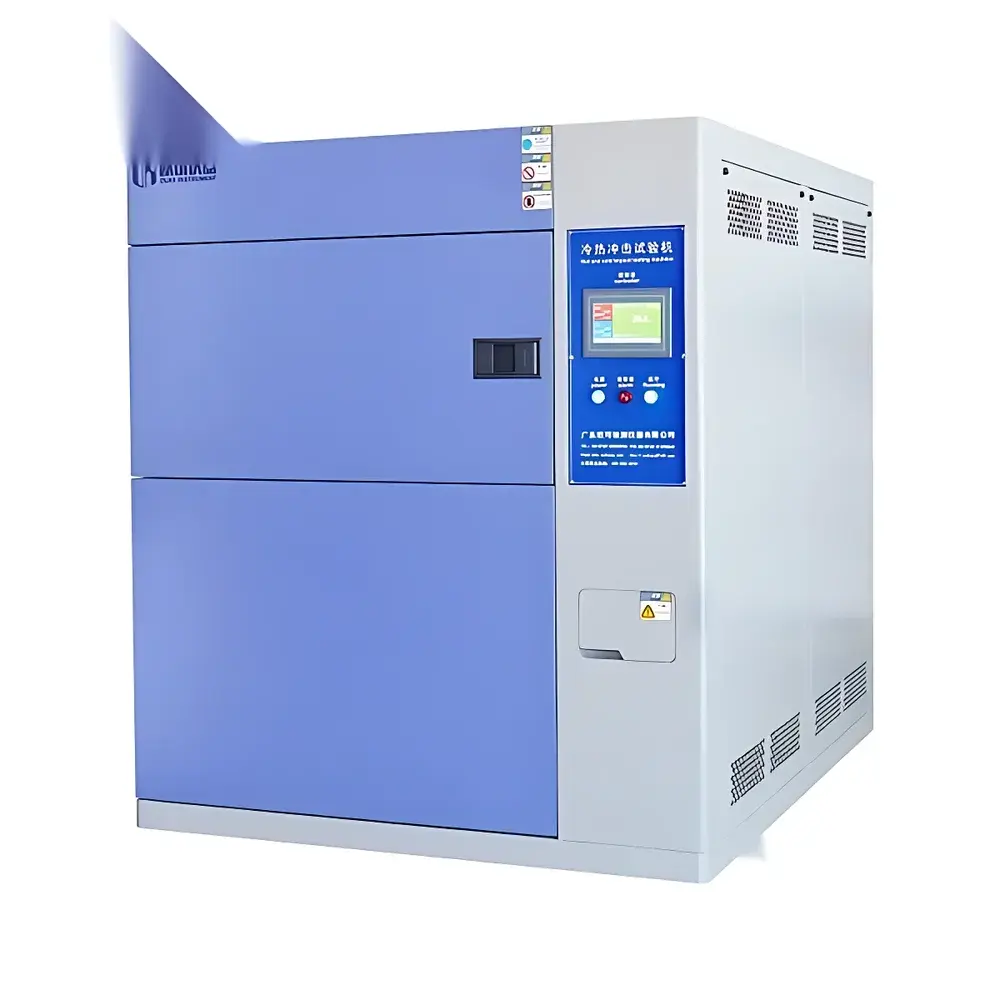
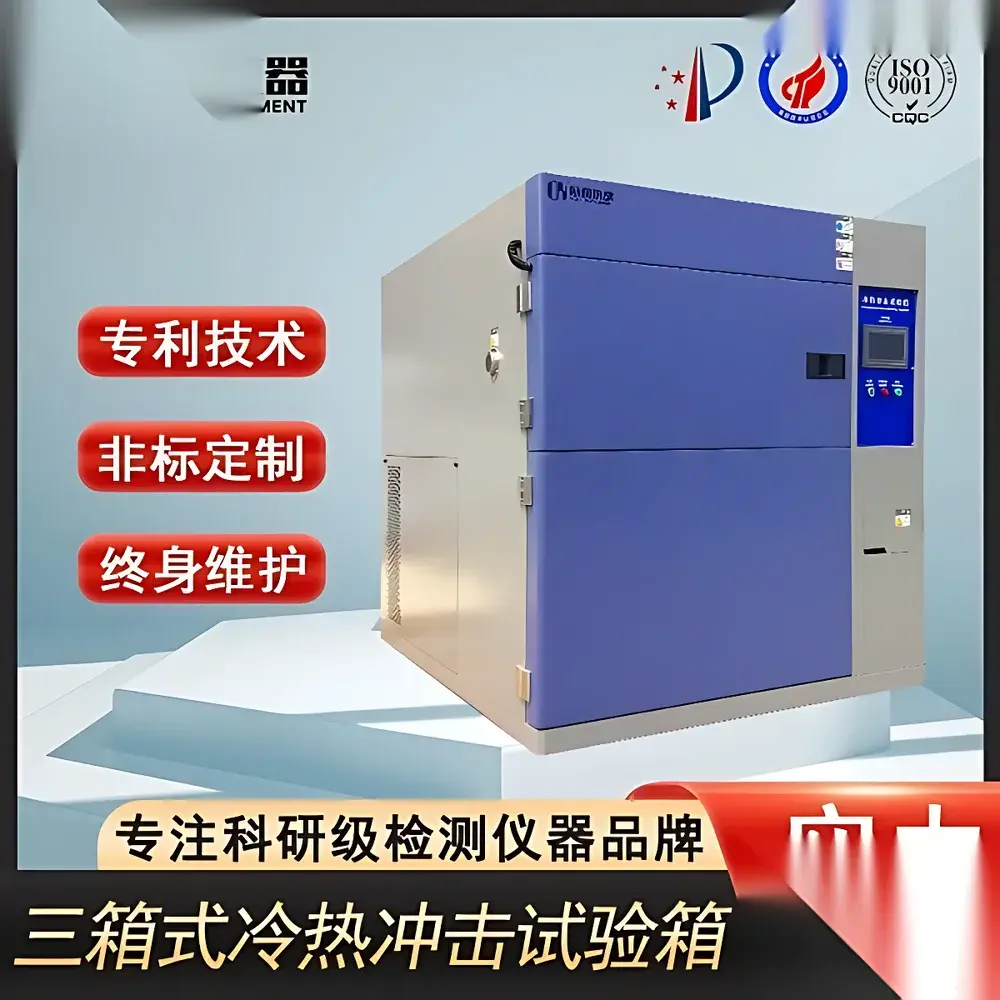
LED Low-Temperature Thermal Shock Test Chamber
| Brand | OEM |
|---|---|
| Origin | Imported |
| Manufacturer Type | Authorized Distributor |
| Price | USD 12,500 (FOB) |
| Chamber Configuration | Two-Zone or Three-Zone Thermal Shock System |
| Internal Volume Options | 49 L / 80 L / 150 L / 225 L |
| Temperature Range | High Zone: RT to +200 °C |
| Low Zone | RT to −70 °C |
| Test Zone | Thermal Shock from +60 °C to +150 °C (Hot Soak) and 0 °C to −65 °C (Cold Soak) |
| Switching Mechanism | Pneumatic Air-Door Isolation (Static Specimen) |
| Recovery Time | ≤5 min |
| Temperature Uniformity | ±2.0 °C |
| Control Accuracy | ±0.5 °C |
| Refrigeration | Dual-Stage Cascade System with Semi-Hermetic German Compressors |
| Refrigerants | R404A (HT Stage) / R23 (LT Stage) |
| Insulation | High-Density Fire-Retardant PU Foam (≥150 mm Thickness) |
| Interior Material | Mirror-Finish SUS304 Stainless Steel |
| Exterior | SUS304 Stainless Steel or Powder-Coated Steel |
| Cooling Water Requirement | External 10 m³/h Closed-Loop Cooling Tower (User-Supplied) |
| Power Supply | AC 380 V ±5 %, 50 Hz ±0.5 Hz, 3-Phase 5-Wire |
Overview
The LED Low-Temperature Thermal Shock Test Chamber is an engineered environmental simulation system designed for accelerated reliability assessment of electronic components, automotive modules, aerospace assemblies, and precision optical devices under rapid, extreme temperature transitions. It operates on the principle of static specimen thermal shock, where test samples remain stationary in a dedicated test compartment while high- and low-temperature zones are isolated via pneumatically actuated air doors—eliminating mechanical stress from moving baskets and ensuring repeatable thermal boundary conditions. The chamber implements a dual- or triple-zone architecture: two-zone configurations utilize independent hot and cold reservoirs; three-zone systems add a dedicated test chamber for enhanced thermal stability and reduced cross-contamination between conditioning phases. Its core function is to subject specimens to repeated, controlled transitions between extreme thermal extremes—typically defined as ≥10 K/s average ramp rate across the operational range—enabling detection of latent defects including solder joint fatigue, delamination in multilayer PCBs, sealant cracking, and coefficient-of-thermal-expansion (CTE) mismatch failures.
Key Features
- Dual-Stage Cascade Refrigeration: Integrates semi-hermetic German compressors with R404A (high-temp stage) and R23 (low-temp stage), enabling stable operation down to −70 °C in the cold reservoir without cryogenic consumables.
- Pneumatic Air-Door Switching: Eliminates moving parts in the test zone—specimens remain fixed while thermally isolated chambers are engaged via fast-acting, leak-tight pneumatic dampers (switching time <1.5 s).
- Precision Temperature Control: Equipped with PID-controlled SSR-driven heating circuits and modulating expansion valves, achieving ±0.5 °C setpoint accuracy and ±2.0 °C uniformity across the full working volume.
- Fire-Retardant Insulation: 150 mm-thick imported polyurethane foam with UL94-V0 rating ensures structural integrity, thermal efficiency, and compliance with laboratory safety codes.
- Configurable Volumes & Customization: Four standard internal volumes (49–225 L); all models support user-defined lead-through ports (Φ50 mm), stainless steel shelving (2-tier), and optional data logging interfaces (RS485/Modbus TCP).
- Energy Regulation Architecture: Load-matching refrigerant flow control minimizes compressor cycling, reduces power consumption by up to 22% during partial-load operation, and extends system service life.
Sample Compatibility & Compliance
This thermal shock chamber accommodates rigid and semi-rigid specimens up to 60 cm × 50 cm × 50 cm (OK-HH-150 model), including printed circuit board assemblies (PCBAs), MEMS sensors, battery packs, LED lighting modules, and hermetically sealed optoelectronic housings. It fully satisfies the thermal shock and temperature change test requirements of major international standards, including:
ASTM D5229/D5229M (composite materials),
IEC 60068-2-14 (Test N: Change of Temperature),
MIL-STD-810H Method 503.6 (Temperature Shock),
GJB 150.5A-2009 (Chinese military standard for temperature shock),
GB/T 2423.22–2012 (Environmental testing – Part 2: Tests – Test N: Change of temperature),
QC/T 17–1992 (Automotive component climatic resistance),
and EIA-364-32 (Thermal shock evaluation of electrical connectors).
All models are constructed to meet CE machinery directive (2006/42/EC) and electromagnetic compatibility (2014/30/EU) requirements. Optional IQ/OQ documentation packages support GLP and ISO/IEC 17025 laboratory accreditation workflows.
Software & Data Management
The integrated controller features a 10.1″ capacitive touchscreen HMI with embedded real-time OS, supporting up to 100 programmable test profiles with nested steps (soak, transition, dwell, ramp). Data logging records temperature readings from ≥6 calibrated PT100 sensors (hot zone, cold zone, test zone center, corners) at user-selectable intervals (1–60 s). Export formats include CSV and PDF reports compliant with FDA 21 CFR Part 11 requirements—including electronic signatures, audit trails, and user-access-level permissions (admin/operator/viewer). Optional Ethernet connectivity enables remote monitoring via Modbus TCP or integration into centralized MES/QMS platforms (e.g., Siemens Opcenter, ETQ Reliance). Calibration certificates traceable to NIST or CNAS-accredited labs are provided with each shipment.
Applications
- Qualification testing of automotive ECUs prior to PPAP submission
- Reliability screening of consumer electronics after reflow soldering
- Validation of conformal coating adhesion under cyclic thermal stress
- Failure mode analysis (FMA) of ceramic capacitors and SiC power modules
- Pre-certification testing for IEC 61215 (photovoltaic modules) and AEC-Q200 (passive components)
- Material compatibility studies involving epoxy encapsulants, silicone gels, and thermal interface materials (TIMs)
FAQ
What is the difference between two-zone and three-zone thermal shock configurations?
Two-zone systems use a single chamber partitioned into hot and cold sections, with specimens transferred via a lift basket; three-zone designs isolate the test specimen continuously, using separate hot/cold storage chambers and a neutral test chamber—reducing thermal inertia and improving repeatability.
Does the chamber require external cooling water infrastructure?
Yes. The dual-stage cascade refrigeration system requires a closed-loop cooling tower delivering 10 m³/h at 32 °C inlet temperature; this is not included but must be installed by the end user.
Can the chamber perform temperature ramping tests outside thermal shock protocols?
Yes. The controller supports linear and stepwise ramp profiles between −70 °C and +200 °C at rates up to 15 °C/min (dependent on load mass and volume), complying with GB/T 2424.13–2002 temperature change guidance.
Is calibration verification included with delivery?
Each unit ships with factory calibration data for all critical sensors (traceable to national standards) and a full IQ/OQ protocol template compatible with ISO/IEC 17025 and GMP validation frameworks.
What maintenance intervals are recommended for long-term reliability?
Compressor oil analysis every 2,000 operating hours; refrigerant leak check annually; air filter replacement quarterly; door gasket inspection biannually per IEC 60068-3-5 maintenance guidelines.



