
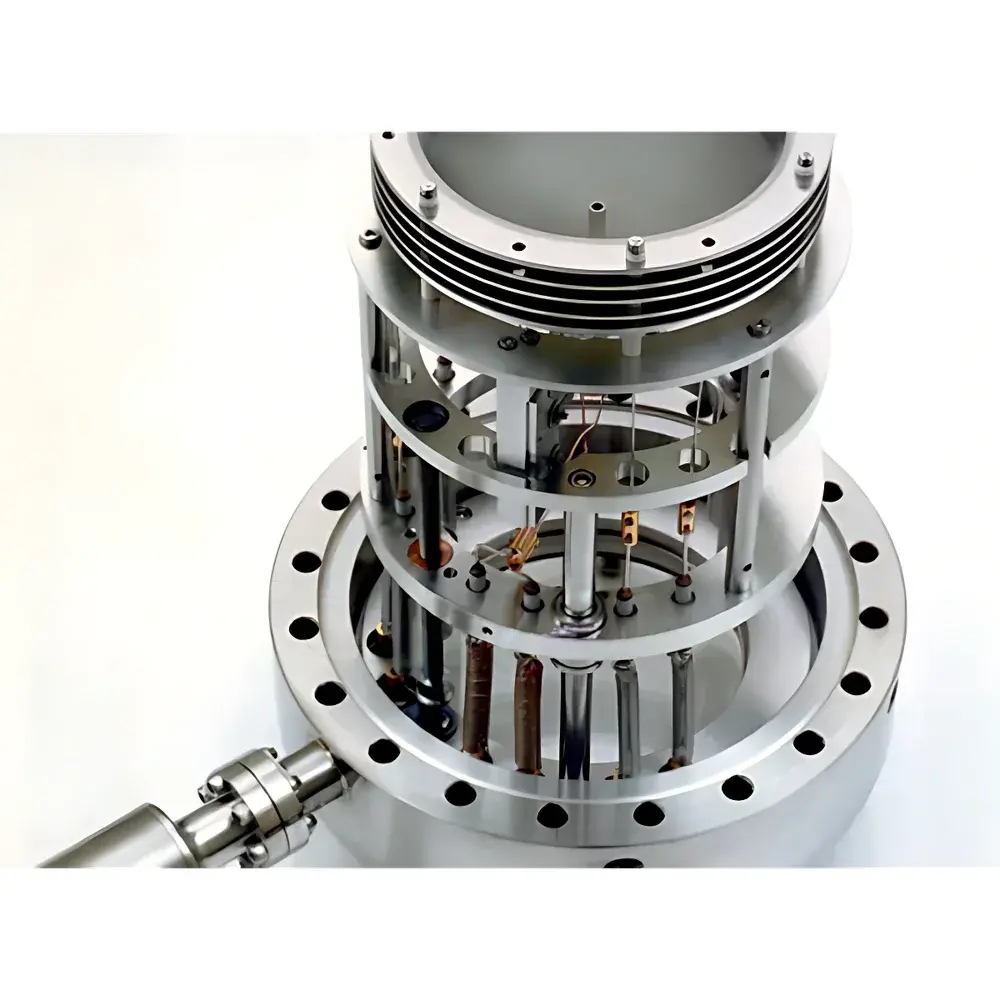
LEED Low-Energy Electron Diffraction System RVL2000 by LK (USA)
| Brand | Angstrom (USA) |
|---|---|
| Origin | USA |
| Manufacturer Type | Authorized Distributor |
| Origin Category | Imported |
| Model | RVL2000 |
| Pricing | Upon Request |
Overview
The RVL2000 LEED (Low-Energy Electron Diffraction) System, engineered and distributed by LK (USA) since 1998, is a high-precision surface science instrument designed for atomic-scale structural characterization of crystalline surfaces under ultra-high vacuum (UHV) conditions. Operating on the principle of elastic scattering of low-energy electrons (typically 20–200 eV), the system generates diffraction patterns that directly reflect the two-dimensional periodicity and symmetry of surface atomic lattices. Unlike bulk-probing techniques, LEED is inherently surface-sensitive—penetration depths are limited to ~5–10 Å—making it indispensable for studying adsorption geometries, surface reconstructions, epitaxial growth, and interfacial ordering in catalysis, thin-film deposition, and semiconductor research. The RVL2000 integrates a compact, all-metal UHV-compatible electron optics train with rigorous electromagnetic shielding and thermal stability, enabling reproducible pattern acquisition and quantitative intensity analysis.
Key Features
- UHV-integrated optical architecture: Fully metallic construction with no polymer-coated wiring or glass-fiber insulation—compliant with base pressures ≤1×10⁻¹⁰ mbar.
- Precision reverse-geometry LEED optics: Four-grid tungsten electrostatic lens assembly ensures optimal beam collimation, angular resolution, and compatibility with simultaneous AES (Auger Electron Spectroscopy) acquisition.
- Miniaturized 1.59 cm diameter electron gun: Engineered for stable emission at low landing energies; features 103° field-of-view and <0.5% energy resolution (ΔE/E) across the operational range.
- Scalable optical column: Standard 2-inch retraction; optional extension to 4-inch retraction for integration into multi-technique UHV chambers.
- Integrated high-sensitivity detection: Available with microchannel plate (MCP) detectors supporting pA- and nA-level current measurement, coupled to low-noise preamplifiers and lock-in amplification for signal-to-noise optimization.
- Modular UHV interface: Flange-mounted assembly includes integrated viewport, feedthroughs for HV biasing, filament control, and detector bias—compatible with CF-63, CF-100, and ISO-KF standards.
Sample Compatibility & Compliance
The RVL2000 accommodates standard UHV sample holders (e.g., Ta or W heating stages, LN₂ cryo-stages, and biasable substrates) and supports in situ annealing, gas dosing, and electron-beam-induced desorption protocols. Its all-metal design and absence of outgassing-prone materials ensure long-term vacuum integrity and minimize surface contamination during extended experiments. The system meets essential requirements for surface science infrastructure compliant with ASTM E1905 (Standard Practice for LEED Pattern Interpretation), ISO/IEC 17025 traceability frameworks for analytical instrumentation, and GLP-aligned lab documentation workflows. Electrical safety conforms to UL 61010-1 and IEC 61010-1; electromagnetic compatibility follows EN 61326-1.
Software & Data Management
Control and data acquisition are managed via platform-independent software supporting Windows and Linux environments. The suite provides real-time beam alignment visualization, automated pattern capture sequences, intensity-vs.-energy (I–V) curve acquisition, and diffraction spot indexing with symmetry-assisted auto-recognition. Raw LEED patterns are stored in HDF5 format with embedded metadata (beam energy, sample temperature, acquisition time, HV settings). Audit-trail logging—including user actions, parameter changes, and calibration events—is enabled to support 21 CFR Part 11-compliant environments where electronic records require attribution, integrity, and retention. Export modules support ASCII, TIFF, and CIF-compatible structure factor output for integration with surface modeling tools (e.g., JEMS, Diffrac).
Applications
- Determination of surface unit cell dimensions and rotational domains in epitaxial oxide films (e.g., SrTiO3, LaAlO3).
- Quantitative analysis of adsorbate-induced reconstructions on transition metal catalysts (e.g., Pt(111), Ni(100)).
- Verification of monolayer completeness and registry in 2D material growth (graphene, h-BN, TMDs).
- Time-resolved studies of surface phase transitions during thermal cycling or reactive gas exposure.
- Correlative surface characterization when combined with co-located AES, XPS, or STM modules in multi-technique UHV systems.
FAQ
What vacuum level is required for stable RVL2000 operation?
The system requires sustained UHV conditions ≤1×10⁻¹⁰ mbar to prevent electron scattering from residual gas molecules and ensure diffraction pattern fidelity.
Can the RVL2000 be retrofitted into an existing UHV chamber?
Yes—the modular flange-mount design supports CF-63 and CF-100 ports; electrical and HV feedthrough configurations are customizable per chamber layout.
Is energy calibration traceable to NIST standards?
Beam energy calibration is performed using known work-function references (e.g., clean W(110)) and verified against tabulated I–V maxima; full calibration reports are provided with each system shipment.
Does the system support automated I–V data collection?
Yes—software-controlled energy ramping (0.1–5 eV steps), dwell time adjustment, and background subtraction are fully programmable for unattended acquisition over 12+ hours.
What maintenance is required for long-term reliability?
Annual filament replacement and MCP gain verification are recommended; no routine optical realignment is needed due to rigid, kinematically mounted lens assemblies.
Related Products




