
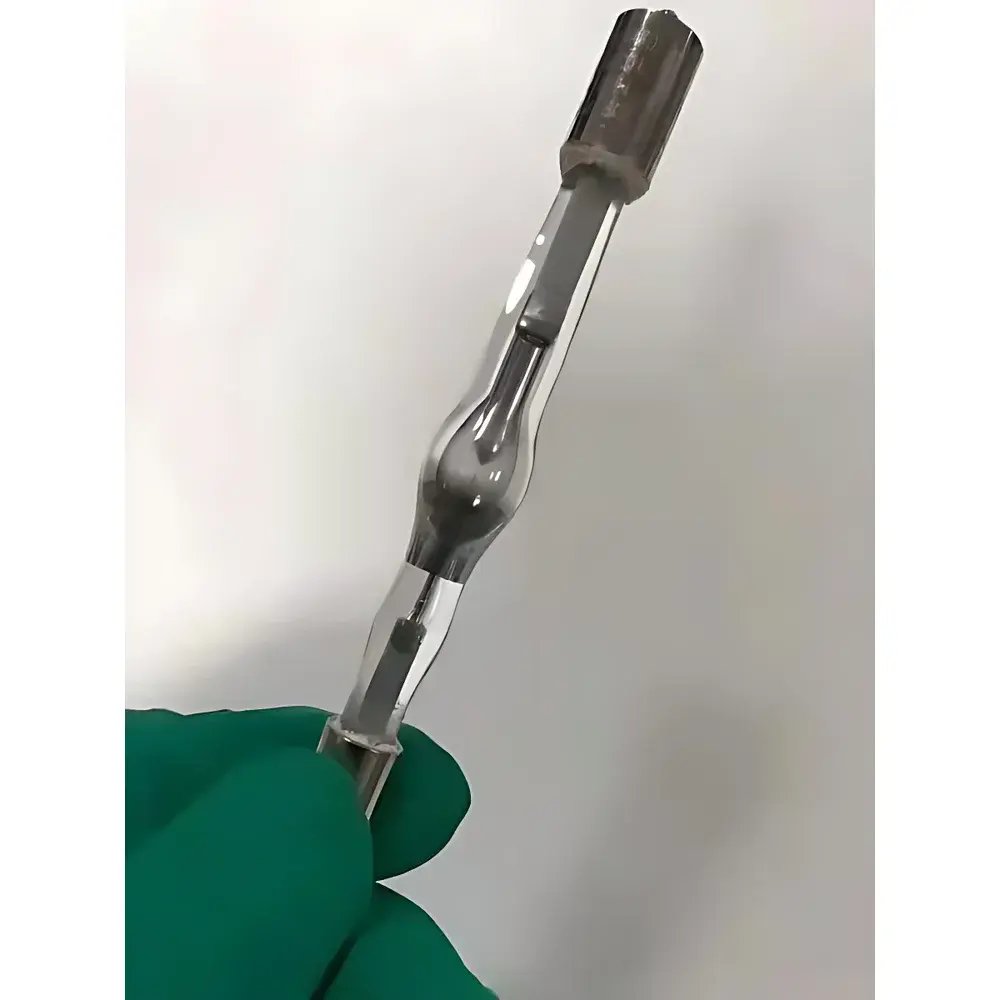
Leica i/2000479213/hxc Mercury Vapor Lamp
| Brand | Leica |
|---|---|
| Origin | Germany |
| Supplier Type | Authorized Distributor |
| Import Status | Imported |
| Model | i/2000479213/hxc |
| Light Source Type | Mercury Vapor Lamp |
| Illumination Mode | Internal Illumination |
| Spectral Characteristic | Discrete Line Emission (Strong UV, Violet, Blue, and Green Lines |
Overview
The Leica i/2000479213/hxc Mercury Vapor Lamp is a precision-calibrated, internally illuminated arc-discharge light source engineered for demanding optical laboratory applications requiring high-intensity, spectrally stable line emission. Operating on the principle of electrical excitation of mercury vapor within a fused quartz envelope, the lamp generates characteristic atomic emission lines—most prominently at 253.7 nm (UV-C), 365.0 nm (UV-A), 404.7 nm (violet), 435.8 nm (blue), 546.1 nm (green), and 577–579 nm (yellow doublet)—with minimal continuum background. Its spectral output is intrinsically non-continuous and exhibits negligible radiant power above 620 nm, making it unsuitable for colorimetric or full-spectrum illumination tasks but highly valuable in fluorescence microscopy excitation, photolithography alignment, spectral calibration, and UV-curable resin curing where discrete wavelength selectivity is critical. Designed for integration into Leica’s modular optical platforms—including upright and inverted research microscopes—the lamp features thermally stabilized housing, regulated DC current supply compatibility, and precise mechanical alignment for repeatable beam positioning.
Key Features
- German-engineered quartz arc tube with optimized mercury amalgam composition for stable output over ≥2,000 hours of operation
- Internal illumination architecture enabling direct coupling to microscope condenser systems without external light guides or fiber bundles
- Integrated thermal management system minimizing spectral drift (< ±0.2 nm peak shift over 30-min warm-up)
- Compliant with IEC 62471:2006 (Photobiological Safety) for UV hazard classification (Risk Group 3 for unshielded exposure)
- Electrical interface compatible with Leica’s standardized lamp control units (e.g., LUMA II series), supporting soft-start ignition and current ramping to extend electrode life
- CE-marked and RoHS-compliant construction; no mercury leakage risk under normal operating conditions per EN 61347-2-13
Sample Compatibility & Compliance
The i/2000479213/hxc lamp is validated for use with Leica DMi8, DM6 B, and DMI6000B microscope platforms and supports standard DIN 43139 optical mounts. It meets ISO 10934-1:2003 (Optics and photonics — Vocabulary for spectroscopy) definitions for “line-source lamp” and conforms to ASTM E308-22 Annex A3 for spectral irradiance reference characterization. While not intended for human-occupied ambient lighting, its UV output enables compliance with USP and EP 2.2.25 for fluorescence intensity verification in pharmaceutical QC workflows when used with calibrated photodetectors. The lamp’s spectral profile is traceable to NIST SRM 2035 (Mercury Argon Hollow Cathode Lamp) via Leica’s factory calibration certificate (included).
Software & Data Management
No embedded firmware or onboard software is present—the lamp operates as a hardware-level optical component. However, it integrates seamlessly with Leica LAS X software (v3.7+) via hardware handshake protocols, enabling automated lamp status reporting (ignition success, runtime hours, thermal fault flags) and synchronized shutter control during multi-channel fluorescence acquisition. All operational logs—including cumulative burn time and voltage/current history—are recorded in LAS X’s instrument metadata repository, supporting GLP/GMP audit trails per FDA 21 CFR Part 11 requirements when configured with electronic signature modules. Calibration data is stored in encrypted XML format compliant with ISO/IEC 17025:2017 clause 7.7.
Applications
- Excitation source for DAPI, FITC, and TRITC fluorophores in widefield epifluorescence microscopy
- Reference standard for wavelength calibration of monochromators and spectrographs (e.g., Horiba iHR320, Andor Shamrock)
- UV alignment illumination in semiconductor mask inspection and photomask metrology
- Accelerated aging studies of polymers and coatings under controlled UV-B/UV-C stress (per ISO 4892-3)
- Photochemical reaction initiation in catalytic research setups requiring narrowband UV input
- Calibration of radiometric sensors used in environmental UV monitoring networks (e.g., Brewer spectrophotometers)
FAQ
What is the typical warm-up time to achieve spectral stability?
Full spectral stabilization requires 15–20 minutes after ignition; output intensity reaches 95% of nominal value within 5 minutes. Thermal equilibration must be confirmed before quantitative measurements.
Can this lamp be operated with third-party power supplies?
Only Leica-certified DC current-regulated power supplies (e.g., Leica LSP 2000) are supported. Non-compliant drivers may cause electrode sputtering, spectral shift, or premature failure.
Is ozone generation a concern during operation?
Yes—significant ozone is produced below 240 nm. Operation requires forced-air ventilation or exhaust ducting per OSHA 29 CFR 1910.1200 guidelines. Enclosed optical paths must include ozone-scavenging filters.
Does the lamp require periodic recalibration?
No intrinsic recalibration is needed; however, annual spectral irradiance verification against a NIST-traceable reference detector is recommended for GLP-compliant labs.
What safety interlocks are built into the lamp housing?
The housing includes dual redundant thermal cutoffs (120°C and 140°C thresholds) and a mercury-vapor pressure sensor that disables ignition if ambient temperature falls below 15°C or exceeds 40°C.




