
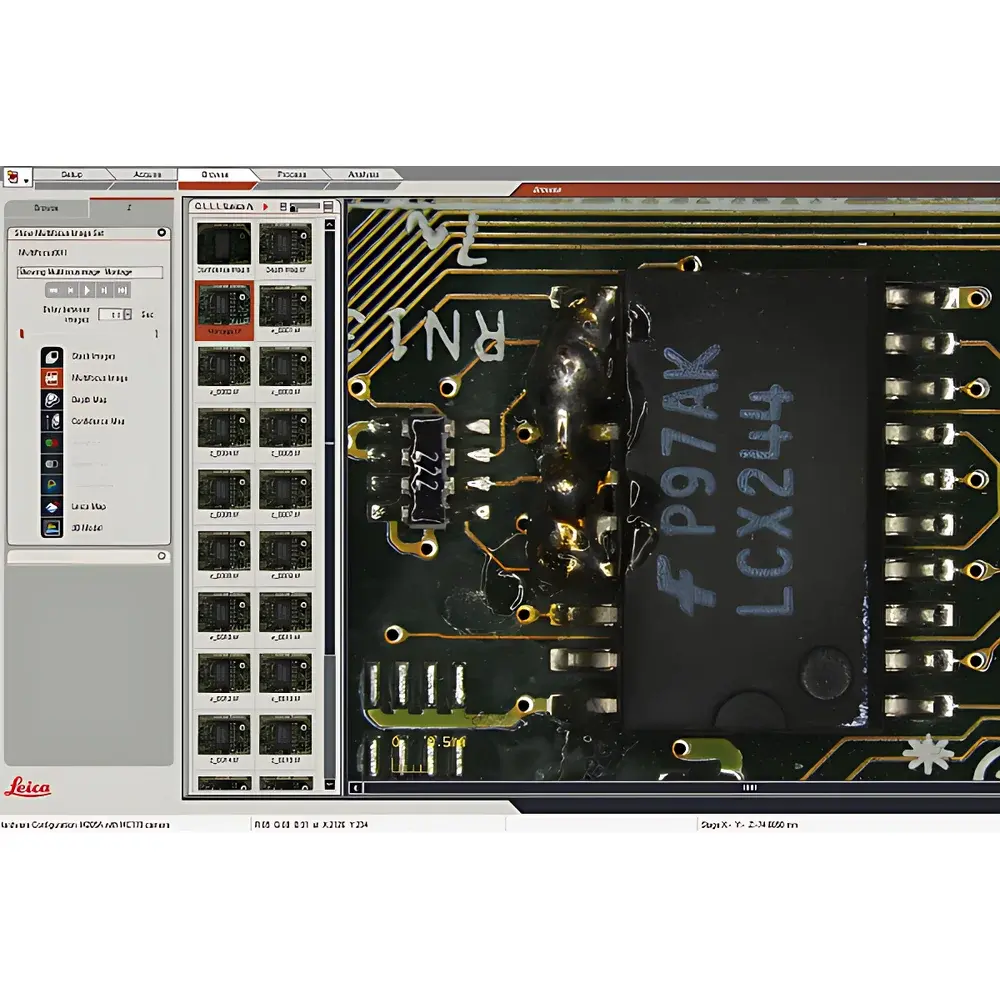
Leica Application Suite (LAS) Software Platform for Microscopy Systems
| Brand | Leica |
|---|---|
| Origin | Germany |
| Manufacturer Type | Authorized Distributor |
| Product Origin | Imported |
| Model | Leica Application Suite |
| Price Range | USD 13,500 – 27,000 |
Overview
Leica Application Suite (LAS) is a comprehensive, modular software platform engineered to control and synchronize Leica Microsystems’ automated upright and inverted microscopes, digital cameras, motorized stages, illumination systems, and peripheral devices. Built on a robust architecture, LAS implements deterministic real-time image acquisition, multi-channel fluorescence registration, Z-stack reconstruction, time-lapse sequencing, and hardware-triggered event logging. Its core design adheres to scientific imaging principles grounded in pixel-accurate spatial calibration, intensity-linear sensor response mapping, and metadata-embedded acquisition protocols—ensuring traceability and reproducibility across experimental sessions. LAS serves as the central command interface for both routine quality assurance workflows and advanced life science research, supporting standardized optical microscopy methodologies including brightfield, phase contrast, differential interference contrast (DIC), and widefield fluorescence.
Key Features
- Unified hardware integration: Native support for Leica DMi8, DM6 B, DM2500, and DFC series cameras—including sCMOS and EMCCD models—with full parameter synchronization (exposure, gain, binning, ROI, white balance).
- Modular workflow engine: Configurable modules for Image Acquisition, Measurement & Analysis, Tile Scanning, Multi-Dimensional Acquisition (XYZT), and Automated Focus Mapping.
- GLP-compliant audit trail: Timestamped, user-attributed log entries for all acquisition parameters, hardware state changes, and annotation edits—fully compliant with FDA 21 CFR Part 11 requirements when deployed with validated system configurations.
- High-fidelity image processing: Real-time background subtraction, flat-field correction, deconvolution (via LAS X Deconvolution module), and spectral unmixing for multi-label fluorescence imaging.
- Export flexibility: Native export to TIFF (with embedded EXIF and OME-TIFF metadata), PNG, JPEG2000, and HDF5 formats; direct import into ImageJ/Fiji, MATLAB, and Python-based analysis pipelines via documented APIs.
Sample Compatibility & Compliance
Leica Application Suite supports a broad spectrum of sample types—from fixed tissue sections and live-cell cultures to industrial metallurgical specimens and semiconductor wafers—when paired with appropriate Leica microscope platforms and optical configurations. The software enforces ISO/IEC 17025-aligned measurement traceability through calibrated stage encoders and objective lens magnification metadata. For regulated environments, LAS deployments may be qualified per ASTM E2922–22 (Standard Guide for Digital Imaging in Microscopy) and aligned with ISO 10993-12 (biocompatibility testing sample documentation). All image metadata conforms to the Open Microscopy Environment (OME) schema, facilitating interoperability within institutional LIMS and ELN infrastructures.
Software & Data Management
Leica Application Suite employs a centralized project-based file structure (.lif) that embeds raw image data, acquisition settings, region-of-interest annotations, and user-defined measurement templates. Version-controlled project backups are supported via integrated network drive synchronization or optional Leica LAS X Server deployment. The software includes role-based access control (RBAC) for multi-user laboratories, enabling administrator-defined permissions for acquisition, analysis, and report generation. Audit logs are exportable as CSV or PDF for internal QA review or external regulatory submissions. Optional integration with Leica’s LAS X Server enables remote monitoring, centralized license management, and scheduled backup policies compliant with ISO 27001 information security standards.
Applications
- Life sciences: Time-lapse imaging of mitotic progression, neuronal growth cone dynamics, and organoid development under controlled environmental chambers.
- Quality control: Automated defect detection and dimensional metrology on printed circuit boards (PCBs), coated optical lenses, and injection-molded polymer components.
- Materials science: Grain boundary analysis in metallographic samples, inclusion identification in steel alloys, and thin-film thickness quantification via interference contrast.
- Clinical pathology: Digital slide scanning preparation, immunohistochemistry (IHC) scoring, and morphology-based classification of hematological smears.
- Entomology & botany: High-resolution morphometric analysis of arthropod exoskeletons, pollen grain morphology, and leaf epidermal cell patterning.
FAQ
Is Leica Application Suite compatible with non-Leica cameras or third-party microscopes?
No—LAS is exclusively designed for native communication with Leica hardware via proprietary USB3 Vision and GenICam-compliant drivers. Integration with non-Leica devices requires custom middleware and is not supported under warranty.
Does LAS support automated image analysis for particle counting or fluorescence intensity quantification?
Yes—LAS includes built-in measurement tools for area, perimeter, intensity profiling, and threshold-based object segmentation. Advanced quantification (e.g., colocalization, FRET, or machine learning–based classification) requires optional LAS X Advanced Analysis or integration with external Python/R environments.
Can LAS projects be migrated to newer versions of the software without data loss?
Yes—LAS maintains backward compatibility for project files (.lif) across major releases; however, forward compatibility is not guaranteed. Leica recommends archiving projects in OME-TIFF format for long-term preservation.
What operating systems are officially supported?
Windows 10 (64-bit) and Windows 11 (64-bit) with minimum 16 GB RAM, NVIDIA Quadro or RTX-series GPU (for GPU-accelerated deconvolution), and SSD storage for optimal performance.
Is remote access or cloud-based deployment available?
Remote desktop access is permitted within local networks. Cloud-hosted deployment is not certified; however, LAS X Server supports virtualized environments compliant with VMware vSphere 7.0+ and Microsoft Hyper-V, subject to validation per GxP guidelines.






