
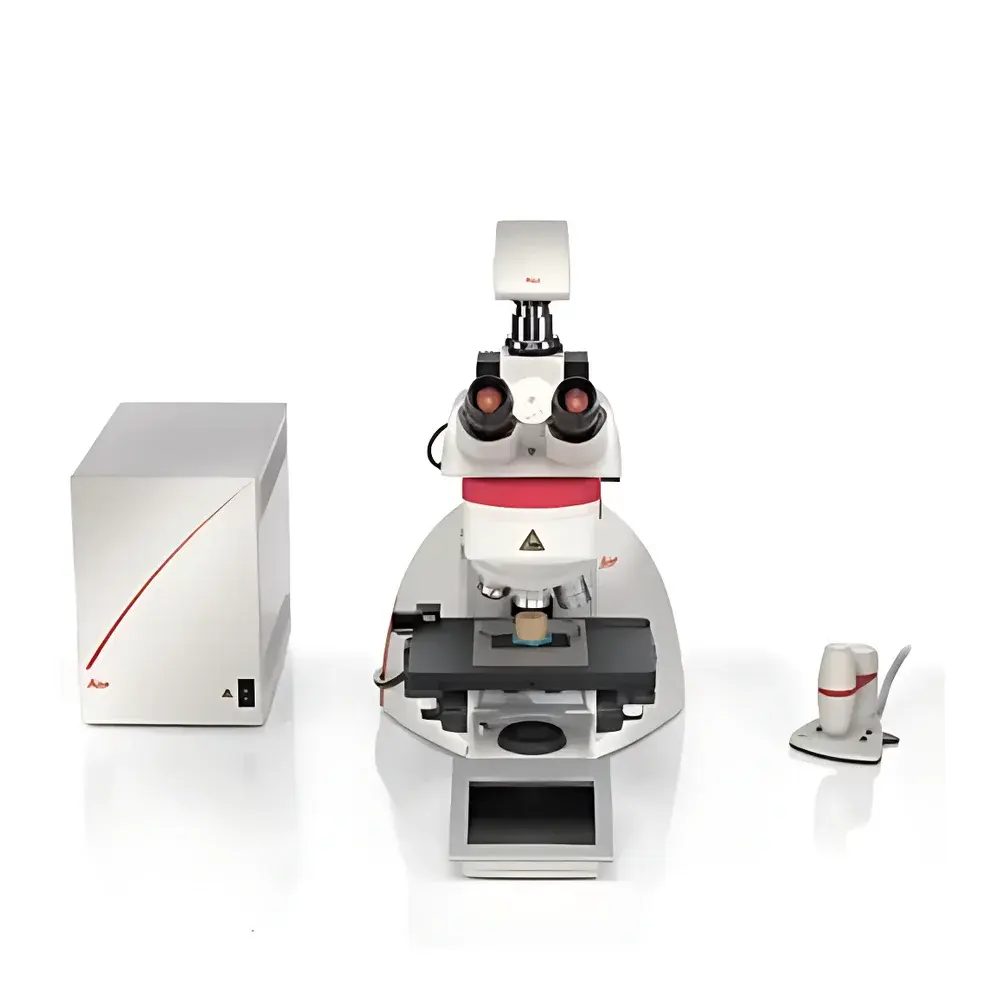
Leica DM6M Digital Upright Metallurgical Microscope
| Brand | Leica |
|---|---|
| Origin | Germany |
| Model | DM6M |
| Configuration | Upright |
| Optical Design | Achromatic-Corrected Reflected-Light Path with 25 mm Field of View |
| Objective Turret | Motorized 6-Position, Compatible with 32 mm Industrial Objectives |
| Focusing System | Integrated Motorized Z-Drive with 0.015 µm Step Resolution |
| Illumination | Built-in LED Transmitted & Reflected Light Sources with Adaptive Intensity Control |
| Observation Modes | Fully Automated Brightfield, Darkfield, Polarized Light, and Differential Interference Contrast (DIC) |
| Control Interface | Large Touchscreen LCD Display with Real-Time Status Monitoring and Touch-Based Operation |
| Software Integration | Leica Application Suite (LAS) X for Image Acquisition, Measurement, Annotation, and Report Generation |
| Compliance | Designed to Support GLP/GMP workflows with audit trail capability (via optional LAS X Audit Trail module), compatible with ISO 9001-certified quality control environments |
| Sample Handling | Modular Stage Options Including 4×4 mm and 6×6 mm Large-Sample Carriers |
| Accessories | Compatible with Fluorescence Modules, High-Temperature Stages, Cathodoluminescence Detectors, Photometers, and Digital Cameras (e.g., Leica DFC9000 GT) |
Overview
The Leica DM6M is a high-precision, fully automated upright metallurgical microscope engineered for rigorous materials science laboratories and industrial quality assurance facilities. It employs a reflected-light optical architecture optimized for opaque, polished, or coated specimens — including metals, alloys, ceramics, composites, electronic components, and particulate contaminants. Its core optical path features apochromatically corrected optics supporting a 25 mm field of view diameter, ensuring uniform resolution and chromatic fidelity across the entire imaging area. Unlike conventional metallurgical microscopes, the DM6M integrates a motorized Z-axis drive with sub-nanometer repeatability (0.015 µm step resolution), enabling precise focus stacking and depth profiling in routine metallographic analysis. The system’s modular platform supports both pure reflected-light observation and combined transmitted/reflected configurations — critical for evaluating thin coatings, layered structures, or semi-transparent ceramic substrates.
Key Features
- Fully motorized 6-position objective turret, designed for rapid, repeatable switching between industrial-grade objectives with 32 mm mounting diameter — ideal for high-magnification inspection of grain boundaries and phase distributions.
- Built-in dual LED illumination system for both reflected and transmitted light, delivering stable color temperature (5700 K) and intensity linearity over time — eliminating thermal drift during extended acquisition sessions.
- Intelligent illumination adaptation: automatically recalls optimal aperture diaphragm position, condenser height, and light intensity settings per objective and contrast mode (brightfield, darkfield, polarization, DIC), reducing operator variability and accelerating workflow standardization.
- Integrated 10.1-inch full-HD capacitive touchscreen display provides real-time status feedback on focus position, magnification, lamp output, filter wheel state, and stage coordinates — all controllable via intuitive gesture-based interface.
- Native compatibility with Leica Application Suite (LAS) X software, supporting multi-channel image acquisition, geometric and grayscale measurements, particle counting, inclusion rating per ASTM E45 and ISO 4967, and automated report generation with embedded metadata.
- Modular expansion capability: accepts motorized XY scanning stages for automated large-area mapping, high-temperature stages (up to 1200 °C), cathodoluminescence detectors, fluorescence filter cubes, and photometric sensors for quantitative reflectance analysis.
Sample Compatibility & Compliance
The DM6M accommodates a broad spectrum of metallurgical and advanced material specimens: polished metallographic mounts, sintered ceramics, semiconductor wafers, solder joints, printed circuit board cross-sections, and airborne particulate filters. Its large-format stage options (4×4 mm and 6×6 mm carriers) enable full-wafer inspection without repositioning. For regulatory compliance, the system supports traceable operation through LAS X’s optional Audit Trail module — meeting requirements for FDA 21 CFR Part 11, ISO/IEC 17025, and GLP documentation standards. All optical components are manufactured in Wetzlar, Germany, under ISO 9001-certified processes, ensuring long-term calibration stability and inter-laboratory reproducibility.
Software & Data Management
Leica LAS X serves as the central hub for image capture, processing, and data governance. It enables batch acquisition with auto-focus and auto-exposure per field-of-view, annotation with calibrated scale bars (automatically updated per objective magnification), and export of measurement data in CSV, XML, or PDF formats. The software includes dedicated modules for cleanliness analysis (ISO 16232, VDA 19), non-metallic inclusion classification (ASTM E45 Type A–D), and grain size determination (ASTM E112). Raw image files are stored in TIFF or Leica’s proprietary LIF format, preserving bit-depth and metadata integrity for retrospective analysis or third-party validation.
Applications
- Metallographic evaluation of heat-treated steels, aluminum alloys, and titanium grades per ASTM E3, E407, and ISO 643.
- Failure analysis of electronic interconnects, wire bonds, and die attach integrity using polarized light and DIC contrast.
- Ceramic microstructure characterization — pore distribution, grain boundary delineation, and second-phase identification.
- Automated cleanliness assessment of automotive hydraulic components and aerospace fasteners per ISO 16232 Class C–F.
- Quantitative phase analysis in duplex stainless steels and nickel-based superalloys using polarization contrast and spectral unmixing (with optional camera).
- High-temperature in situ observation of oxidation kinetics and phase transformation using integrated heating stages.
FAQ
Does the DM6M support automated reporting for ISO/ASTM-compliant metallographic analysis?
Yes — LAS X includes preconfigured templates for ASTM E45 inclusion rating, ISO 643 grain size, and ISO 16232 particle counting, with embedded calibration verification and digital signature support.
Can the system be integrated into an existing laboratory information management system (LIMS)?
Yes — LAS X supports HL7 and ASTM E1384-compliant data export, and can be configured for direct database push via ODBC or REST API integration.
Is the 0.015 µm focusing resolution achievable across all magnifications and objectives?
Yes — the closed-loop motorized Z-drive maintains consistent step resolution independent of objective focal length or mechanical tube length configuration.
What illumination options are available for fluorescence applications?
The DM6M accepts Leica’s LED-based fluorescence modules (e.g., GFP, TRITC, DAPI) and supports external EL6000 mercury/xenon sources with TTL synchronization for time-resolved imaging.
How is calibration traceability maintained for measurement functions?
Each instrument ships with NIST-traceable calibration certificates for stage movement, focus encoder, and pixel-to-micron scaling — updated automatically during LAS X software calibration routines.




