
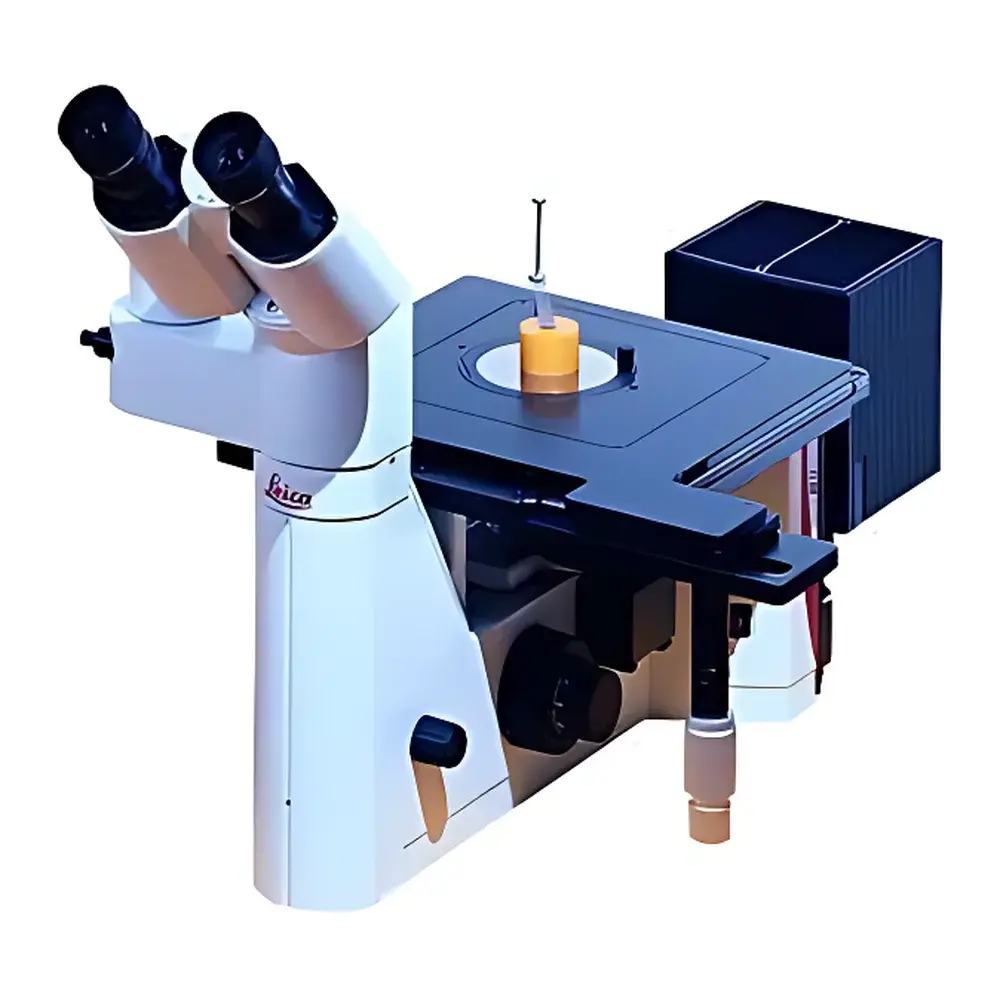
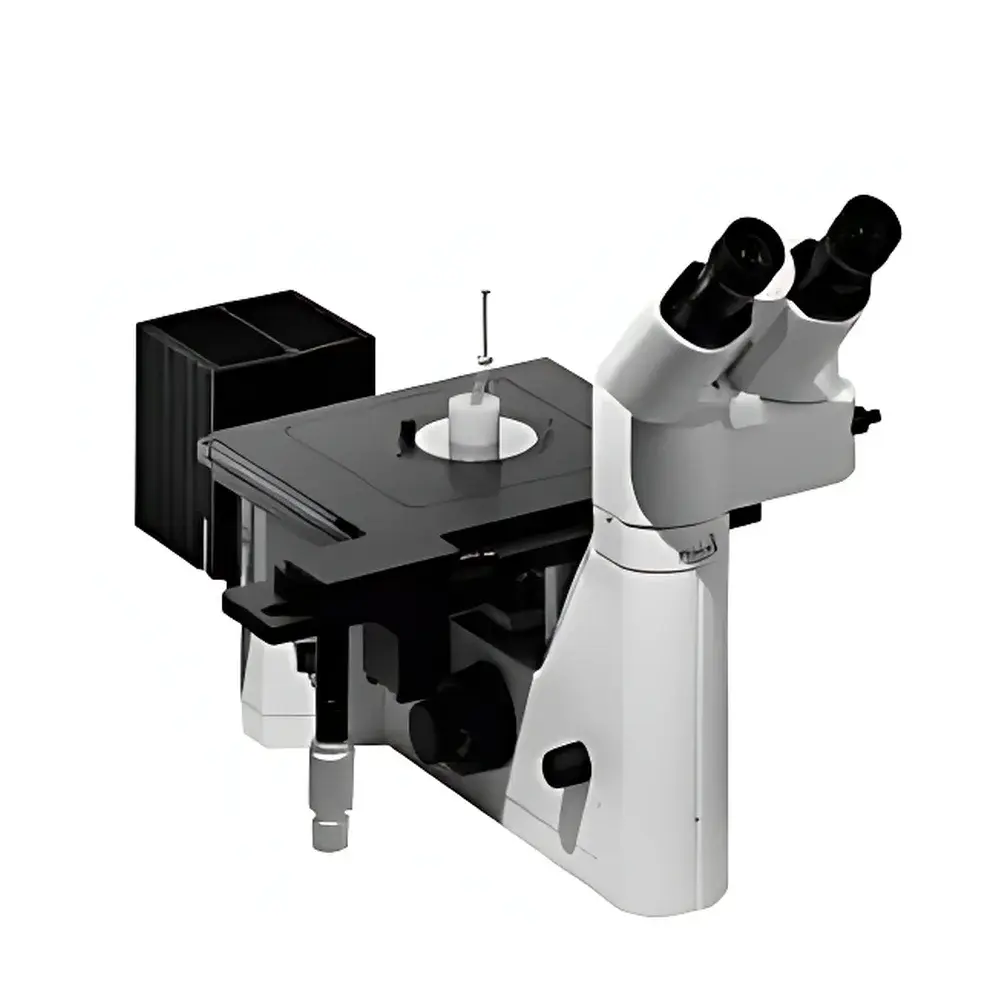
Leica DMI LM Inverted Metallurgical Microscope
| Brand | Leica |
|---|---|
| Origin | Germany |
| Model | DMI-LM |
| Configuration | Inverted |
| Image Analysis System | Integrated |
| Total Magnification Range | 100×–1000× |
| Eyepieces | 10× (20 mm field of view) |
| Objective Lenses | 5×, 10×, 20×, 50×, 100× (dry) |
| Optical System | HC Infinity-Corrected, Brightfield & Polarized Light |
| Focusing Mechanism | Coaxial coarse/fine focus (7 mm upward, 2 mm downward travel) |
| Nosepiece | 4-position revolving turret (M25 thread) |
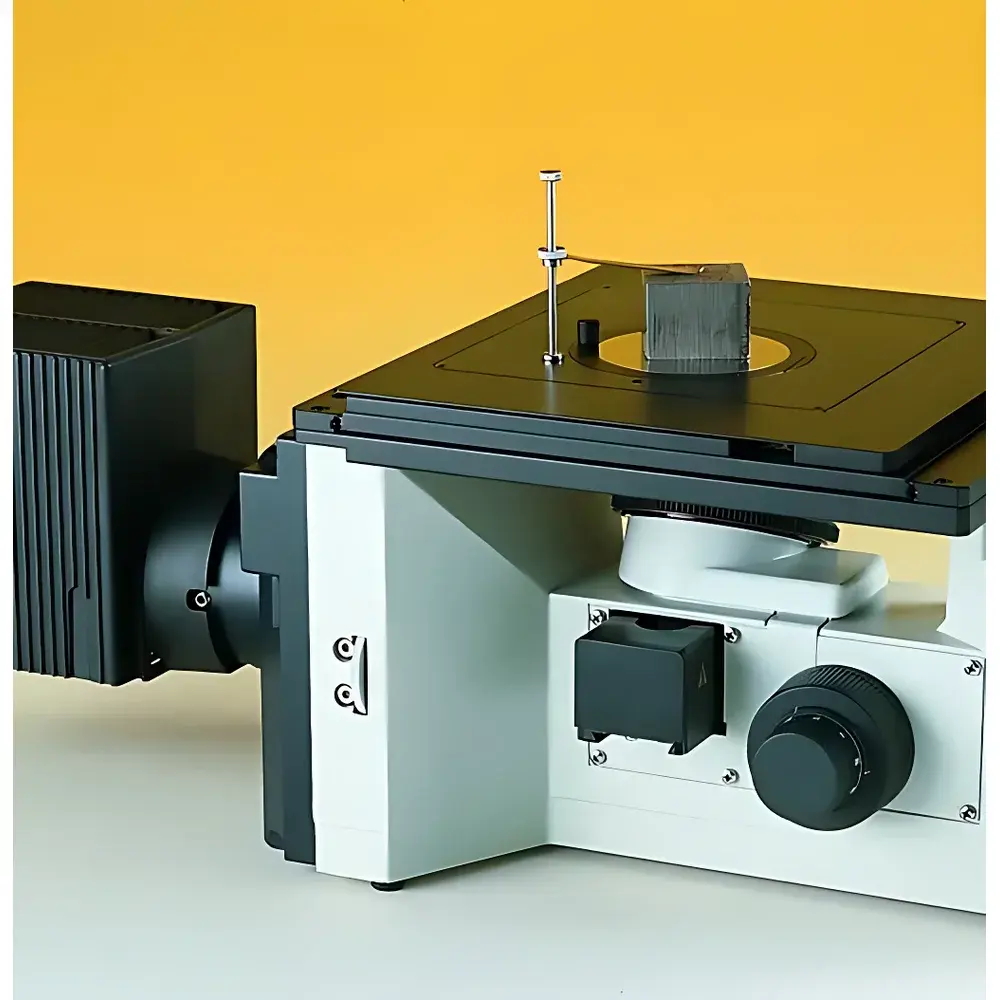
| Stage | Fixed mechanical stage, 247 mm × 230 mm, 60 mm × 40 mm travel range |
| Illumination | 6 V / 35 W halogen lamp (built-in), optional 12 V / 100 W external illuminator |
| Tube | Binocular inclined tube (30° tilt), interpupillary adjustment 48–75 mm, 100% beam split for side-mounted camera |
| Camera Interface | C-mount adapter |
| Dimensions (W×D×H) | 236 × 624 × 407 mm |
| Weight | ~10 kg |
| Compliance | Designed and manufactured in accordance with ISO 9001 and CE directives for laboratory instrumentation |
Overview
The Leica DMI LM is a purpose-engineered inverted metallurgical microscope designed for rigorous inspection, qualitative analysis, and quantitative measurement of metallic alloys, sintered materials, composites, and other opaque industrial specimens. Its inverted configuration places the objective lenses beneath the specimen stage—enabling unobstructed access to large, heavy, or irregularly shaped samples mounted on standard metallographic holders or custom fixtures. The system employs Leica’s HC (High Contrast) infinity-corrected optical architecture, which applies axial and radial chromatic aberration correction across the entire optical train—including objectives, tube lenses, eyepiece optics, and phototube interfaces—to maximize resolution, contrast uniformity, and color fidelity. This optical design ensures diffraction-limited performance at all magnifications from 50× to 1000×, supporting both brightfield (BF) and polarized light (POL) observation modes critical for grain structure evaluation, phase identification, inclusion analysis, and stress-induced birefringence detection in heat-treated or cold-worked metals.
Key Features
- Inverted ergonomic layout with fixed mechanical stage (247 × 230 mm) and 60 × 40 mm travel range—optimized for stability during high-magnification imaging and microhardness testing integration.
- HC infinity-corrected optical path delivering consistent flat-field illumination and edge-to-edge sharpness across wide-field 10× eyepieces (20 mm field number).
- Four-position M25-thread nosepiece accommodating dry objectives: 5×, 10×, 20×, 50×, and 100×—each engineered for high numerical aperture and long working distance where applicable.
- Dual-mode illumination: integrated 6 V / 35 W halogen source with plug-in filter carriers for neutral density, green interference, and polarization components; optional 12 V / 100 W external illuminator for extended intensity control and thermal load management.
- Binocular viewing tube inclined at 30°, with adjustable interpupillary distance (48–75 mm) and 100% light diversion to a side-mounted C-mount camera port—enabling simultaneous visual observation and digital capture without beam splitting losses.
- Coaxial coarse/fine focusing mechanism with 7 mm upward and 2 mm downward travel—designed for precise Z-axis positioning during serial sectioning or depth-resolved imaging workflows.
Sample Compatibility & Compliance
The DMI LM accommodates standard metallographic specimens up to 40 mm in height and 150 mm in diameter, including mounted cross-sections, as-polished or etched coupons, and coated or plated components. Its robust stage design supports integration with motorized XYZ stages, microhardness indenter adapters, and thermal stage accessories for in situ elevated-temperature microscopy. All optical and mechanical components comply with ISO 10934-1 (microscopy terminology), ISO 8578 (objective lens labeling), and EN 61000-6-3 (EMC emission standards). The instrument meets CE marking requirements for laboratory equipment and is compatible with GLP/GMP documentation workflows when paired with Leica’s audit-trail-enabled imaging software.
Software & Data Management
The DMI LM interfaces seamlessly with Leica Application Suite (LAS) X—a modular, FDA 21 CFR Part 11-compliant platform supporting image acquisition, annotation, measurement (grain size per ASTM E112, inclusion rating per ASTM E45), and report generation. Optional modules include Extended Depth of Field (EDF) for focus stacking, Leica Metallography Suite for automated phase segmentation and porosity quantification, and LAS X Core for remote operation via LAN/Wi-Fi. All metadata—including objective ID, magnification, exposure time, illumination mode, and calibration parameters—is embedded in TIFF or JPEG2000 files and preserved in structured database archives for traceability and regulatory review.
Applications
- Metallographic quality control: grain boundary delineation, carbide distribution mapping, weld zone characterization, and decarburization depth measurement per ISO 3887.
- Failure analysis: crack propagation path reconstruction, fatigue striation counting, and corrosion pit morphology assessment.
- Materials R&D: phase transformation kinetics monitoring, intermetallic compound identification under polarized light, and thermal oxidation layer thickness quantification.
- Coating and surface engineering: adhesion interface inspection, PVD/CVD layer uniformity analysis, and residual stress evaluation via birefringence imaging.
- Standards compliance testing: verification of microstructure against ASTM E3, ISO 643, and EN 10360 specifications.
FAQ
What observation modes does the Leica DMI LM support?
Brightfield and polarized light observation are standard; darkfield and differential interference contrast (DIC) require optional accessory kits and compatible objectives.
Is the DMI LM suitable for automated image analysis workflows?
Yes—when configured with LAS X software and a calibrated motorized stage, it supports batch acquisition, region-of-interest stitching, and AI-assisted particle classification pipelines.
Can the microscope be integrated into a cleanroom or controlled environment?
Its sealed optical pathways, low-outgassing housing materials, and absence of internal fans make it suitable for ISO Class 7–8 environments with appropriate environmental conditioning.
Does Leica provide validation documentation for regulated industries?
Upon request, Leica supplies IQ/OQ documentation templates, calibration certificates traceable to NIST standards, and software validation packages compliant with GAMP 5 guidelines.
What maintenance intervals are recommended for routine operation?
Annual optical alignment verification and lamp replacement every 2000 hours are advised; objective cleaning and stage lubrication should follow Leica’s scheduled preventive maintenance protocol (documented in the user manual).




