
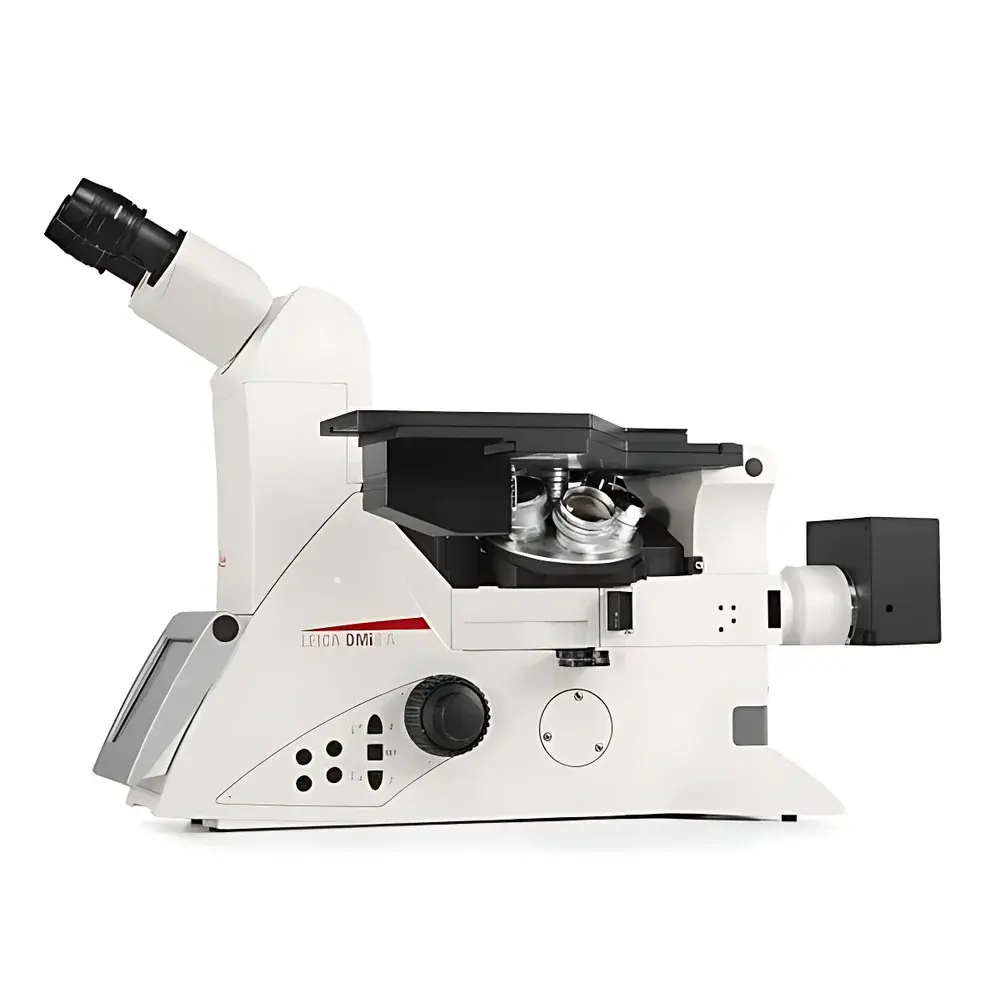
Leica DMi8M / DMi8C / DMi8A Inverted Microscope System
| Brand | Leica |
|---|---|
| Origin | Germany |
| Model | DMi8M / DMi8C / DMi8A |
| Configuration Type | Inverted Metallurgical and Industrial Microscope |
| Total Magnification Range | 7×–2000× |
| Eyepiece | 10× |
| Objective Magnification Range | 0.7×–100× |
| Integrated Imaging Analysis System | Yes |
| Maximum Sample Weight Capacity | 30 kg |
| Macro Objectives Available | Yes (0.7×, 5×, 10×, 20×, 50×, 100×) |
| Illumination | LED-based UC-3D Contrast Illumination |
| Contrast Modes | Brightfield, Polarized Light, Differential Interference Contrast (DIC), Hoffman Modulation Contrast (HMC), Phase Contrast (optional) |
| Focus Drive | Tri-position manual/encoded motorized focusing |
| Software Platform | Leica Application Suite (LAS) with Expert Modules (e.g., Steel Expert, Grain Expert, Phase Expert) |
| Compliance | Designed for ISO 9001-aligned manufacturing environments |
Overview
The Leica DMi8M, DMi8C, and DMi8A are high-performance inverted microscope systems engineered for industrial metallurgy, quality control in medical device manufacturing, semiconductor inspection, and advanced materials research. Unlike upright configurations, the inverted optical architecture positions objectives beneath the stage—enabling rapid, collision-free handling of large, heavy, or topographically complex specimens up to 30 kg. The system operates on a modular platform built around Leica’s proprietary HCX (High Contrast X) optical design, delivering diffraction-limited resolution across a continuous magnification range from 7× to 2000×. Core imaging principles rely on Köhler illumination, precise optical path alignment, and contrast-specific light management—including DIC, polarized light, and UC-3D illumination—to extract surface topography, grain boundary contrast, phase distribution, and crystallographic orientation without staining or sectioning. This makes the DMi8 series particularly suited for non-destructive evaluation of castings, welds, sintered components, thin-film substrates, and MEMS devices.
Key Features
- Modular inverted platform supporting manual (DMi8M), encoded (DMi8C), and fully automated (DMi8A) operation modes
- Tri-position focusing drive with adjustable sensitivity for consistent focus repeatability across magnifications
- UC-3D illumination system: multi-angle LED-based lighting enabling dynamic surface relief enhancement and improved edge definition in reflective and semi-transparent samples
- Wide-field macro objectives (0.7×–100×) providing field-of-view up to 35.7 mm at 0.7×, enabling rapid overview-to-detail transitions
- Integrated 6-position objective turret with M25 threading and optional encoding for automatic magnification recognition
- Dual-path optical design accommodating simultaneous visual observation and high-resolution digital imaging
- LED illumination modules calibrated for stable color temperature (5700 K) and intensity linearity across all contrast techniques
- Ergonomic stage design with 180 mm × 180 mm travel range and load-rated mechanical stability for vibration-sensitive measurements
Sample Compatibility & Compliance
The DMi8 platform accommodates diverse industrial sample formats: bulk metallographic mounts, wafer fragments, PCB assemblies, coated substrates, and large-section biomedical implants. Its inverted geometry eliminates the need for specimen inversion or custom holders—critical for time-sensitive QC in foundries or microelectronics fabs. All optical components comply with DIN EN ISO 10934-1 for quantitative microscopy and meet CE marking requirements for laboratory instrumentation. When configured with LAS software and enabled audit trail features, the system supports documentation traceability aligned with ISO/IEC 17025, ASTM E3, ASTM E112, and USP guidelines for instrument qualification. Optional DIC and polarization modules conform to ISO 11146 for beam parameter measurement and ASTM E407 for etch-based microstructural analysis.
Software & Data Management
Leica Application Suite (LAS) serves as the unified control and analysis environment, offering role-based user permissions, electronic lab notebook (ELN)-compatible reporting, and 21 CFR Part 11–compliant audit trails. Expert modules—including Steel Expert (for inclusion rating per ASTM E45), Grain Expert (for grain size quantification per ASTM E112), and Phase Expert (for phase fraction mapping)—are validated for routine use in regulated environments. LAS supports TIFF, JPEG2000, and raw camera format export with embedded metadata (objective ID, magnification, illumination settings, timestamp). Batch processing, region-of-interest (ROI) masking, and geometric measurement tools (line, angle, area, particle count) are natively integrated. Remote access via Leica LAS X Core enables centralized fleet management and cross-site method sharing without compromising local data sovereignty.
Applications
- Metallurgical QC: Rapid assessment of porosity, dendritic structure, intermetallic phases, and heat-affected zones in aluminum alloys, stainless steels, and superalloys
- Medical device inspection: Visual verification of laser-weld integrity, coating uniformity on stents, and surface finish on orthopedic implants
- Semiconductor packaging: Die attach void detection, wire bond inspection, and underfill delamination screening
- Additive manufacturing: In-situ powder bed characterization, post-build porosity mapping, and melt pool morphology analysis
- Failure analysis labs: Corrosion product identification, fracture surface topography reconstruction, and fatigue crack propagation tracking
- Research & development: In situ thermal cycling experiments using heated stages, coupled with real-time DIC strain mapping
FAQ
What distinguishes the DMi8M, DMi8C, and DMi8A configurations?
The DMi8M is a manually operated system with two-speed coarse/fine focus and mechanical objective encoding. The DMi8C adds motorized Z-drive and encoded turrets for repeatable positioning and software-controlled magnification recall. The DMi8A includes full automation—motorized XY stage, autofocus, and integrated camera shutter control—optimized for unattended batch imaging.
Can the DMi8 be used for quantitative grain size analysis per ASTM E112?
Yes—when equipped with LAS Grain Expert module and calibrated stage micrometer, the system meets ASTM E112 requirements for planimetric and intercept methods, including automatic thresholding, grain boundary tracing, and statistical reporting.
Is UC-3D illumination compatible with all contrast modes?
UC-3D is fully integrated with brightfield, polarized light, and DIC. It enhances surface texture perception without requiring additional hardware; illumination angle and intensity are software-adjustable within LAS.
Does the system support third-party cameras or only Leica-branded sensors?
The DMi8 features a standardized C-mount interface and supports industry-standard USB3 Vision and GigE Vision cameras. Leica provides SDK documentation for OEM integration and custom driver development.
How is calibration maintained across long-term operation?
LAS includes built-in calibration routines for magnification, stage movement, and illumination intensity. Optional NIST-traceable calibration kits (e.g., stage micrometer, photometric reference tiles) enable periodic verification per ISO/IEC 17025 internal audit protocols.





