
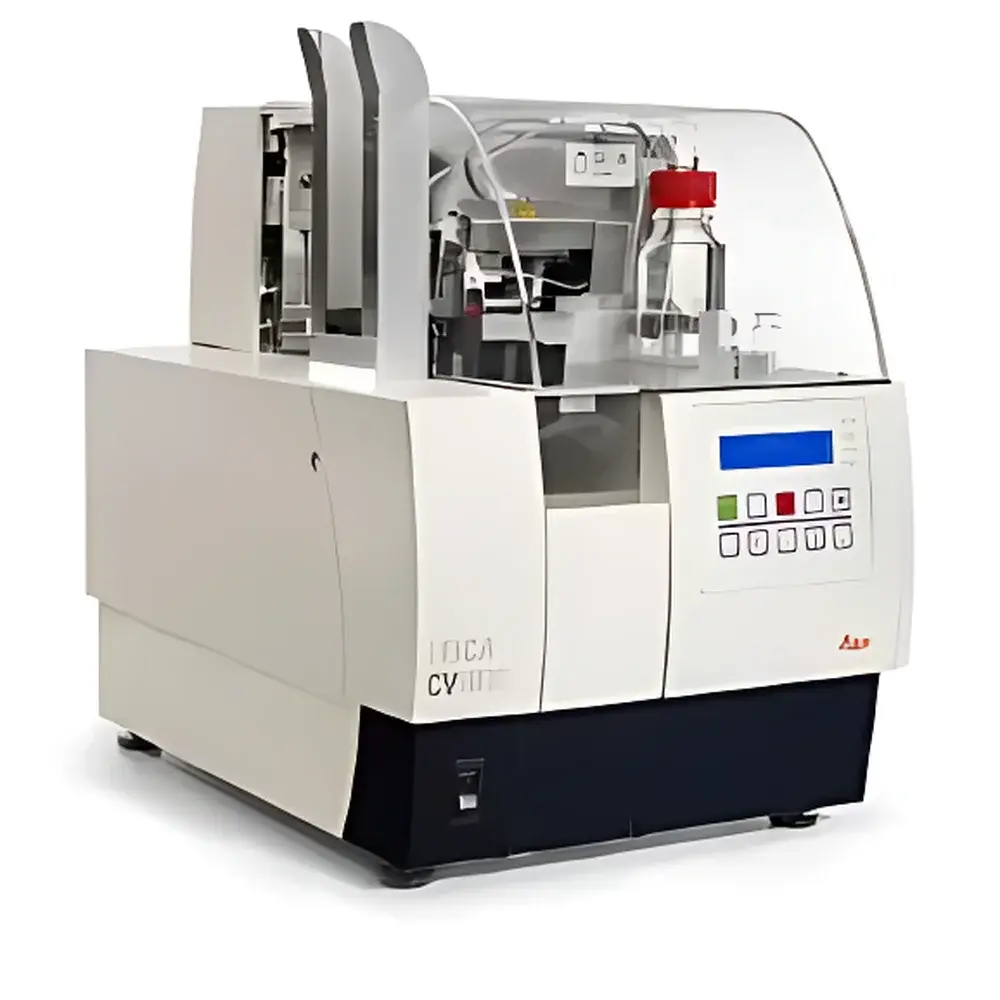
Leica HistoCore CV5030 Coverslipper
| Brand | Leica |
|---|---|
| Origin | USA |
| Manufacturer Type | Authorized Distributor |
| Origin Category | Imported |
| Model | HistoCore CV5030 Coverslipper |
| Pricing | Available Upon Request |
Overview
The Leica HistoCore CV5030 Coverslipper is an automated, high-throughput coverslipping system engineered for routine and high-volume histopathology laboratories. It operates on a precision fluid-dispense-and-press principle: a controlled volume of mounting medium is deposited onto the tissue section, followed by accurate robotic placement and gentle compression of the coverslip to ensure uniform thickness, bubble-free adhesion, and optimal optical clarity. Designed to integrate seamlessly with Leica’s full suite of staining platforms—including the ST5010, ST4020, and Bond RX systems—the CV5030 eliminates manual slide transfer between staining and coverslipping steps, thereby reducing pre-analytical variability, minimizing human handling errors, and supporting end-to-end automation under GLP-compliant workflows.
Key Features
- Throughput of up to 300 slides per hour—maintaining consistent cycle time across batch sizes without compromising alignment accuracy or seal integrity.
- Modular architecture enables standalone operation or bidirectional integration into existing Leica or third-party staining workflows via standardized slide transport interfaces (e.g., Leica Slide Transfer Module compatibility).
- Intelligent adaptive positioning: real-time optical detection of slide geometry and tissue location ensures precise mounting medium deposition and coverslip centering—even for eccentrically mounted specimens or non-standard slide formats.
- Multi-parameter programmability: independent control over mounting medium volume (0.5–5.0 µL), dispensing speed, dwell time, press force (1–15 N), and dwell duration (0.5–10 s) per protocol.
- Tool-free cassette loading: accommodates standard Leica staining racks (up to 30 slides/rack) and most commercially available open-frame staining carriers compliant with ANSI/SLAS microplate footprint standards.
- Sealed reagent reservoirs with RFID-tracked consumable monitoring for mounting media (e.g., DPX, Eukitt, VectaMount, and water-soluble alternatives) and coverslips (22 × 22 mm, 22 × 30 mm, 22 × 40 mm, 22 × 50 mm).
Sample Compatibility & Compliance
The CV5030 supports diverse specimen types including formalin-fixed paraffin-embedded (FFPE) tissue sections (3–5 µm), frozen sections, cytology smears (Pap, Diff-Quik), and monolayer cell preparations. It accepts conventional glass microscope slides (75 × 25 mm, ASTM E2913-compliant) and accommodates both hydrophobic and hydrophilic surface treatments. The system meets ISO 13485:2016 requirements for in vitro diagnostic medical device manufacturing environments and supports audit-ready documentation for FDA 21 CFR Part 11 compliance when paired with Leica Biosystems’ LAS X software suite. All wetted components are chemically resistant to common xylene-substitute clearing agents and resinous mounting media.
Software & Data Management
Controlled via Leica’s intuitive touch-based HistoCore OS v3.x interface, the CV5030 provides full protocol management—including user-defined presets, version-controlled method libraries, and timestamped execution logs. Integrated Ethernet connectivity enables remote monitoring, firmware updates, and HL7/SOAP-based LIS interfacing. Audit trails record operator ID, date/time stamps, parameter changes, and error events—fully traceable for CAP, CLIA, and ISO 15189 accreditation. Optional data export in CSV or PDF format includes per-slide metadata (slide ID, protocol name, medium lot number, coverslip size, and QC pass/fail flag).
Applications
- Routine surgical pathology: high-volume diagnostic slide preparation with reproducible refractive index matching and archival stability (>10-year shelf life under ambient storage).
- Research histology: standardized coverslipping for quantitative image analysis—minimizing focus drift and chromatic aberration across multi-channel fluorescence imaging.
- Cytology laboratories: rapid, low-pressure application ideal for fragile monolayer preparations and liquid-based cytology (LBC) specimens.
- Biobanking and digital pathology: production of uniformly sealed slides compatible with whole-slide imaging (WSI) scanners requiring flatness tolerance ≤2 µm across the coverslip surface.
- Quality assurance: built-in daily verification using Leica-certified calibration slides to validate dispensing accuracy and positional repeatability (±15 µm at 95% confidence).
FAQ
Can the CV5030 process slides stained on non-Leica stainers?
Yes—it accepts standard ANSI/SLAS-compatible staining racks from Sakura, Thermo Fisher, Agilent, and other major vendors, provided slide spacing and rack geometry conform to Leica’s mechanical interface specifications.
Does it support water-based mounting media?
Yes, with optional humidity-controlled chamber add-on and validated protocols for aqueous media such as Glycergel and Aquatex.
Is routine maintenance documented and serviceable on-site?
All preventive maintenance tasks—including nozzle cleaning, vacuum pump filter replacement, and optical sensor calibration—are guided interactively via the onboard OS and logged automatically; field service engineers can remotely diagnose via secure VNC session.
How is slide identification preserved during automated transfer?
Barcoded slide labels (ISO/IEC 15416-compliant) are read at intake using integrated linear imager; ID data is embedded in the audit trail and exported with each batch report.
What safety certifications does the instrument hold?
CE-marked per IEC 61010-1:2010, UL 61010-1, and RoHS 2011/65/EU; laser class 1 for all internal optical sensors.



