
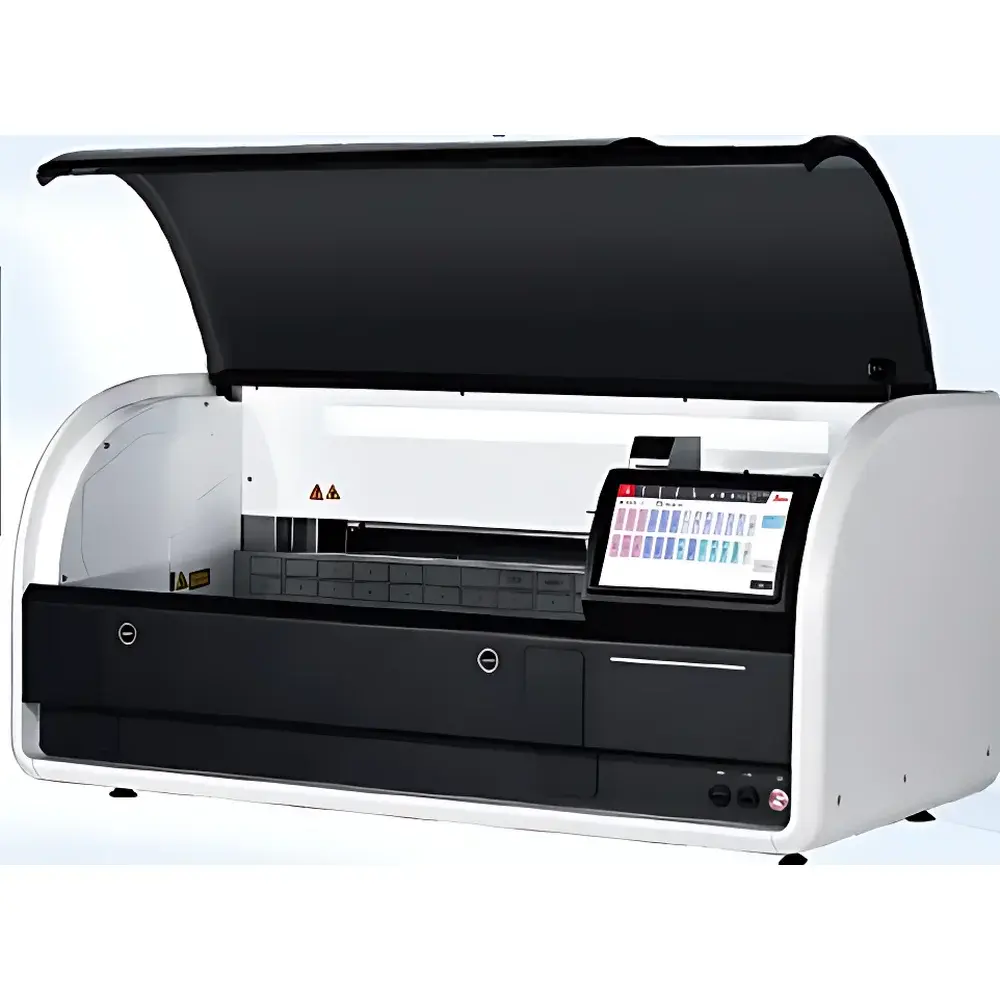
Leica HistoCore SPRING ST Fully Automated Tissue Stainer
| Brand | Leica |
|---|---|
| Origin | Germany |
| Model | HistoCore SPRING ST |
| Automation Level | Fully Automatic |
| Staining Method | Immersion-Based |
| Maximum Slide Capacity | 3000 slides per run |
| Maximum Reagent Slots | 20 |
| Primary Staining Applications | Hematoxylin and Eosin (H&E) |
| Operating Ambient Temperature Range | ≤35 °C |
| Regulatory Compliance | CE-IVD, ISO 13485 compliant |
| Intended Use | Routine histopathological staining in clinical and research laboratories |
Overview
The Leica HistoCore SPRING ST is a CE-IVD marked, fully automated tissue stainer engineered for high-throughput, reproducible hematoxylin and eosin (H&E) staining in diagnostic pathology and translational research laboratories. Based on precision immersion-based fluidics architecture, the system delivers consistent reagent exposure time, temperature-controlled incubation, and uniform slide agitation across the full processing cycle — from deparaffinization through hydration, staining, differentiation, bluing, dehydration, and clearing. Its core design adheres to ISO 13485 quality management principles and supports compliance with GLP/GMP-aligned laboratory workflows. The instrument operates within a defined ambient temperature envelope (≤35 °C), ensuring thermal stability of reagents and minimizing evaporation-related variability during extended runs.
Key Features
- Fully automated, walk-away operation with integrated slide loading, staining, and unloading — no manual intervention required between cycles.
- Intelligent Stain Optimization algorithm dynamically adjusts reagent dwell times and rinse durations based on real-time slide count and cumulative usage, maintaining color fidelity from Slide #1 to Slide #3000.
- 20-position reagent carousel with individual temperature monitoring and leak-detection sensors; compatible with standard glass or plastic reagent bottles (500 mL–1000 mL).
- Optical slide counter with dual-sensor verification ensures accurate tracking of processed slides and enables precise reagent consumption forecasting.
- Intuitive 10.1-inch capacitive touchscreen interface with graphical workflow visualization, multilingual support (English, German, French, Spanish, Chinese), and context-sensitive help.
- Onboard memory stores up to 99 user-defined protocols — including custom H&E variants, trichrome, PAS, and modified silver stains — with password-protected access levels for operators, supervisors, and administrators.
Sample Compatibility & Compliance
The HistoCore SPRING ST processes standard 1 mm–1.2 mm thick, 25 × 75 mm glass microscope slides, accommodating both conventional and charged adhesion slides. It accepts paraffin-embedded tissue sections ranging from 2 µm to 10 µm thickness. All fluid pathways are constructed from chemically resistant PTFE and stainless steel components, validated for compatibility with xylene, ethanol, isopropanol, hematoxylin, eosin Y, lithium carbonate, acid alcohol, and other common histology reagents. The system meets IEC 61010-1 safety requirements and carries CE marking under In Vitro Diagnostic Regulation (IVDR) 2017/746. Audit trail functionality records all user actions, protocol modifications, error events, and maintenance logs — supporting FDA 21 CFR Part 11 readiness when deployed with validated IT infrastructure.
Software & Data Management
Leica’s proprietary HistoCore Software Suite provides centralized control, remote monitoring, and comprehensive data governance. Each staining run generates a timestamped digital log containing slide count, reagent lot numbers, temperature profiles, cycle duration, and deviation alerts. Export options include CSV and PDF reports compliant with LIS/HIS integration standards (HL7 v2.x). Optional Leica Connect module enables secure cloud-based fleet management, predictive maintenance scheduling, and cross-site protocol synchronization. All audit trails are immutable, time-stamped, and digitally signed — fulfilling traceability requirements for CAP, CLIA, and ISO 15189-accredited laboratories.
Applications
The HistoCore SPRING ST serves as a primary staining platform in hospital pathology departments, reference laboratories, biobanks, and academic core facilities. Its robustness supports routine diagnostic H&E staining for surgical specimens, biopsies, and cytology preparations. With programmable flexibility, it accommodates specialized applications including Masson’s trichrome for collagen detection, Periodic Acid-Schiff (PAS) for basement membranes and fungi, and reticulin stains for architectural assessment in liver and lymphoid tissues. The system integrates seamlessly into Lean laboratory environments by reducing manual handling errors, minimizing reagent waste, and enabling shift-independent consistency — critical for longitudinal studies and multi-center trials.
FAQ
Does the HistoCore SPRING ST support non-H&E staining protocols?
Yes — while optimized for H&E, the system supports any immersion-based histological stain requiring up to 20 sequential reagent steps, provided reagents are compatible with its fluidics and temperature specifications.
Can the instrument be integrated into an existing laboratory information system (LIS)?
Yes — via HL7 v2.x interface using optional Leica Connect or third-party middleware; configuration requires LIS vendor collaboration and validation per local IT policy.
What maintenance is required to ensure long-term performance?
Daily cleaning of slide racks and fluid paths; monthly calibration of optical counters and temperature sensors; annual preventive maintenance by Leica-certified service engineers.
Is remote diagnostics supported?
Yes — with Leica Connect enabled, authorized service personnel can initiate secure remote sessions for troubleshooting, firmware updates, and performance diagnostics.
How does the system handle reagent depletion during a run?
Real-time volume sensing triggers visual and audible alerts; if critical thresholds are breached, the system pauses the current cycle and logs the event without compromising stained slides already processed.




