
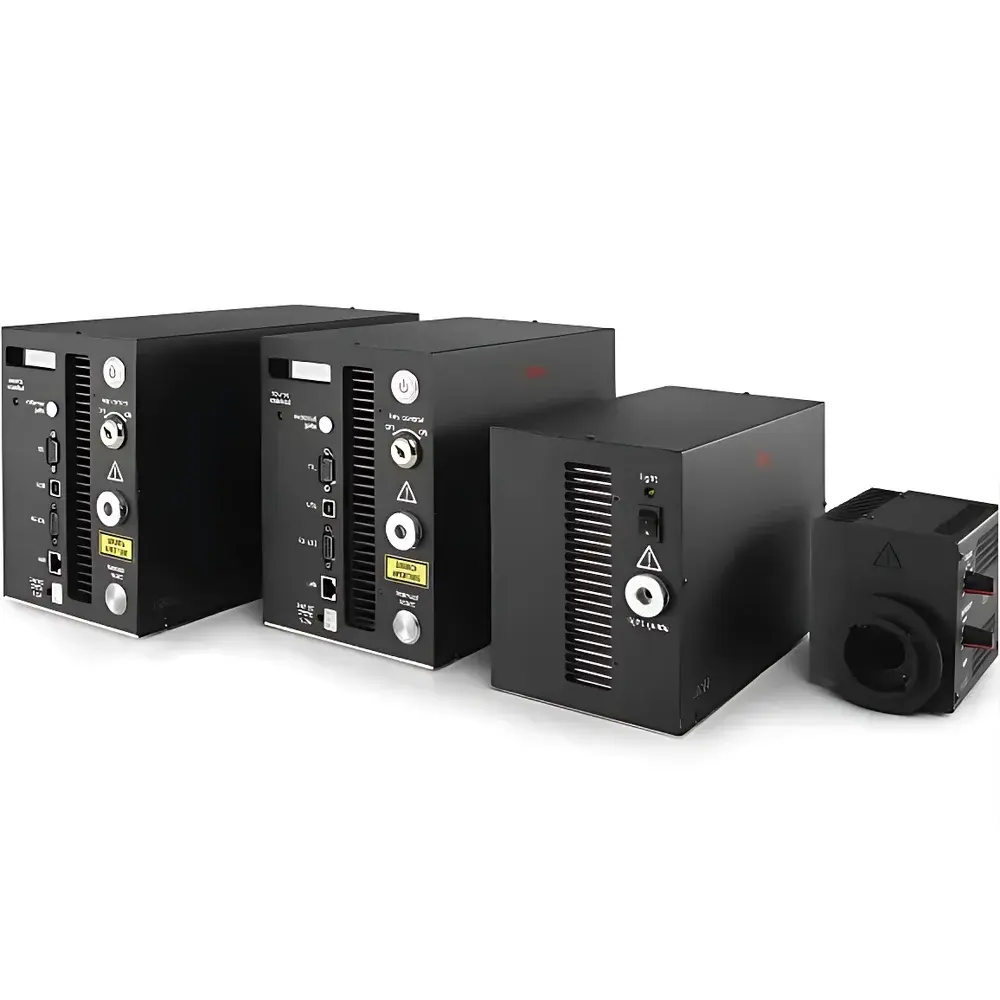
Leica LED Fluorescence Light Sources Series: LED1, LED3, LED5 & LED8
| Brand | Leica |
|---|---|
| Origin | Germany |
| Model | LED1, LED3, LED5, LED8 |
| Light Source Type | Solid-State LED |
| Illumination Mode | Epi-illumination (External) |
| Wavelength Range (LED1) | 380–650 nm (White + 4 Discrete Channels) |
| Compatibility | Leica DM2500, DM4 B Microscopes |
| Control Interface | Analog Knob + TTL Trigger |
| LED Pod Support | Yes |
| Regulatory Compliance | CE, RoHS, IEC 61000-6-3 |
Overview
The Leica LED Fluorescence Light Sources Series—comprising the LED1, LED3, LED5, and LED8 models—represents a purpose-engineered transition from legacy arc-lamp illumination to solid-state, high-stability LED excitation for fluorescence microscopy. These systems operate on the principle of narrow-band or broad-spectrum electroluminescence, delivering precise, repeatable excitation energy without the thermal load, spectral drift, or hazardous mercury content associated with traditional mercury or xenon lamps. Designed specifically for integration with Leica upright and inverted research microscopes—including the DM2500 and DM4 B platforms—the series supports both routine and advanced fluorescence workflows, including live-cell imaging, multi-channel co-localization, time-lapse acquisition, and quantitative intensity-based assays. Each model is calibrated for photometric stability (<2% intensity variation over 8 hours), low temporal noise, and minimal spectral crosstalk between channels, ensuring consistent signal-to-background ratios across repeated experiments.
Key Features
- Mercury-free, RoHS-compliant solid-state illumination with >20,000-hour LED lifetime—eliminating lamp replacement cycles and disposal hazards
- LED1: Broadband white LED (380–650 nm) plus four independently switchable monochromatic channels (typical peaks at 395 nm, 470 nm, 555 nm, and 625 nm) for flexible multi-fluorophore excitation
- LED3, LED5, LED8: Dedicated multi-channel units offering up to eight discrete excitation bands, optimized for spectral unmixing and sequential acquisition protocols
- Analog intensity control via front-panel rotary encoder—enabling rapid, software-free brightness adjustment from 0–100% with sub-1% resolution
- TTL-compatible external triggering (5 V logic) for hardware-synchronized illumination and camera exposure—reducing phototoxicity and enabling precise frame-locked acquisition
- Integrated LED Pod accessory for ergonomic manual operation: tactile color selection, real-time intensity modulation, and one-hand channel switching during imaging sessions
- Thermally stabilized driver architecture with active heat dissipation—ensuring wavelength consistency and output stability under prolonged operation
Sample Compatibility & Compliance
The Leica LED series is validated for use with standard fluorescence labeling protocols involving DAPI, FITC, TRITC, Cy3, Cy5, Alexa Fluor dyes, GFP/RFP derivatives, and quantum dots. All units comply with European CE marking requirements and conform to IEC 61000-6-3 (EMC emission standards) and IEC 62471 (photobiological safety classification—Risk Group 1). The absence of UV-C emission and mercury vapor renders them suitable for open-lab environments without additional shielding. Units meet GLP-aligned operational documentation standards and support audit-ready usage logs when integrated with Leica LAS X software (v3.7+). No special facility modifications—such as dedicated exhaust or high-voltage isolation—are required for installation.
Software & Data Management
While fully functional in standalone mode, the LED series achieves full interoperability with Leica LAS X software (Windows 10/11, 64-bit). Through the Leica Hardware Interface (LHI), users can automate illumination parameters—including channel selection, intensity ramping, dwell time per channel, and TTL-gated pulsing—within acquisition sequences. All illumination events are timestamped and logged alongside image metadata in .lif files, supporting traceability in regulated environments. Optional integration with third-party platforms (e.g., Micro-Manager, Python-based PyMicroscope via ASCOM or serial API) is supported through documented ASCII command protocol. Audit trails include operator ID, session start/end timestamps, and cumulative LED operating hours—facilitating compliance with ISO/IEC 17025 and FDA 21 CFR Part 11 requirements when paired with appropriate electronic signature modules.
Applications
- Routine cell culture monitoring: rapid assessment of transfection efficiency, confluency, and morphological changes using DAPI/FITC dual staining
- Fixed-tissue section imaging: high-contrast nuclear/cytoplasmic co-localization in FFPE samples with minimal autofluorescence interference
- Long-term time-lapse studies: reduced photobleaching and thermal stress enable 24–72 hour acquisitions with stable signal dynamics
- Quantitative fluorescence intensity profiling: calibrated output enables comparative analysis across sessions and instruments
- Teaching laboratory deployment: intuitive knob-based control lowers entry barrier for students while maintaining scientific rigor
- Core facility multi-user environments: channel-locking and user-profile settings prevent unintended configuration changes
FAQ
Can the LED1 be used with non-Leica microscopes?
Yes—via standard epi-illumination port coupling (C-mount or Leica-specific adapter); however, optimal spectral alignment and TTL synchronization require validation with the target microscope’s shutter and camera interface.
Is spectral calibration provided with each unit?
Each LED module ships with a factory-measured relative spectral power distribution (SPD) report, traceable to NIST-traceable reference spectroradiometers.
What maintenance is required?
None—solid-state design eliminates consumables; periodic optical path inspection (every 6 months) is recommended for dust accumulation on collector optics.
How does LED illumination affect phototoxicity in live-cell experiments?
Compared to mercury lamps, LED sources reduce out-of-band irradiance by >90%, lower sample heating by ~60%, and enable precise temporal gating—collectively decreasing ROS generation and improving cell viability over extended imaging durations.
Are firmware updates available?
Yes—Leica provides quarterly firmware releases via the Leica Service Portal, including enhancements to TTL timing precision, thermal compensation algorithms, and compatibility with new LAS X feature sets.




