
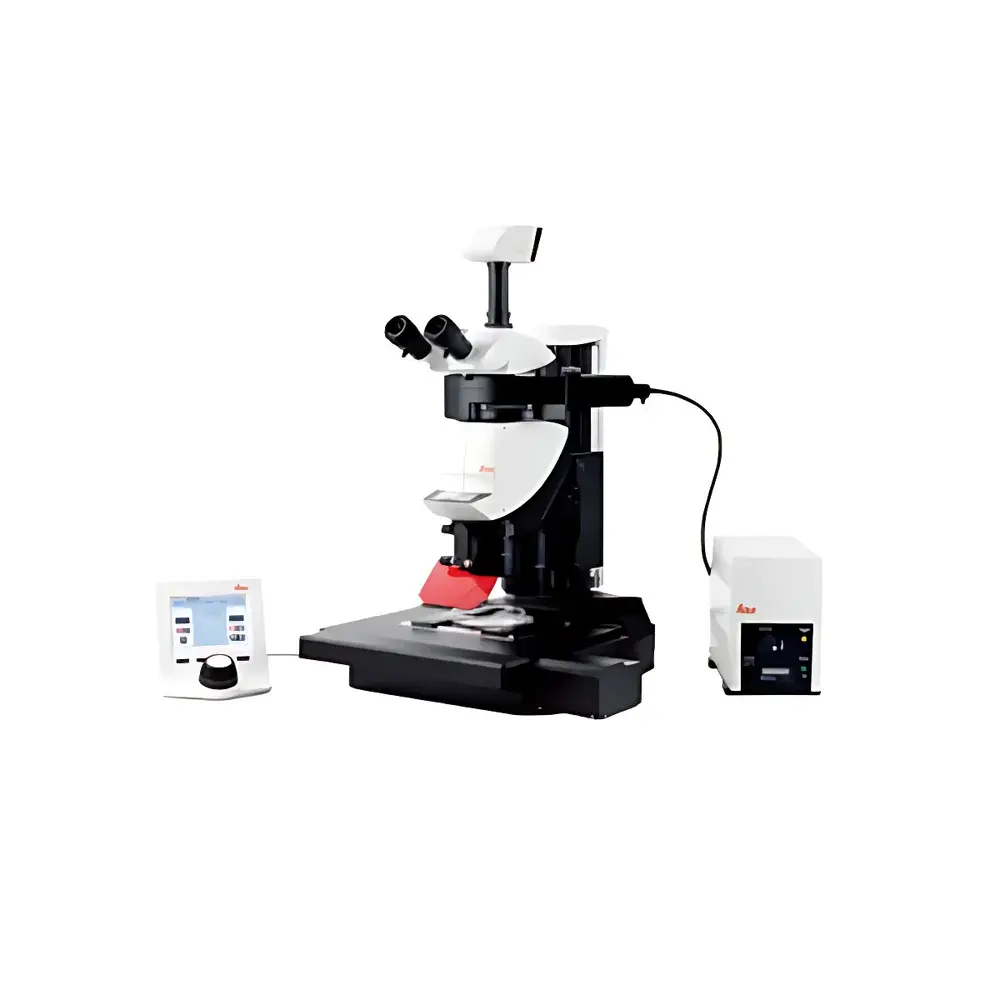
Leica M205A Motorized Stereo Microscope
| Brand | Leica |
|---|---|
| Origin | USA |
| Model | Leica M205A Motorized Stereo Microscope |
| Zoom Ratio | 20.5:1 (continuous and stepwise) |
| Standard Magnification Range | 7.8× – 160× |
| Resolution | Up to 1050 lp/mm |
| Working Distance (with 1× objective) | 61.5 mm |
| Optional Objectives | 0.5×, 0.63×, 0.8×, 1×, 1.6×, 2× |
| Optional Eyepieces | 10×, 16×, 25×, 40× |
Overview
The Leica M205A Motorized Stereo Microscope is an advanced, research-grade stereomicroscope engineered for high-precision visual inspection, documentation, and analytical workflows in life science, materials science, electronics manufacturing, and quality assurance laboratories. Built upon Leica Microsystems’ proprietary FusionOptics optical architecture, the M205A simultaneously optimizes resolution and depth of field—overcoming the classical trade-off between these two critical imaging parameters. This is achieved through a dual-path optical design that delivers true 3D perception without compromise: one beam path is optimized for maximum resolution, while the other is tuned for extended depth of field; the human visual system or digital sensor fuses both signals into a single, spatially coherent image. The system operates on a fully apochromatic optical pathway, eliminating chromatic aberration across the entire visible spectrum and ensuring faithful color reproduction and geometric fidelity in both visual observation and quantitative image analysis.
Key Features
- FusionOptics technology enables concurrent high-resolution (up to 1050 line pairs per millimeter) and large depth of field imaging—critical for inspecting complex topographies such as circuit boards, biological specimens, or fractured surfaces.
- 20.5:1 zoom ratio with continuous and stepwise magnification control; standard magnification range extends from 7.8× to 160× using the integrated 1× plan apochromat objective (working distance: 61.5 mm).
- Motorized zoom, focus, and iris diaphragm—fully programmable via Leica Application Suite (LAS X) software; supports repeatable recall of user-defined configurations including illumination intensity, magnification, and focus position.
- ESD-safe housing compliant with IEC 61340-5-1, with static discharge time < 2 seconds—essential for handling electrostatic-sensitive devices (ESDs) in semiconductor, microelectronics, and medical device assembly.
- Integrated dual adjustable diaphragm for independent control of contrast and depth of field; enables real-time optimization of optical sectioning and surface texture visualization.
- Parfocal objective turret accommodates up to six apochromatic objectives (0.5×–2×); objective change requires no refocusing—ensuring workflow continuity during multi-scale inspection.
- Auto-magnification recognition: when coupled with a Leica DFC camera, the system automatically detects current magnification and overlays the correct scale bar—supporting ISO/IEC 17025-compliant metrology reporting.
Sample Compatibility & Compliance
The Leica M205A accommodates diverse sample geometries—from sub-millimeter microcomponents to large industrial parts—thanks to its modular stage options (manual, motorized XY, transmitted-light base) and extensive working distance. Its optical design complies with DIN ISO 10934-1 for stereomicroscope performance verification and supports GLP/GMP-aligned documentation workflows when used with LAS X software’s audit-trail-enabled acquisition modules. The system meets IEC 61000-4-2 (ESD immunity), IEC 61340-5-1 (ESD protection), and CE/UL safety standards. Optional illumination configurations—including coaxial, ring, multi-contrast, and oblique lighting—facilitate ISO 9001-compliant visual inspection protocols across aerospace, automotive, and medical device manufacturing.
Software & Data Management
Controlled exclusively via Leica Application Suite (LAS X) v3.7+, the M205A integrates seamlessly into regulated environments requiring traceability and data integrity. LAS X provides FDA 21 CFR Part 11-compliant user management, electronic signatures, and immutable acquisition logs—including timestamped metadata for magnification, exposure, illumination settings, and objective selection. Image stacks, Z-series acquisitions, and multi-channel composites are stored in TIFF or Leica’s proprietary LIF format, supporting downstream analysis in third-party platforms (e.g., ImageJ/Fiji, MATLAB). Exported reports include embedded calibration certificates and scale bar metadata—enabling direct inclusion in ISO/IEC 17025 test reports or regulatory submissions.
Applications
- Microelectronics: solder joint inspection, PCB defect analysis, wire bonding verification, and flip-chip alignment under variable contrast illumination.
- Life Sciences: dissection of model organisms, embryo manipulation, histology slide screening, and live-cell observation with minimal phototoxicity.
- Materials Characterization: fracture surface analysis, coating uniformity assessment, particle morphology evaluation, and additive manufacturing part qualification.
- Forensics & Document Examination: ink differentiation, fiber analysis, latent print enhancement, and security feature verification.
- Quality Control: incoming inspection of precision machined parts, medical device component validation, and packaging integrity assessment per ASTM E2923 and ISO 10934-2.
FAQ
Does the Leica M205A support automated Z-stacking and extended depth of field (EDF) reconstruction?
Yes—when paired with LAS X software and a compatible motorized focus drive, the system performs synchronized Z-stack acquisition and real-time EDF synthesis using Leica’s proprietary algorithms.
Is the M205A compatible with third-party cameras and image analysis software?
It supports industry-standard USB 3.0 and GigE Vision cameras via TWAIN/DirectShow drivers; exported TIFF files retain full metadata for interoperability with MATLAB, Python (OpenCV), and commercial metrology suites.
Can the illumination be controlled programmatically during automated workflows?
Yes—LAS X allows full scripting of illumination parameters (intensity, mode, polarization) alongside zoom, focus, and stage movement—enabling unattended batch inspection sequences.
What calibration documentation is provided for metrological use?
Each system ships with a factory-verified calibration certificate traceable to NIST standards, covering magnification accuracy, resolution verification (per ISO 10934-1 Annex B), and ESD performance validation.
How does FusionOptics differ from conventional stereo microscope optics?
Unlike traditional Greenough or Common Main Objective (CMO) designs, FusionOptics uses two independent optical paths with distinct aberration corrections—delivering simultaneous high resolution and deep focus without computational post-processing or focus stacking.





