
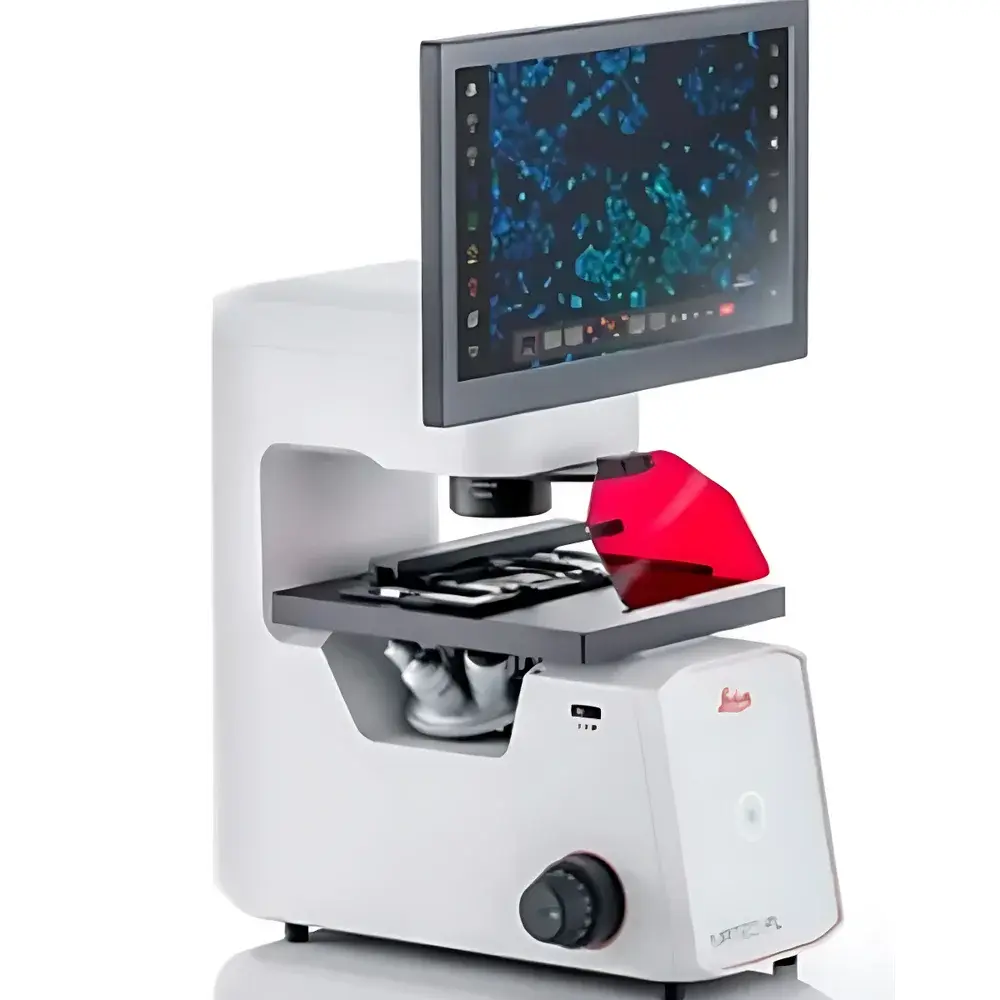
Leica Mateo FL Digital Inverted Fluorescence Microscope
| Brand | Leica |
|---|---|
| Origin | Germany |
| Model | Mateo FL |
| Imaging Modes | Phase Contrast, Brightfield, Fluorescence |
| Camera System | Integrated Dual-Camera (Monochrome + Color) |
| Sterilization Compatibility | UV, 70% Ethanol, Hydrogen Peroxide |
| Biosafety Level Support | BSL-1 and BSL-2 |
| Compliance | FDA 21 CFR Part 11 (Audit Trail & User Management) |
| Onboard Storage | 500 GB (≈3 million images) |
| AI-Powered Features | Confluence Detection, Cell Counting (5 s), Transfection Optimization, Smart Insights |
Overview
The Leica Mateo FL is a purpose-engineered digital inverted fluorescence microscope designed for advanced live-cell culture monitoring and quantitative cell biology workflows in regulated and non-regulated laboratory environments. Built upon Leica Microsystems’ legacy of optical precision and modular reliability, the Mateo FL integrates dual-path optical imaging—simultaneous monochrome high-sensitivity fluorescence detection and full-color brightfield/phase contrast acquisition—within a single, compact benchtop platform. Its core measurement principle relies on transmitted-light contrast enhancement (phase contrast and brightfield) combined with epi-fluorescence excitation using LED-based, multi-band illumination optimized for common fluorophores (e.g., DAPI, FITC, TRITC, Cy5). Unlike conventional inverted microscopes requiring manual camera swaps or external image capture systems, the Mateo FL employs a fixed, co-aligned dual-camera architecture that eliminates mechanical realignment, minimizes parallax error, and ensures pixel-registered multimodal correlation across all imaging modes.
Key Features
- Integrated dual-camera system: Simultaneous acquisition of monochrome fluorescence and color brightfield/phase contrast images without optical reconfiguration or hardware intervention.
- Automated phase contrast optimization: Real-time, software-driven phase ring alignment and contrast adjustment for unstained, low-contrast, or semi-transparent specimens—including primary cells, organoids, and stem cell colonies.
- AI-accelerated quantification suite: Validated algorithms for confluence estimation (±3% deviation vs. manual ground truth), automated cell counting (completed in ≤5 seconds per field-of-view), and transfection efficiency prediction based on morphological and intensity metrics.
- BSL-1/BSL-2 compatible decontamination: Full surface compatibility with UV-C irradiation (254 nm), 70% ethanol wipe-down, and vaporized hydrogen peroxide (VHP) protocols—enabling safe operation inside laminar flow hoods or biosafety cabinets without instrument relocation.
- FDA 21 CFR Part 11–compliant data governance: Role-based user authentication, immutable audit trail logging (including image metadata, parameter changes, and user actions), electronic signatures, and automatic timestamping of all acquisitions and analyses.
- Barcode and QR code integration: Direct sample ID association via USB barcode scanner; one-tap export of annotated images and reports to mobile devices or LIMS via encrypted QR code handshake.
Sample Compatibility & Compliance
The Mateo FL supports standard tissue culture formats including 6–96-well plates, Petri dishes (35 mm, 60 mm, 100 mm), T-flasks (T25, T75, T175), and chambered coverslips—all imaged directly within incubator-compatible stage inserts or under ambient conditions. Its optical path is calibrated for use with common growth media (e.g., DMEM, RPMI-1640) and standard cover glass thicknesses (No. 1.5H, 0.17 mm). The system meets ISO 13485 design control principles for medical device-associated research instrumentation and aligns with GLP/GMP documentation requirements through its embedded audit trail, electronic record retention, and user-access restriction framework. No third-party validation kits are required for basic compliance verification.
Software & Data Management
Leica Application Suite X (LAS X) Core software provides unified control of illumination, focus, stage movement, camera acquisition, and AI analytics. All processing occurs locally on the integrated industrial-grade computing module—no cloud dependency or external server infrastructure is needed. Raw image data (TIFF, JPEG2000) and analysis logs are stored in a tamper-evident database with SHA-256 hashing. Export options include DICOM-SR for integration into PACS environments, CSV/Excel for statistical packages (e.g., GraphPad Prism, R), and PDF report generation with embedded metadata (acquisition time, objective used, exposure settings, user ID). The 500 GB onboard SSD supports continuous acquisition at up to 30 fps (monochrome) or 15 fps (color) for time-lapse experiments spanning >72 hours without external storage intervention.
Applications
- Long-term live-cell monitoring of adherent and suspension cultures under controlled environmental conditions.
- Quantitative assessment of confluence dynamics during passaging, differentiation, or drug treatment studies.
- Validation of CRISPR/Cas9 editing efficiency via fluorescent reporter expression kinetics.
- High-content screening of transfection reagents using morphology-intensity correlation models.
- Documentation and archiving of master cell bank vials in accordance with ICH Q5D and USP guidelines.
- Teaching and training in academic core facilities where reproducibility, ease of use, and regulatory readiness are prioritized.
FAQ
Does the Mateo FL support oil immersion objectives?
No—the Mateo FL is optimized for air and dry objectives (4× to 63×) used in routine cell culture observation; it does not accommodate oil-immersion lenses due to ergonomic and contamination-control design constraints.
Can third-party analysis plugins be loaded into LAS X Core?
Only Leica-certified modules are supported; custom Python or MATLAB scripts cannot be executed within the validated software environment to maintain 21 CFR Part 11 integrity.
Is remote access to the microscope possible?
Yes—via secure TLS-encrypted web interface for status monitoring and scheduled acquisition, though real-time interactive control requires local network presence for latency-sensitive operations.
What fluorescence filter sets are included by default?
The standard configuration includes a triple-band set (DAPI/FITC/TRITC) and a Cy5-optimized single-band set; additional sets can be ordered as field-installable modules.
How frequently must the system be recalibrated for confluence analysis?
Calibration is performed once during installation and remains stable for ≥12 months under normal usage; annual verification using Leica’s NIST-traceable calibration slide is recommended for GxP environments.



