
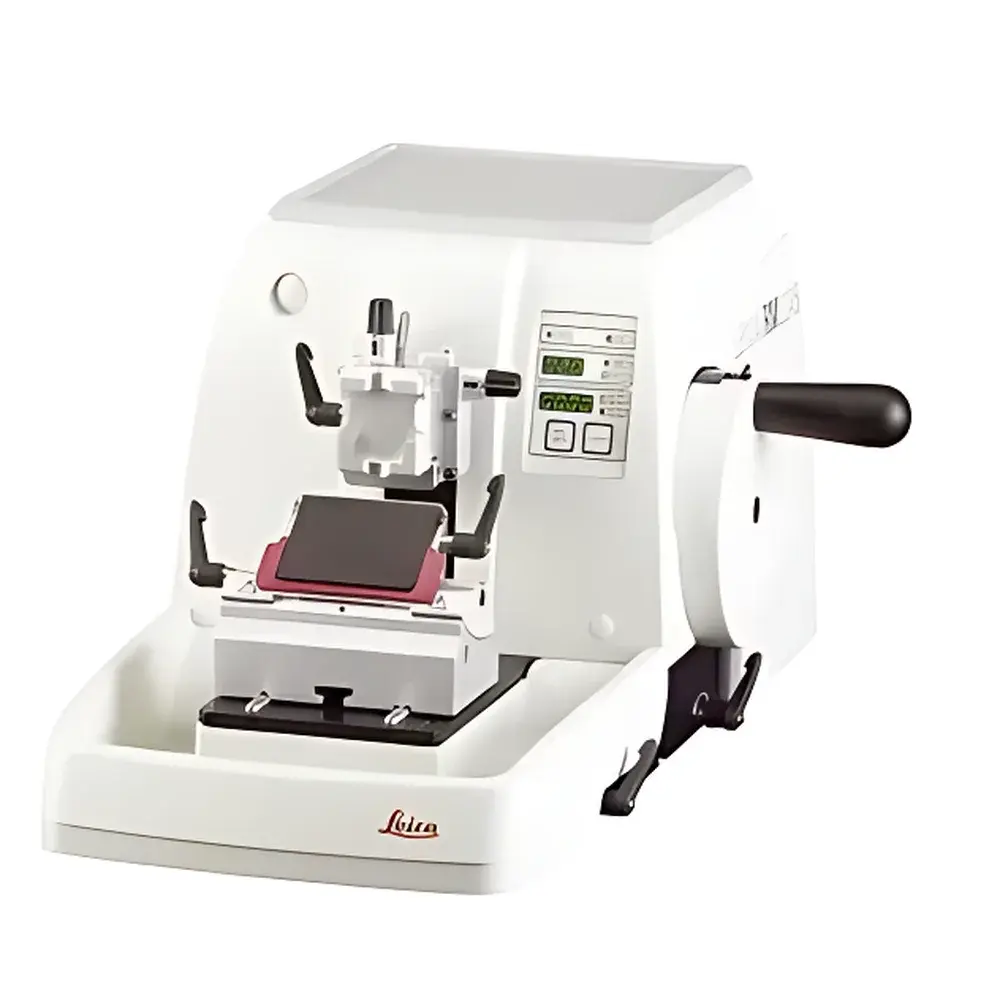
Leica RM2245 Semi-Automatic Rotary Microtome
| Origin | Germany |
|---|---|
| Manufacturer Type | Authorized Distributor |
| Origin Category | Imported |
| Model | RM2245 |
| Pricing | Upon Request |
Overview
The Leica RM2245 is a semi-automatic rotary microtome engineered for high-fidelity sectioning of paraffin-embedded, frozen, and resin-embedded biological and industrial specimens in routine histopathology, quality assurance laboratories, and academic research settings. It operates on the fundamental principle of precision-controlled vertical specimen advancement combined with manual or semi-automated handwheel-driven knife traversal—leveraging classical rotary microtomy mechanics while integrating modern motion control to enhance reproducibility without compromising operator tactile feedback. Unlike fully motorized systems, the RM2245 retains full manual control over cutting stroke initiation and speed, making it particularly suited for experienced technicians who require intuitive kinesthetic input during delicate sectioning tasks—such as serial sectioning for immunohistochemistry, neural tissue mapping, or hard-material embedding blocks.
Key Features
- Stepper Motor–Driven Specimen Advancement: A closed-loop stepper motor delivers precise, repeatable section thickness control from 0.5 µm to 100 µm in 0.5 µm increments, ensuring consistency across batches and compatibility with sensitive downstream staining protocols including H&E, PAS, and multiplex IHC.
- 70 mm Vertical Stroke Range: Enables handling of oversized embedding cassettes (up to 45 × 45 mm) and provides ample clearance between specimen surface and blade edge—reducing risk of accidental contact during cassette exchange and facilitating safer, more ergonomic workflow in high-throughput labs.
- Adjustable Handwheel Balance System: A patented counterbalance mechanism eliminates gravitational sag of the specimen head when the handwheel is released mid-stroke, preventing uncontrolled descent onto the knife and preserving both sample integrity and blade longevity.
- Dual-Mode Cutting Operation: Supports traditional full-rotation handwheel mode for maximum control, as well as “half-cut” short-stroke mode (±15° handwheel displacement), allowing rapid, fatigue-reduced sectioning of serial ribbons or fragile sections.
- Modular Precision Positioning System (Optional): The 8° X/Y mechanical stage offers calibrated fine-positioning capability with dual red reference markers at zero position—enabling accurate re-localization of previously cut surfaces for recutting, block face trimming, or targeted region-of-interest sectioning.
Sample Compatibility & Compliance
The RM2245 accommodates standard histological cassettes (e.g., Leica HistoCore BIOCUT-compatible formats), metal-reinforced blocks, and composite industrial samples—including polymer composites, ceramics, and metallurgical mounts—when paired with appropriate knife types (disposable steel, tungsten carbide, or diamond). Its mechanical architecture conforms to ISO 13485 design principles for medical device manufacturing infrastructure, and its operational documentation supports GLP-compliant recordkeeping when integrated into validated laboratory workflows. While not intrinsically 21 CFR Part 11–compliant (as it lacks embedded electronic audit trail functionality), the system is compatible with external LIMS or ELN platforms via standardized data export (CSV, XML) from optional digital readout modules.
Software & Data Management
The RM2245 operates as a standalone electromechanical instrument without onboard firmware or touchscreen interface. Section thickness settings, stroke count, and positioning offsets are manually recorded or logged externally. Optional accessories—including the Leica DM6000 B upright microscope and Leica Application Suite (LAS X) software—enable synchronized image capture and metadata tagging of sectioned specimens. For regulated environments, users may implement procedural SOPs requiring manual entry of section parameters into electronic lab notebooks, with timestamped entries traceable to individual operators per ISO/IEC 17025 and CAP accreditation requirements.
Applications
- Routine diagnostic histology in clinical pathology labs performing H&E and special stain preparation.
- Preclinical research involving serial sectioning of rodent brain, spinal cord, or tumor xenografts for 3D reconstruction.
- Industrial QA/QC of coated substrates, laminated composites, and sintered metal parts where layer thickness uniformity must be verified microscopically.
- Teaching laboratories emphasizing hands-on microtomy technique development under expert supervision.
- Forensic tissue analysis requiring morphologically intact sections for subsequent DNA/RNA extraction post-staining.
FAQ
Is the RM2245 suitable for cryosectioning?
Yes—the instrument supports cryo-adapted specimen holders and can be operated inside refrigerated rooms (4–10°C) when used with low-temperature blades and anti-static accessories.
Can section thickness be changed during an ongoing cutting session?
Yes—thickness adjustments are made via a calibrated micrometer dial and take effect immediately upon next stroke, enabling real-time optimization without resetting the block orientation.
Does the RM2245 include knife alignment assistance?
It features a built-in knife angle indicator and adjustable knife holder tilt (0–5°), but does not incorporate laser-assisted alignment; alignment is performed manually using the Leica Knife Alignment Tool (sold separately).
What maintenance intervals are recommended?
Daily cleaning of the specimen chuck and knife holder, biweekly lubrication of the feed screw assembly, and annual calibration of the stepper motor encoder by authorized Leica service personnel.
Is training provided with purchase?
Leica Microsystems offers on-site or virtual operator certification courses covering safe operation, troubleshooting, and compliance documentation practices—delivered by certified histotechnology specialists.



