
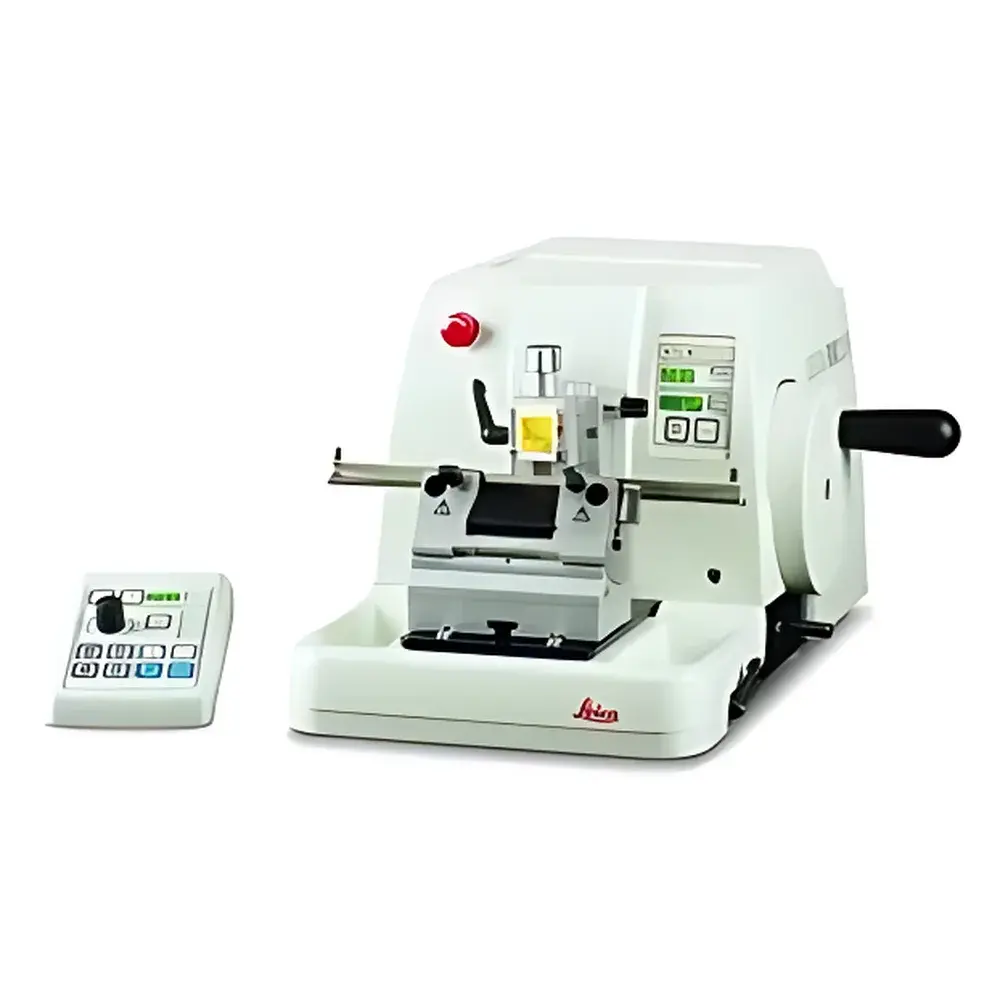
Leica RM2265 Fully Automatic Rotary Microtome
| Origin | Germany |
|---|---|
| Manufacturer Type | Authorized Distributor |
| Origin Category | Imported |
| Model | RM2265 |
| Pricing | Available Upon Request |
Overview
The Leica RM2265 is a fully automatic, programmable rotary microtome engineered for high-precision sectioning of biological, biomedical, and industrial specimens across a broad hardness spectrum—from rigid paraffin-embedded tissues to semi-firm cryogenic samples. Designed and manufactured in Germany under stringent ISO 13485-certified quality systems, the RM2265 operates on classical rotary microtomy principles: a precisely controlled vertical specimen advance mechanism engages with a horizontally oscillating knife holder to produce consistent, distortion-free sections. Its architecture integrates mechanical stability, thermal inertia management, and ergonomic engineering to support reproducible sectioning at thicknesses ranging from 0.5 µm to 100 µm—making it suitable for routine histopathology, advanced research microscopy (e.g., serial block-face SEM preparation), and materials science QA/QC workflows requiring structural integrity assessment.
Key Features
- Constant-Speed Sectioning Motor: A brushless DC motor delivers stable, programmable cutting velocity (0.05–12 mm/s) and consistent feed force—minimizing chatter, compression artifacts, and knife-edge wear while reducing operator fatigue and mitigating occupational risk of repetitive strain injury (RSI) per EU Directive 2002/44/EC.
- 8° X/Y Precision Positioning System (Optional): Motorized stage with calibrated micrometric adjustment enables accurate repositioning for recutting or serial sectioning. After relocation, the system auto-returns to a factory-referenced zero position marked by dual red alignment indicators—ensuring traceable positional repeatability within ±1.5 µm.
- 70 mm Vertical Specimen Travel: Accommodates oversized embedding cassettes (up to 60 × 40 mm) and provides ample clearance between specimen surface and knife edge—enhancing safety during cassette exchange and minimizing accidental blade contact.
- Universal Knife Compatibility: Supports standard glass knives (including triangular and Ralph-type geometries) as well as industrial-grade diamond knives for semi-thin (0.5–2 µm) and ultra-thin (≤70 nm) sectioning—enabling seamless transition between light microscopy, TEM sample prep, and polymer/metallographic analysis.
- Cryo-Integration Ready: Fully compatible with the Leica LN22 liquid nitrogen cooling system for cryosectioning down to –150 °C—enabling preservation of labile epitopes, lipid structures, and crystalline phases without chemical fixation or solvent exposure.
Sample Compatibility & Compliance
The RM2265 accepts specimens embedded in paraffin, epoxy, acrylic, and low-viscosity resins—including hard metals, ceramics, and composite laminates when prepared using vacuum infiltration protocols. It complies with IEC 61000-6-2 (EMC immunity) and IEC 61000-6-4 (EMC emissions), and meets essential health and safety requirements under the EU Machinery Directive 2006/42/EC. When operated in GLP- or GMP-regulated environments, its programmable parameters (section thickness, speed, trimming mode) support audit-ready documentation when paired with Leica Application Suite (LAS X) software and compliant LIMS interfaces.
Software & Data Management
Controlled via the intuitive Leica Microscope Control (LMC) interface, the RM2265 supports full parameter logging—including date/time stamps, user ID, section count, thickness setting, and motor status. Optional integration with LAS X enables automated protocol recall, remote diagnostics, and export of structured CSV metadata for traceability in FDA 21 CFR Part 11-compliant workflows. All firmware updates are delivered through Leica’s secure update portal, ensuring continued alignment with evolving cybersecurity standards (IEC 62443-3-3).
Applications
- Histopathology labs performing high-volume diagnostic sectioning of bone, calcified tissue, and decalcified specimens
- Academic core facilities supporting correlative light-electron microscopy (CLEM) and volume electron microscopy (vEM)
- Materials testing laboratories conducting failure analysis on turbine blades, battery electrodes, and fiber-reinforced polymers
- Pharmaceutical R&D units evaluating tablet coating uniformity and excipient dispersion via cross-sectional imaging
- Cryo-biobanking infrastructure requiring artifact-free sectioning of vitrified human tissue for spatial omics profiling
FAQ
Is the RM2265 compatible with third-party knife holders or only Leica-branded accessories?
The RM2265 uses a standardized knife clamp interface conforming to ISO 8598; however, optimal performance and warranty coverage require Leica-certified knife holders and alignment tools.
Can section thickness be adjusted during an ongoing cut cycle?
Yes—thickness parameters are dynamically modifiable via the touchscreen interface without interrupting the motorized advance sequence.
Does the RM2265 meet ISO/IEC 17025 requirements for accredited testing laboratories?
While the instrument itself is not certified to ISO/IEC 17025, its metrological stability, calibration traceability (via optional verification kit), and data logging capabilities support method validation and uncertainty estimation per ISO/IEC 17025 Clause 7.7.
What maintenance intervals are recommended for the precision lead screw and linear guides?
Leica recommends biannual inspection and lubrication of the Z-axis drive system by authorized service engineers, with full recalibration every 12 months or after 10,000 cutting cycles.



