
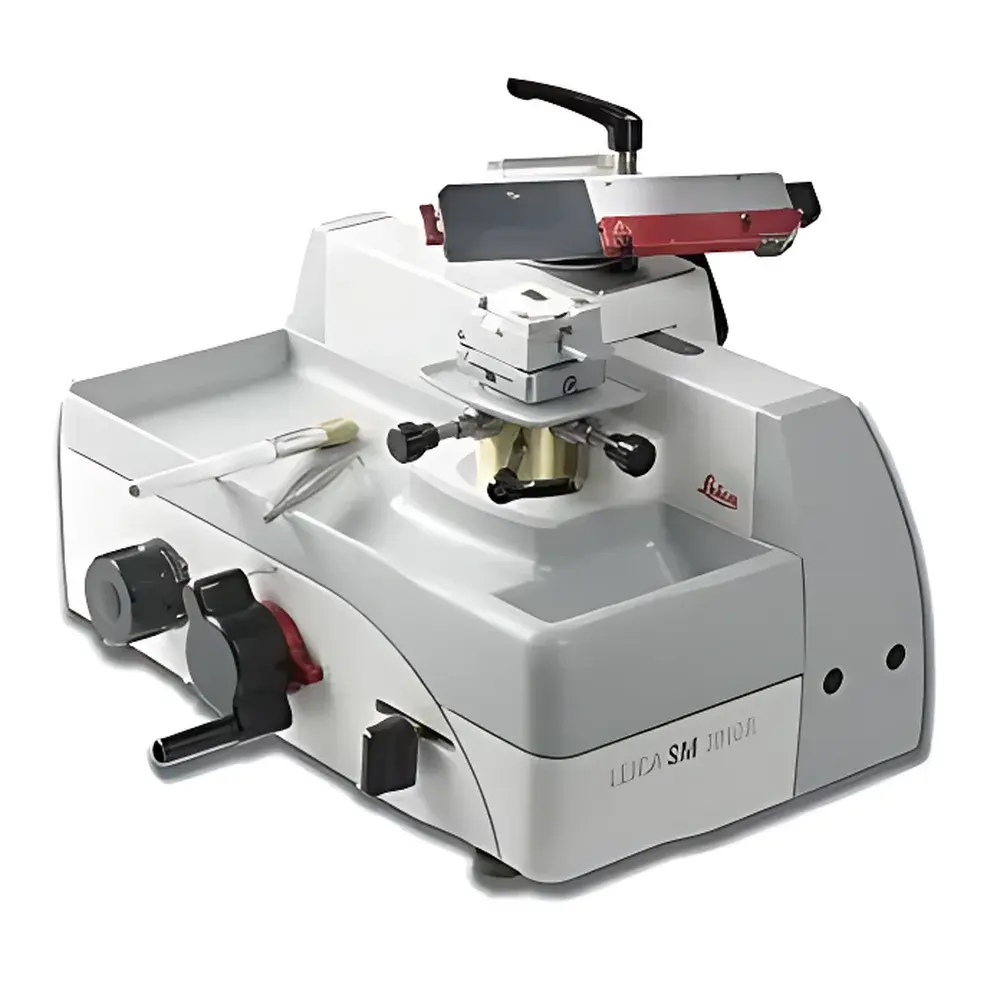
Leica SM2010 R Rotary Microtome
| Origin | Germany |
|---|---|
| Manufacturer Type | Authorized Distributor |
| Origin Category | Imported |
| Model | SM2010 R |
| Pricing | Upon Request |
Overview
The Leica SM2010 R is a high-precision rotary microtome engineered for consistent, reproducible sectioning of paraffin-embedded tissue, fixed-frozen neural specimens (e.g., rodent or primate brain), and heterogeneous industrial materials including polyurethane foams, wood composites, and polymer-based substrates. Its robust horizontal translational (sliding) stage architecture—distinct from vertical knife-motion designs—minimizes vertical vibration and ensures exceptional slice uniformity across the full specimen width. The instrument operates on classical rotary microtomy principles: the specimen advances vertically in precise increments (micrometer-controlled feed), while the knife remains stationary; the specimen block moves horizontally past the blade during each cutting stroke. This configuration delivers superior planarity control, reduced chatter artifacts, and enhanced long-term mechanical stability—critical for diagnostic histopathology labs, neuroscience core facilities, and materials QA/QC environments requiring GLP-compliant documentation.
Key Features
- Horizontally sliding specimen stage with 11-position mechanical lock: Enables rapid repositioning and repeatable alignment without manual recalibration; locks engage positively via tactile feedback and visual indicator.
- Enclosed micrometer feed mechanism: Fully sealed against dust and paraffin residue ingress; calibrated range 0.5–60 µm in 0.5 µm increments with vernier scale for sub-micron verification.
- Ergonomic sample head placement: Positioned at optimal height and proximity to operator (ISO 9241-5 compliant reach envelope), reducing wrist flexion and shoulder abduction during extended use.
- Quick-change specimen clamp system: Tool-free lever actuation allows exchange of standard brass, aluminum, or cryo-compatible clamps in <3 seconds—eliminating downtime between specimen types.
- Large anti-static waste tray (capacity: 1.2 L): Integrated static-dissipative polymer surface (surface resistivity: 10⁹–10¹¹ Ω/sq) prevents electrostatic adhesion of paraffin shavings; includes dedicated tool storage compartment with magnetic retention.
- Lateral blade-shift function: Motor-assisted 10 mm lateral displacement (±5 mm from center) extends usable blade edge length by up to 4×, reducing frequency of blade changes and consumables cost per section.
Sample Compatibility & Compliance
The SM2010 R accommodates specimen blocks up to 60 × 40 × 40 mm (W × D × H) and supports standard 25 × 40 mm and 30 × 50 mm knife holders (compatible with tungsten-carbide, stainless-steel, and disposable blades). It meets EN ISO 13857 (safety distances for machinery), EN 61000-6-3 (EMC emissions), and IEC 61000-6-2 (immunity) standards. For regulated environments, its mechanical repeatability (±0.2 µm over 1000 cuts, per internal Leica validation protocol) supports adherence to CAP/CLIA histology accreditation requirements and ASTM E2126-21 (standard practice for microtomy of biological tissues). No electronic data logging is embedded; however, manual logbooks or external LIMS integration satisfy FDA 21 CFR Part 11 audit-trail requirements when paired with documented SOPs.
Software & Data Management
The SM2010 R is a fully mechanical instrument with no onboard electronics, firmware, or digital interface. All operational parameters—including section thickness, number of sections, blade position offset, and stage lock index—are recorded manually in laboratory notebooks or imported into institutional LIMS via standardized templates. This design eliminates cybersecurity vulnerabilities, reduces maintenance complexity, and ensures uninterrupted operation in environments where electromagnetic interference (e.g., adjacent MRI suites or electrophysiology rigs) could compromise sensor-based systems. Calibration certificates for the micrometer feed are traceable to PTB (Physikalisch-Technische Bundesanstalt) standards upon request.
Applications
- Diagnostic Histopathology: Routine sectioning of formalin-fixed, paraffin-embedded (FFPE) human tissue biopsies for H&E and IHC staining; validated for lymph node, prostate, and breast carcinoma workflows per CAP checklist ANP.12540.
- Neuroscience Research: Serial sectioning of fixed-frozen murine, porcine, or non-human primate brain blocks (20–50 µm thickness) for Nissl staining, immunofluorescence, and subsequent slide-scanning digitization.
- Industrial Materials Science: Precision slicing of low-density polyurethane foams (ASTM D3574), hardwood cross-sections (ISO 3129), and composite laminates for SEM sample preparation and pore-structure analysis.
- Botanical & Forensic Labs: Sectioning of resin-infiltrated plant stems and charred wood fragments for anatomical identification under transmitted light microscopy.
FAQ
Does the SM2010 R support cryomicrotomy?
No—it is designed exclusively for room-temperature paraffin and fixed-frozen sections. For unfixed frozen tissue, Leica CM1950 or CM3050 S cryostats are recommended.
Is blade alignment automated?
No. Knife angle adjustment (dorsal tilt: 0–5°, lateral tilt: ±2°) is performed manually using precision-ground adjustment screws with locking nuts—ensuring long-term angular stability without drift.
Can it be integrated with automated staining platforms?
Yes. Standardized section thickness and ribbon consistency enable reliable pickup by Leica ST5010 or Sakura Tissue-Tek AutoStainer XL feed mechanisms.
What maintenance intervals are recommended?
Lubrication of the sliding stage rails and feed screw every 6 months (using Leica Microtome Grease #14045025); annual calibration verification by authorized service engineer.
Is training provided with purchase?
Yes—on-site installation qualification (IQ) and operator competency training (including safety protocols, clamp selection, and troubleshooting common chatter/artifact causes) are included in the standard delivery package.



