
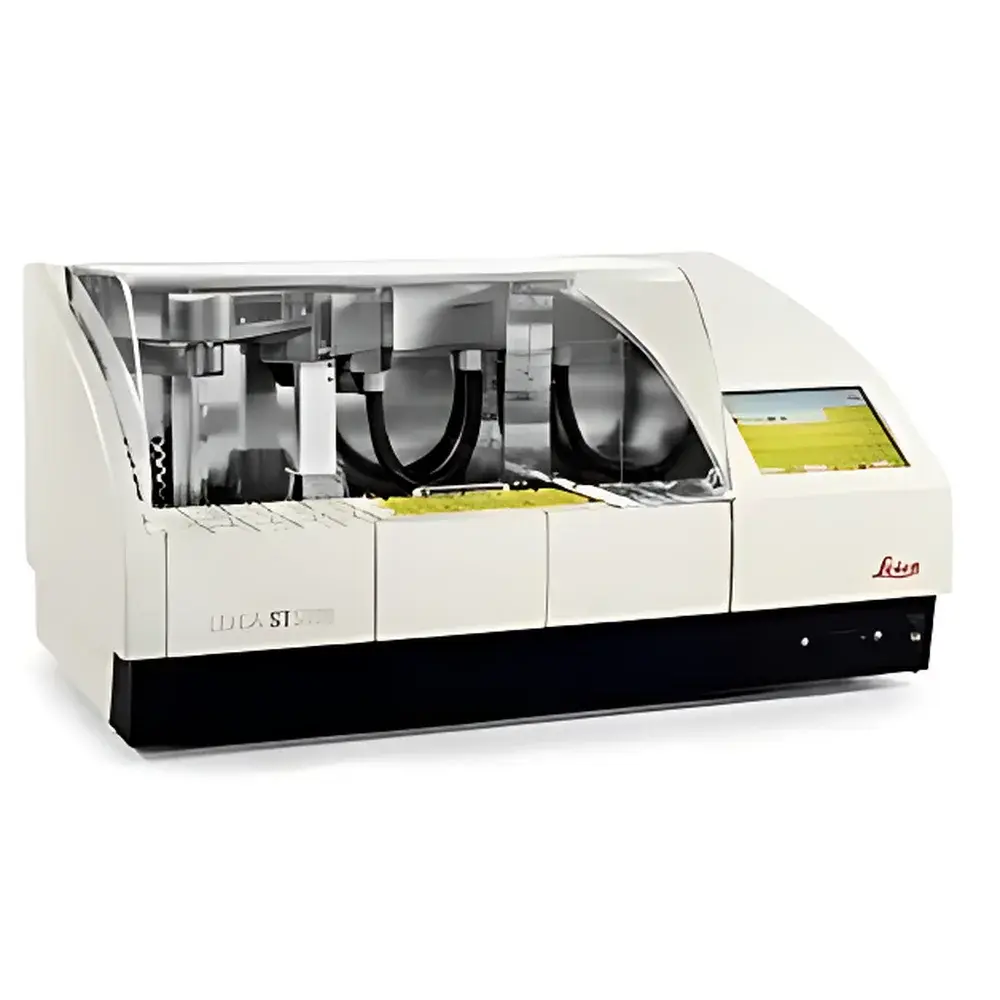
Leica ST5020 Advanced Integrated Staining and Coverslipping Workstation
| Brand | Leica |
|---|---|
| Origin | Germany |
| Model | ST5020 |
| Automation Level | Fully Automatic |
| Instrument Type | Rotary Stainer |
| Stations | 40 (incl. up to 4 optional oven stations and up to 6 rinse stations) |
| Water Savings | Up to 80% |
| Integrated Workflow | Compatible with Leica TS5025 Transfer Station and Leica CV5030 Coverslipper |
| Display | Corrosion-resistant large-color touchscreen |
| Rack Recognition | Leica Code-Rack™ RFID-based programmable rack identification system |
| Compliance | Designed for ISO 15189, CLIA, CAP, and GLP/GMP-aligned pathology laboratory environments |
Overview
The Leica ST5020 Advanced Integrated Staining and Coverslipping Workstation is a fully automated, rotary-format tissue and cytology stainer engineered for high-throughput, reproducible histopathological processing in clinical and research laboratories. It operates on a precisely controlled rotational platform where reagent baths, incubation zones, and rinsing modules are arranged in a circular configuration—ensuring consistent dwell times, uniform temperature distribution, and minimal carryover between steps. Unlike legacy batch stainers, the ST5020 integrates programmable rack-level protocol assignment via Leica’s proprietary Code-Rack™ technology, enabling concurrent execution of multiple staining protocols—including routine H&E, special stains (e.g., PAS, Masson’s Trichrome), immunohistochemistry (IHC) pretreatment modules, and cytological Papanicolaou (Pap) staining—without manual intervention or cross-program interference. Its architecture supports seamless handoff to downstream automation, including direct interfacing with the Leica TS5025 Transfer Station and Leica CV5030 Coverslipper, forming a validated end-to-end workflow for glass-slide preparation compliant with CAP checklist ANP.40500 and ISO 15189:2022 requirements for pre-analytical standardization.
Key Features
- Fully automated rotary staining platform with 40 configurable stations—including up to 4 programmable oven modules (temperature range: ambient to 75°C) and up to 6 dedicated rinse stations with flow-controlled deionized water delivery.
- Leica Code-Rack™ RFID-enabled rack recognition system: each stained slide rack carries an embedded code that auto-loads the correct staining protocol, eliminating operator-dependent programming errors and ensuring traceability per rack.
- Corrosion-resistant 10.4-inch color TFT touchscreen interface with intuitive icon-driven navigation, multi-language support (EN/DE/FR/ES), and real-time status monitoring of reagent levels, temperature stability, and cycle progress.
- Water conservation architecture: intelligent rinse sequencing, recirculation-assisted wash cycles, and pressure-sensing valve control reduce total water consumption by up to 80% compared to conventional stainers—validated per ISO 14040 life cycle assessment methodology.
- Modular reagent management: standardized 1-L and 2-L reagent bottles with integrated level sensors; optional barcode scanning for reagent lot tracking and expiration date enforcement aligned with FDA 21 CFR Part 11 audit trail requirements.
Sample Compatibility & Compliance
The ST5020 accommodates standard 1″ × 3″ (25 × 75 mm) glass microscope slides in Leica-compatible metal or plastic racks (up to 36 slides/rack). It supports paraffin-embedded tissue sections (3–5 µm), frozen sections, cytology smears, and liquid-based cytology (LBC) preparations. All fluid pathways are constructed from chemically inert PTFE, PVDF, and stainless-steel 316 components to withstand aggressive reagents including xylene substitutes, acid hematoxylin, lithium carbonate bluing solutions, and enzymatic antigen retrieval buffers. The system is CE-marked under IVDR 2017/746 Annex II Class B and complies with IEC 61010-1 for laboratory equipment safety. Validation documentation includes IQ/OQ/PQ templates supporting CAP accreditation, CLIA certification, and EU MDR-aligned quality system integration.
Software & Data Management
Controlled by Leica Application Suite (LAS X) Core v4.13 firmware, the ST5020 provides full audit trail functionality—including user login/logout timestamps, protocol modification history, reagent usage logs, and error event reporting—with encrypted local storage and optional DICOM-SR export for LIS/PACS integration. Software supports method versioning, electronic signature capture (21 CFR Part 11 compliant), and customizable report generation (PDF/CSV) for QA/QC review. Remote diagnostics via secure TLS 1.2 connection enable proactive service intervention without compromising network integrity.
Applications
- Routine diagnostic H&E staining in high-volume surgical pathology labs
- Special stain workflows requiring precise timing and thermal control (e.g., reticulin, silver impregnation, mucin detection)
- IHC pretreatment harmonization—including heat-induced epitope retrieval (HIER) and protease digestion modules
- Cytology laboratories performing dual-stain Pap tests and HPV mRNA assays
- Research core facilities requiring SOP-standardized staining across multi-investigator studies
FAQ
Can the ST5020 run different staining protocols simultaneously?
Yes—the Code-Rack™ system enables independent protocol execution per rack, allowing concurrent H&E, trichrome, and IHC runs within a single cycle.
Is the system compatible with non-Leica coverslippers?
While optimized for Leica CV5030 integration via TS5025, mechanical and data interface specifications (RS-232, Modbus TCP) permit third-party integration with engineering validation.
What reagent compatibility testing has been performed?
Leica validates performance with all major vendor reagents meeting ASTM E2917-20 standards for histological stain reproducibility, including Dako, Ventana, Agilent, and Sigma-Aldrich formulations.
How is temperature uniformity maintained across oven stations?
Each oven station incorporates dual PID-controlled heating elements and NTC thermistors calibrated to ±0.3°C accuracy, with real-time deviation alerts triggered at >±0.8°C.
Does the ST5020 support GLP-compliant archiving?
Yes—full electronic records, including raw sensor data, user actions, and environmental logs, are retained for ≥10 years per configurable retention policy and exportable in PDF/A-2b format.




