
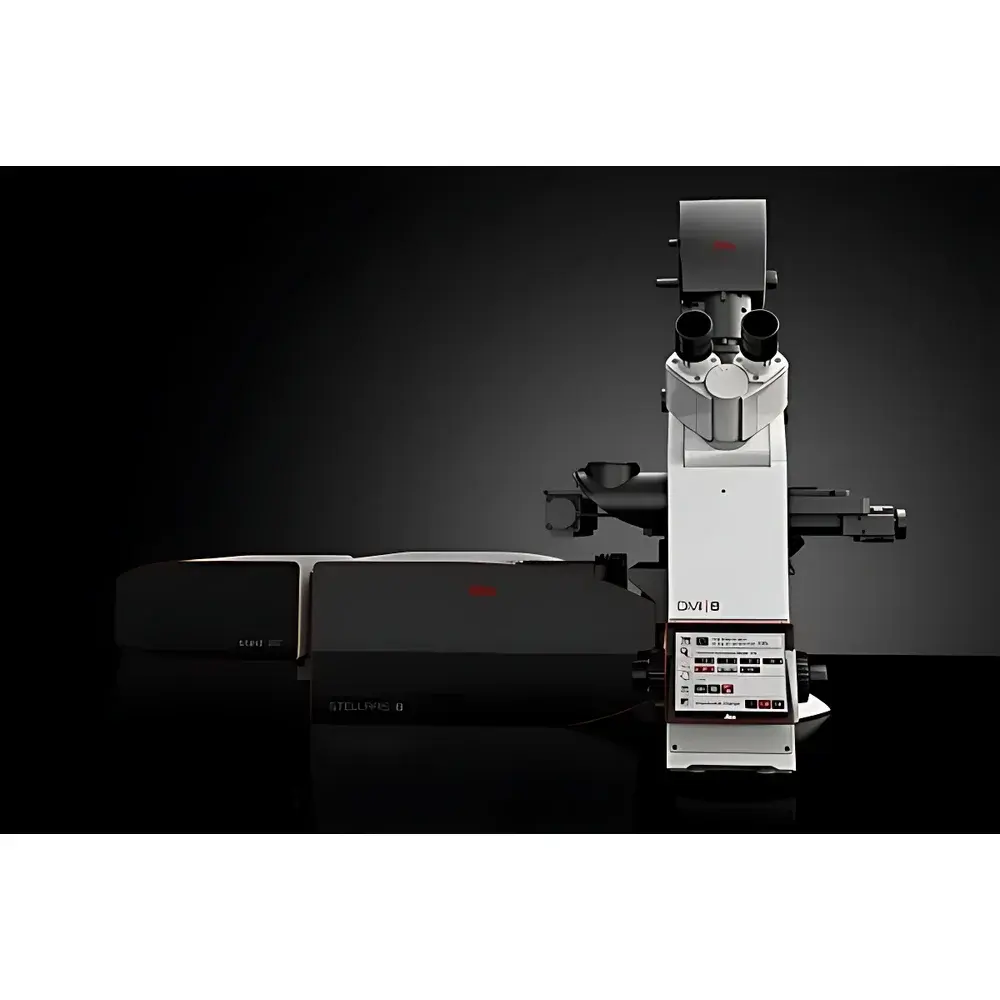
Leica STELLARIS STED Super-Resolution Confocal Microscope
| Brand | Leica |
|---|---|
| Country of Origin | Germany |
| Model | STELLARIS STED |
| Excitation Wavelength Range | 440–790 nm (White Light Laser) |
| STED Depletion Wavelengths | 592 nm, 660 nm, 775 nm |
| Spatial Resolution | <30 nm (lateral), <100 nm (axial), sample- and fluorophore-dependent |
| Detection | Up to 5 spectral Power HyD detectors with 1.5 ns system dead time |
| Objective Options | STED WHITE 100× oil, 93× glycerol (motCORR), 86× water (motCORR) |
Overview
The Leica STELLARIS STED is an integrated super-resolution confocal microscope engineered for quantitative nanoscale imaging in native biological environments. Built upon Leica’s second-generation White Light Laser (WLL) and Acousto-Optical Beam Splitter (AOBS) platform, it combines high-sensitivity confocal microscopy with stimulated emission depletion (STED) nanoscopy—enabling true diffraction-unlimited resolution without reliance on single-molecule localization or post-acquisition reconstruction. The system operates on the physical principle that a focused excitation beam is co-aligned with a spatially donut-shaped STED depletion beam; fluorophores at the periphery of the focal spot are forced into a non-fluorescent ground state, effectively shrinking the effective point spread function (PSF). This deterministic, real-time optical narrowing delivers sub-30 nm lateral and sub-100 nm axial resolution—validated across fixed and live specimens using standard organic dyes and fluorescent proteins. Unlike stochastic super-resolution methods, STELLARIS STED provides deterministic, frame-by-frame quantitative intensity data suitable for kinetic modeling, colocalization analysis, and longitudinal monitoring of dynamic cellular processes.
Key Features
- Integrated dual-mode operation: seamless switching between high-speed confocal, LIGHTNING deconvolution-enhanced imaging, and STED nanoscopy—all within a single acquisition session.
- TauSTED Xtend technology: leverages fluorescence lifetime gradients induced by STED depletion to discriminate signal photons from background, enabling resolution enhancement at significantly reduced laser intensities—critical for prolonged live-cell timelapse experiments.
- Multi-line STED capability: three independently tunable depletion wavelengths (592 nm, 660 nm, 775 nm) support simultaneous or sequential multicolor nanoscopy with minimal crosstalk.
- Power HyD hybrid detectors: up to five spectrally resolved detectors with 1.5 ns system dead time, delivering >10× higher photon collection efficiency per pixel compared to conventional APDs—essential for low-dose, high-fidelity STED acquisition.
- STED-optimized optics: proprietary STED WHITE objective series (100× oil, 93× glycerol, 86× water), each incorporating motCORR motorized correction collars for adaptive compensation of spherical aberration arising from refractive index mismatches, temperature drift, or sample heterogeneity.
- FALCON-enabled FLIM-STED fusion: combines time-resolved fluorescence lifetime imaging with STED to resolve spectrally overlapping fluorophores (e.g., far-red emitting dyes) based on intrinsic lifetime signatures—eliminating the need for spectral unmixing assumptions.
Sample Compatibility & Compliance
The STELLARIS STED is validated for use with adherent and suspension mammalian cells, primary neurons, tissue sections (cryo- and paraffin-embedded), organoids, and cleared whole-mount specimens. Its low phototoxicity profile—enabled by TauSTED and optimized WLL power management—supports long-term (>30 min) 4D nanoscale timelapse of mitosis, vesicular trafficking, and cytoskeletal remodeling. All hardware and LAS X software comply with ISO 13485 design controls and support full traceability under GLP and GMP workflows. Audit trails, electronic signatures, raw data immutability, and configurable user permissions meet FDA 21 CFR Part 11 requirements for regulated preclinical research environments.
Software & Data Management
LAS X software serves as the unified control and analysis environment—providing instrument control, real-time TauSTED optimization, automated dye-excitation matching, and ImageCompass-guided experimental setup. Raw photon arrival time stamps are preserved in HDF5 format with full metadata (laser powers, dwell times, detector gains, objective corrections). Quantitative analysis modules include colocalization (Manders’ coefficients), intensity distribution profiling, 3D surface rendering, and FLIM decay fitting (biexponential, phasor analysis). Batch processing pipelines support reproducible analysis across multi-condition datasets. Export formats include OME-TIFF, N5, and MATLAB-compatible structures—ensuring interoperability with open-source tools (e.g., BigStitcher, Napari, Fiji).
Applications
- Nanoscale mapping of synaptic protein organization in primary neuronal cultures.
- Real-time tracking of clathrin-coated pit maturation and scission dynamics at <30 nm resolution.
- Multicolor STED-FLIM quantification of protein–protein interactions via Förster resonance energy transfer (FRET) in live stem cell colonies.
- 3D ultrastructural analysis of nuclear pore complex distribution in interphase vs. mitotic nuclei.
- Longitudinal monitoring of mitochondrial cristae remodeling during apoptosis using low-dose TauSTED timelapse.
- Correlative light-electron microscopy (CLEM) workflows: STED coordinates directly exported to EM stage controllers for targeted ultramicrotomy.
FAQ
What is the minimum required fluorophore brightness for reliable TauSTED imaging?
TauSTED performance depends on fluorophore photostability and depletion cross-section—not absolute brightness. Dyes such as ATTO 647N, Abberior STAR RED, and CF®680 exhibit optimal TauSTED response due to high STED saturation efficiency and long excited-state lifetimes.
Can STELLARIS STED be upgraded to include FCS or FALCON modules post-purchase?
Yes. The STELLARIS 8 STED configuration supports field-installable upgrades to FCS (fluorescence correlation spectroscopy) and FALCON (fluorescence lifetime analysis) modules without hardware replacement—leveraging the same optical path and detector infrastructure.
Is STED WHITE 86× water objective suitable for long-term imaging of sensitive organoids?
Yes. Its motCORR correction collar dynamically compensates for thermal drift and refractive index shifts over hours, while the water immersion design minimizes mechanical stress and photodamage—making it ideal for gentle, high-resolution organoid imaging.
How does TauSTED improve quantitative accuracy compared to intensity-based STED?
By gating detection based on lifetime thresholds, TauSTED rejects out-of-focus and scattered photons intrinsically—preserving linear intensity response and eliminating the need for empirical background subtraction or deconvolution artifacts.
Does LAS X software support batch processing of STED z-stacks for morphometric analysis?
Yes. The LAS X Analysis Module includes scriptable batch workflows for segmentation, skeletonization, volume rendering, and statistical export—fully compatible with STED-acquired 3D datasets and compliant with MIAME/MINSEQE reporting standards.



