
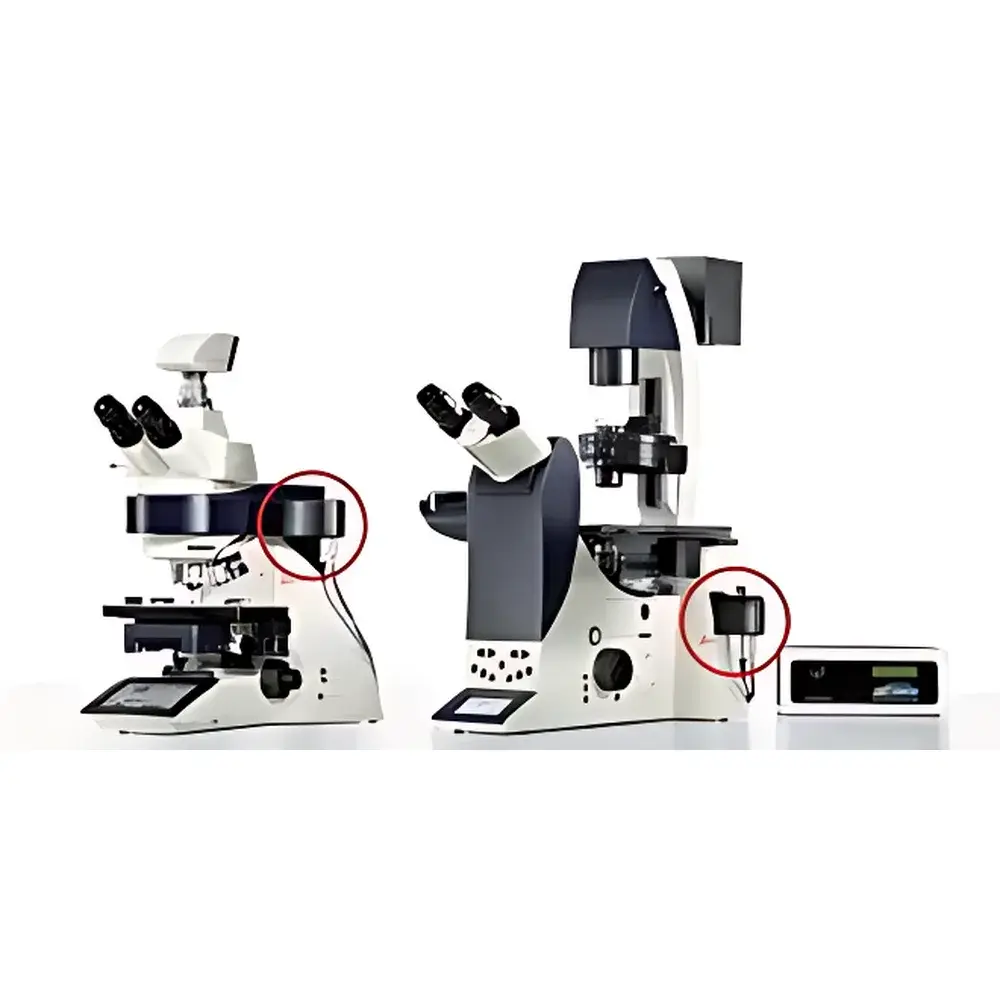
Leica Structured Illumination Microscopy System for Upright and Inverted Research Microscopes
| Brand | Leica Microsystems |
|---|---|
| Origin | Germany |
| Model | Leica Structured Illumination (OptiGrid® Module) |
| Compatibility | Integrated with Leica DM6 B, DMi8, and other upright/inverted research-grade microscopes |
| Illumination Technology | Grid-based optical sectioning via patterned illumination and computational reconstruction |
| Software Platform | Leica Application Suite X (LAS X) with MM AF module |
| Regulatory Compliance | CE-marked, compliant with ISO 13485 manufacturing standards for medical device–related instrumentation |
Overview
The Leica Structured Illumination Microscopy System is a high-precision optical sectioning solution engineered for life science researchers requiring enhanced axial resolution and reduced out-of-focus blur in widefield fluorescence imaging. Unlike conventional widefield microscopy, this system employs the OptiGrid® module—a calibrated, motorized grid projection unit—to project precisely controlled sinusoidal light patterns onto the specimen plane. Through sequential phase-shifted image acquisition and algorithmic reconstruction, it achieves effective lateral resolution improvement up to ∼2× beyond the classical Abbe diffraction limit (~120 nm laterally, ~300 nm axially), while maintaining compatibility with standard fluorescent probes and live-cell imaging conditions. Designed as a modular add-on, it integrates natively with Leica’s flagship upright (e.g., DM6 B) and inverted (e.g., DMi8) research microscopes—enabling consistent optical performance across platform configurations without recalibration or hardware modification.
Key Features
- Universal OptiGrid® Module: A single, field-replaceable illumination unit compatible with both upright and inverted Leica research microscopes—eliminating the need for platform-specific optics or alignment procedures.
- Shared Objective Pathway: All magnification objectives (from 10× to 100× oil immersion) operate through the same optical train; no mechanical repositioning or grid realignment is required when switching objectives.
- Automated Grid Focus & Alignment: Integrated motorized focus control synchronizes grid projection plane with the specimen focal plane in real time—ensuring optimal pattern contrast and reconstruction fidelity across Z-stacks.
- Hardware-Synchronized Acquisition: Precise timing between LED illumination pulses, camera exposure, and stage movement ensures sub-pixel registration stability—critical for quantitative 3D reconstruction reproducibility.
- Thermally Stable Optical Architecture: Aluminum-machined housing with passive thermal management minimizes grid distortion and drift during extended acquisitions (>30 min), supporting time-lapse structural analysis.
Sample Compatibility & Compliance
The system supports standard glass-bottom dishes, multi-well plates (6–96-well), and custom-mounted tissue sections. It is validated for use with common fluorophores (e.g., Alexa Fluor 488, Cy3, DAPI, mCherry) and compatible with live-cell environmental chambers (37°C, 5% CO₂). From a regulatory standpoint, the OptiGrid® module and associated LAS X software are CE-marked under Directive 2014/30/EU (EMC) and 2014/35/EU (LVD). When deployed in GLP-compliant laboratories, the LAS X software supports audit trail logging, user access control, and electronic signature functionality per FDA 21 CFR Part 11 requirements—provided system validation documentation is maintained by the end user.
Software & Data Management
Imaging workflow is managed via Leica Application Suite X (LAS X), with dedicated Structured Illumination modules including MM AF (Microscope Manager Auto Focus). The software enables one-click acquisition setup, real-time preview of deconvolved slices, and batch processing of multi-position Z-stacks. Reconstruction algorithms implement constrained iterative deconvolution with Poisson noise modeling, preserving signal-to-noise ratio in low-light conditions. Raw data (TIFF stacks with metadata tags) and processed volumes (.lif, .czi) are stored with embedded instrument configuration parameters—including grid period, phase steps, objective NA, and immersion medium refractive index—for full traceability. Export options include OME-TIFF for interoperability with Fiji/ImageJ, Imaris, and Huygens deconvolution platforms.
Applications
This system is routinely applied in subcellular organelle mapping (e.g., mitochondrial network topology, nuclear pore distribution), cytoskeletal dynamics (actin filament orientation, microtubule polarity), and multiplexed protein co-localization studies where conventional confocal resolution is insufficient but phototoxicity must remain minimal. Its speed advantage over point-scanning modalities makes it suitable for rapid 3D screening of fixed tissue sections (e.g., brain slice cortical layering) and developmental biology specimens (zebrafish embryos, Drosophila imaginal discs). Additionally, its compatibility with lattice light-sheet sample mounting enables hybrid workflows combining optical sectioning with gentle volumetric imaging.
FAQ
Is the OptiGrid® module compatible with third-party microscope frames?
No—mechanical, optical, and firmware integration is exclusive to Leica upright and inverted research platforms (DM6 B, DMi8, DM5000 B) due to proprietary beam path alignment and controller synchronization protocols.
Does structured illumination require special fluorophores or labeling protocols?
No—standard immunofluorescence, transgenic expression, and chemical dyes perform equivalently; however, fluorophore photostability should be verified for multi-phase acquisition sequences (typically 9–15 raw images per plane).
Can LAS X export reconstructed volumes for downstream machine learning segmentation?
Yes—32-bit TIFF volumes with calibrated voxel dimensions and channel metadata are directly ingestible by Python-based frameworks (e.g., Cellpose, StarDist) and commercial AI tools (e.g., HALO, Visiopharm).
What maintenance is required for long-term OptiGrid® performance?
Annual calibration verification using Leica’s certified grid test slide (PN 11506009) is recommended; no user-serviceable optics or alignment adjustments are permitted per ISO 9001 service guidelines.





