
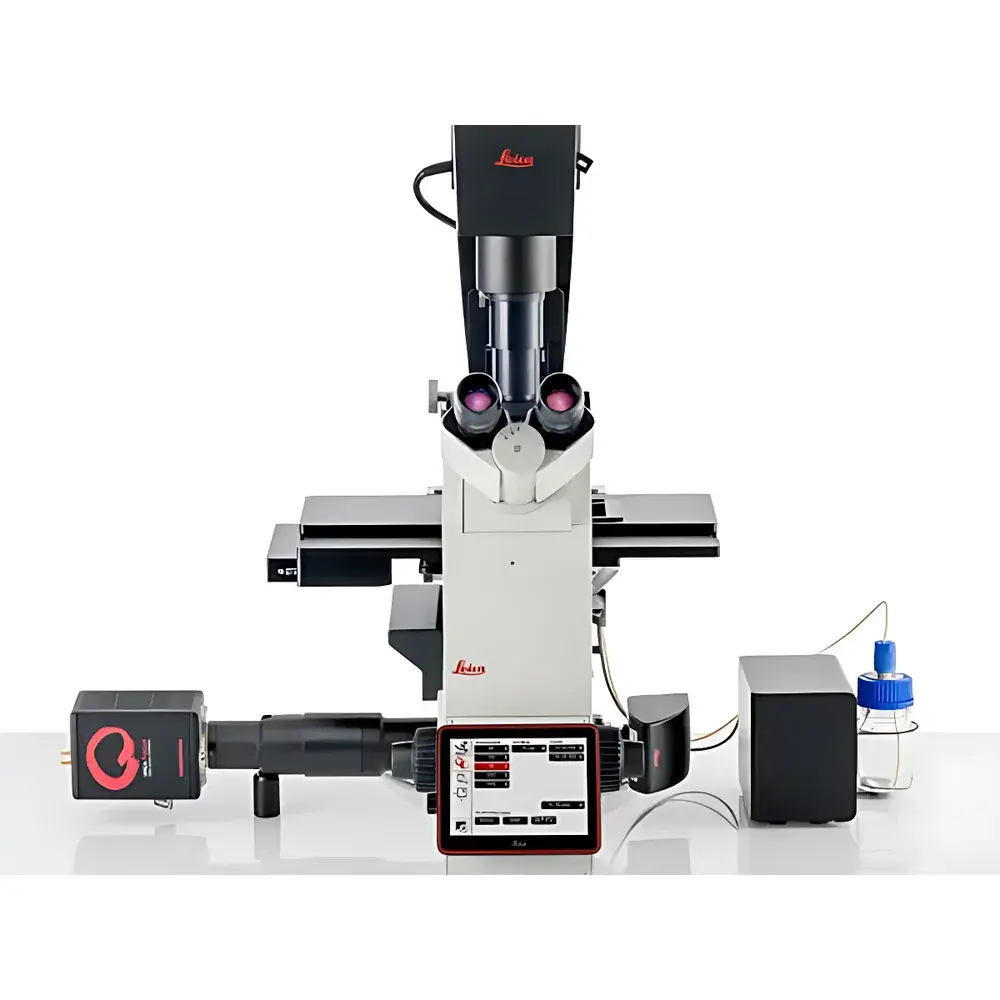
Leica THUNDER Imager Cell Spinning Disk System
| Brand | Leica |
|---|---|
| Origin | Germany |
| Model | THUNDER Imager Cell Spinning Disk System |
| Category | Spinning Disk Confocal Microscopy Platform for 3D Live-Cell and Thick-Tissue Imaging |
| Compliance | Designed for GLP/GMP-adjacent research environments |
Overview
The Leica THUNDER Imager Cell Spinning Disk System is a high-performance, turnkey spinning disk confocal microscopy platform engineered for quantitative 3D imaging of live cells, organoids, spheroids, cleared tissues, and whole-mount model organisms. It integrates the optical architecture of the CrestOptics CICERO spinning disk unit—featuring dual microlens and pinhole arrays—with Leica’s proprietary THUNDER computational clearing engine. Unlike conventional widefield or laser-scanning confocal systems, this hybrid design leverages physical optical sectioning (via spinning disk) combined with real-time, GPU-accelerated deconvolution to suppress out-of-focus blur while preserving signal-to-noise ratio and temporal fidelity. The system operates on the Leica DMi8 inverted microscope base, enabling modular expansion with motorized stages, environmental chambers, and multi-channel fluorescence detection optimized for low phototoxicity and high spatiotemporal resolution.
Key Features
- THUNDER Computational Clearing: Real-time, pixel-wise deconvolution applied to every frame during acquisition—eliminating residual out-of-focus haze without iterative post-processing delays.
- CrestOptics CICERO Spinning Disk: Dual-stage microlens/pinhole array delivering high-speed optical sectioning (up to 200 fps at full FOV) with minimal photobleaching and exceptional axial resolution (~0.7 µm).
- Adaptive Water Immersion Cap: Integrated humidity and meniscus sensors maintain stable water immersion throughout time-lapse experiments—enabling consistent refractive index matching for thick samples without manual refilling or drift-induced focus loss.
- SmartCORR Automatic Correction Collar Optimization: Motorized objective correction collar adjustment based on sample thickness and refractive index—reducing spherical aberration across heterogeneous 3D specimens (e.g., 200 µm planarian sections or 500 µm brain slices).
- Sample Finder Intelligent Navigation: Rapid autofocus mapping across large fields of view generates a depth-resolved overview mosaic—preserving spatial context while enabling precise ROI selection for high-magnification time-lapse or Z-stack acquisition.
- DMi8 Smart Automation Framework: Scriptable hardware control via Leica Application Suite X (LAS X), supporting automated multi-position, multi-channel, multi-timepoint acquisitions compliant with FAIR data principles.
Sample Compatibility & Compliance
The system supports a broad spectrum of biologically relevant specimens: live U2OS cells (WGA/TMRE/tubulin), zebrafish vasculature (GFP/mCherry), rat brain cryosections (Hoechst/CPCA/Fox3/RPCA), DAPI/mRNA FISH-stained planarian tissue (200 µm), and 3D intestinal organoids. All optical components—including HC PL APO 40x/1.30 Oil and HC FLUOTAR L 25x/0.95 W objectives—are calibrated per ISO 10934-1 for resolution verification. Data provenance is maintained through LAS X’s audit trail functionality, supporting 21 CFR Part 11–aligned electronic records where required for preclinical assay development. System validation documentation aligns with ISO/IEC 17025 guidelines for laboratory equipment qualification.
Software & Data Management
Acquisition, processing, and analysis are unified within Leica LAS X software (v4.13+), which includes THUNDER-specific modules for batch deconvolution, intensity normalization, and 3D rendering. Raw data is stored in standardized OME-TIFF format with embedded metadata (acquisition parameters, objective ID, stage coordinates). LAS X supports direct export to Fiji/ImageJ, Imaris, and MATLAB via open APIs. For regulated environments, optional LAS X LMS (Laboratory Management System) add-on enables user access control, electronic signatures, and change management logs traceable to individual experimental sessions.
Applications
- Long-term live-cell dynamics: Mitochondrial trafficking, cytoskeletal remodeling, and nuclear RNA localization in low-phototoxicity regimes.
- High-content screening of 3D tumor spheroids: Quantitative assessment of drug penetration, apoptosis gradients, and proliferation heterogeneity.
- Developmental biology: Multi-color imaging of embryonic patterning in zebrafish and Drosophila, including light-sheet-compatible sample mounting.
- Neuroscience: Structural and functional mapping of synaptic markers in intact cortical slabs or CLARITY-cleared tissue.
- Pathology workflow integration: Automated scanning of large-area tissue sections with adaptive focus tracking and THUNDER-enhanced contrast for rare-event detection.
FAQ
How does THUNDER differ from traditional deconvolution methods?
THUNDER employs a contextual, non-iterative deconvolution algorithm trained on empirical PSF models—enabling real-time processing without sacrificing acquisition speed or introducing ringing artifacts common in classical Wiener or constrained iterative approaches.
Can the system perform simultaneous multi-color acquisition with spectral unmixing?
Yes—when configured with the Leica SP8 DCS spectral detector or external EMCCD/sCMOS cameras, LAS X supports linear unmixing of up to 7 fluorophores using reference spectra acquired in situ.
Is SmartCORR compatible with third-party objectives?
SmartCORR is validated exclusively with Leica HC PL APO and HC FLUOTAR objectives equipped with motorized correction collars; non-Leica lenses require manual calibration and are not supported for automated optimization.
What environmental control options are available for long-term live imaging?
The DMi8 platform integrates seamlessly with OkoLab stage-top incubators (CO₂, O₂, temperature, humidity) and Tokai Hit heated stage adapters—fully controllable via LAS X scripting interface.
Does the system support FRAP or photoactivation protocols?
Yes—when paired with Leica’s FRAP Wizard module and optional 405 nm or 488 nm activation lasers, the system enables quantitative recovery kinetics analysis with precise ROI targeting and THUNDER-enhanced background suppression.





