
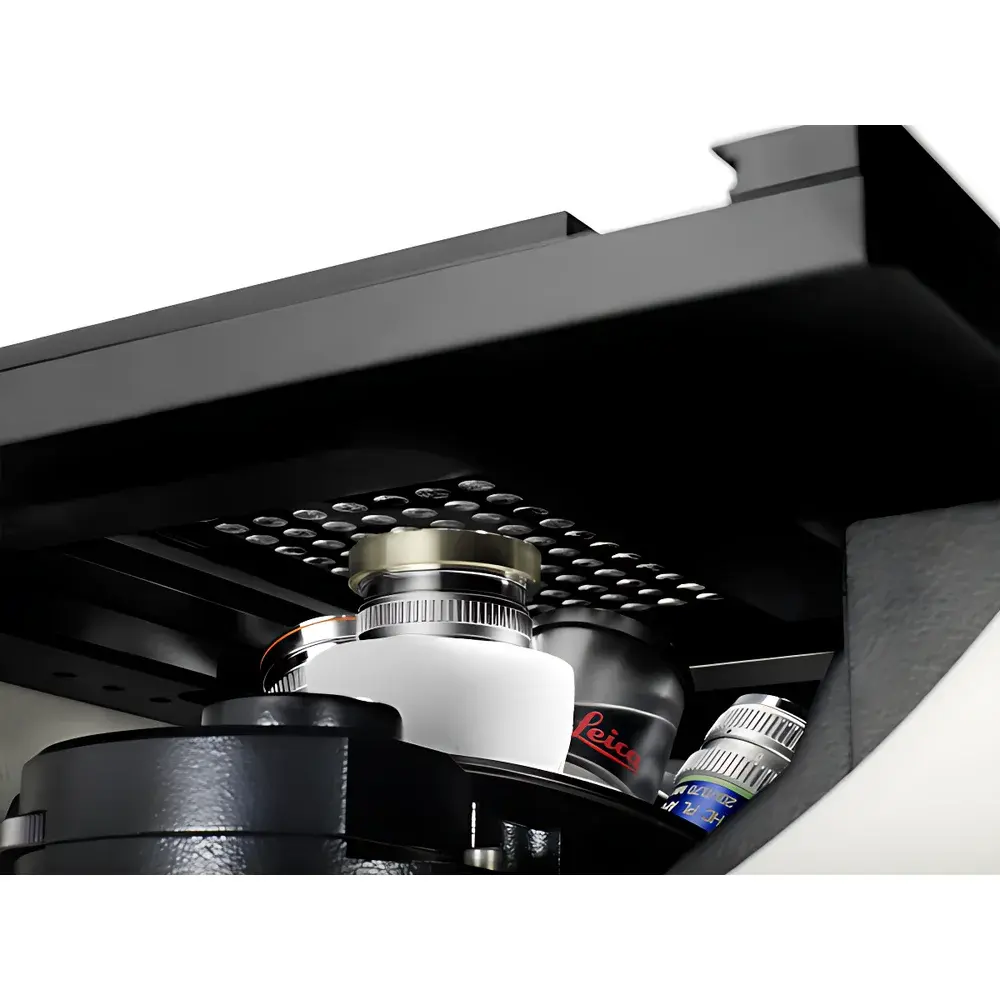
Leica Water Immersion Micro Automatic Water Delivery System
| Brand | Leica |
|---|---|
| Origin | Germany |
| Model | Water Immersion Micro |
| Component Type | Water Immersion Objective Auxiliary System |
| Compliance | Designed for ISO 10993-compliant biological imaging workflows |
| Integration | Fully compatible with Leica DMi8 and THUNDER imaging platforms |
Overview
The Leica Water Immersion Micro Automatic Water Delivery System is an engineered auxiliary module designed to maintain a stable, continuous water immersion layer between high-numerical-aperture (NA ≥ 1.0) water immersion objectives and live biological specimens during extended optical microscopy sessions. Unlike conventional manual refilling or static water chambers, this system operates on a closed-loop hydrostatic principle—using precision micro-pumping, real-time meniscus monitoring, and temperature-stabilized fluid reservoirs—to sustain optimal refractive index matching (n = 1.333 at 37 °C) across the objective-specimen interface. This eliminates spherical and chromatic aberrations induced by air–glass–water interfaces, enabling diffraction-limited resolution deep within aqueous environments such as live-cell monolayers, organotypic slices, and microplate-based assays. The system is not a standalone microscope but a purpose-built integration component for Leica’s inverted research-grade platforms, particularly where long-term time-lapse imaging (>6 h), physiological temperature maintenance (35–37 °C), and dynamic sample handling (e.g., stage scanning, multi-position acquisition) are required.
Key Features
- Automated meniscus replenishment: Integrated capacitive liquid-level sensor triggers micro-pump activation when water film thickness falls below 12–15 µm—preventing dry-contact events without interrupting acquisition.
- Thermally isolated fluid path: Entire water circuit—including 120 mL reservoir, peristaltic pump head, and silicone tubing—is housed inside a dedicated temperature-controlled enclosure (±0.3 °C stability at 37 °C), minimizing thermal drift-induced focus shift.
- Leak-resistant mechanical design: Dual-seal O-ring interface between objective collar and water chamber; IP54-rated housing prevents incidental spill ingress; integrated drip tray with overflow cutoff.
- Software-synchronized operation: Native integration via Leica Application Suite X (LAS X) v4.13+; water delivery events logged in acquisition metadata with timestamped audit trail compliant with GLP documentation requirements.
- No mechanical interference: Compact footprint (125 × 85 × 60 mm) mounts directly to Leica motorized nosepiece adapter—zero impact on Z-stage travel range or objective turret rotation.
Sample Compatibility & Compliance
The system supports standard water immersion objectives (e.g., Leica HCX APO L 40×/0.80 W, HC PL APO 63×/1.20 W), accommodating coverslip thicknesses from #1.5 (0.17 mm) to #1.5H (0.185 mm). It is validated for use with aqueous physiological buffers (PBS, HBSS, CO₂-bicarbonate media) and low-viscosity fluorophore solutions (e.g., Calcein AM, Hoechst 33342). All wetted materials—silicone tubing (USP Class VI), stainless-steel pump housing, and PEEK fluid connectors—meet ISO 10993-5 cytotoxicity standards. The system itself carries CE marking under Directive 2014/30/EU (EMC) and 2014/35/EU (LVD), and its software logging architecture satisfies FDA 21 CFR Part 11 requirements for electronic records when deployed in regulated QC/QA labs.
Software & Data Management
Control is fully embedded in LAS X via dedicated “Water Immersion Manager” module. Users define refill thresholds (µm), maximum delivery volume per event (0.5–5 µL), and timeout intervals (1–30 s) per objective. All parameters are stored in experiment templates and exported alongside TIFF/OME-TIFF datasets as structured JSON metadata. Audit logs record pump actuation count, duration, timestamp, operator ID (LDAP-integrated), and ambient humidity/temperature readings from optional environmental sensors—enabling full traceability for ISO/IEC 17025 accreditation audits.
Applications
- Long-term live-cell imaging of adherent mammalian cultures under controlled CO₂/humidity (e.g., wound-healing assays, mitosis tracking).
- High-content screening (HCS) on 96-/384-well plates using water-dipping objectives for improved signal-to-noise ratio in thick-gel matrices.
- Neuroscience applications: acute brain slice imaging with minimal osmotic perturbation during >8 h recordings.
- Developmental biology: time-lapse observation of zebrafish or C. elegans embryos in custom chamber slides with continuous hydration.
- Correlative light-electron microscopy (CLEM) sample preparation workflows requiring stable optical alignment prior to fixation.
FAQ
Does the system support oil or glycerol immersion objectives?
No—this unit is exclusively engineered for water immersion objectives (designated “W” or “WI” in Leica nomenclature); oil- or glycerol-based systems require separate, chemically compatible fluid management hardware.
Can it be retrofitted to non-Leica microscopes?
Not without third-party mechanical and software adaptation; the mounting interface, electrical signaling, and LAS X API dependencies are proprietary to Leica DMi8/THUNDER platforms.
What maintenance is required?
Monthly tubing replacement (provided in consumables kit), quarterly calibration of capacitive sensor using Leica-certified reference meniscus gauge, and biannual verification of thermal enclosure uniformity per ISO 13406-2 Annex D.
Is deionized water sufficient, or must it be filtered?
Use of 0.22 µm-filtered, particle-free water is mandatory; unfiltered water causes clogging in microfluidic channels and introduces scattering artifacts above 0.5 NTU turbidity threshold.




