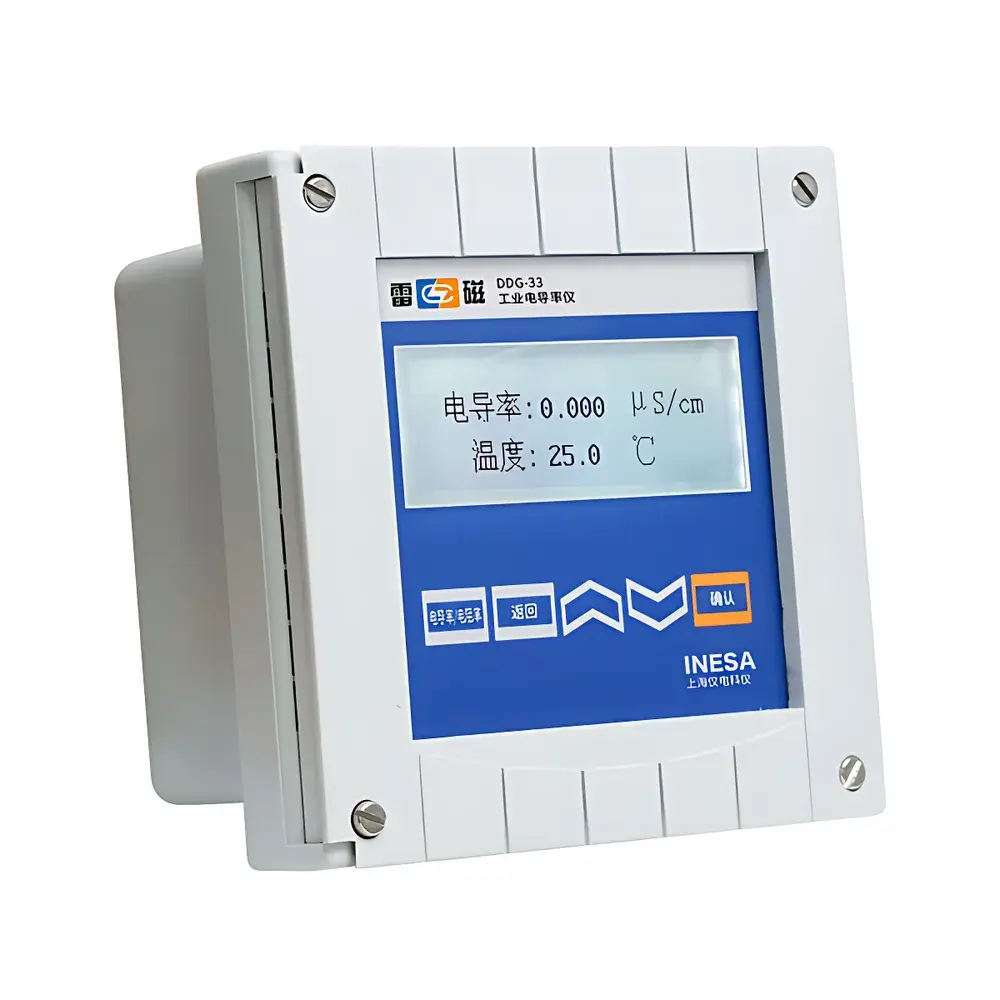
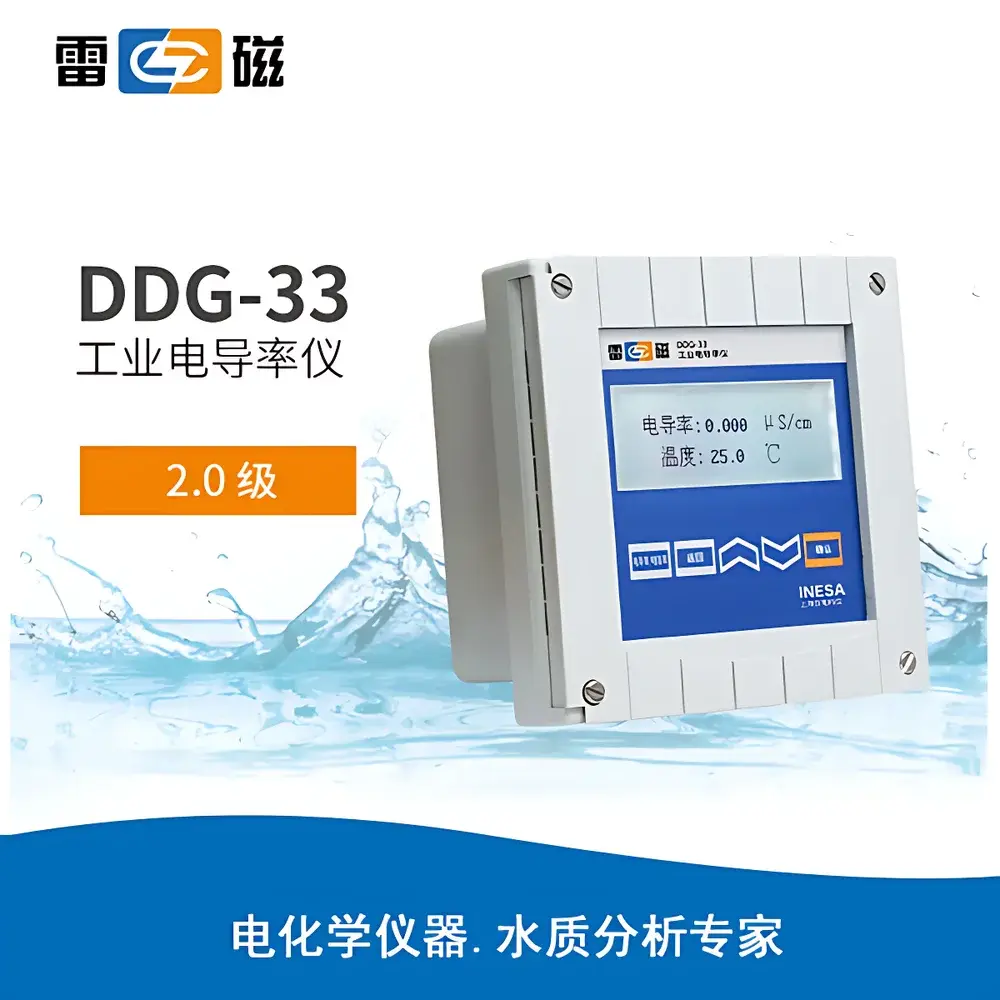
Leichi DDG-33 Online Conductivity Analyzer
| Brand | Leichi |
|---|---|
| Origin | Shanghai, China |
| Manufacturer Type | Direct Manufacturer |
| Country of Origin | China |
| Model | DDG-33 |
| Price | USD 780 (FOB Shanghai) |
| Conductivity Range | K=0.01 cm⁻¹: 0–20 µS/cm |
| K=0.1 cm⁻¹ | 1–200 µS/cm |
| K=1.0 cm⁻¹ | 10–10,000 µS/cm |
| Temperature Range | −10.0 to 120.0 °C |
| Basic Instrument Error | ±2.0% FS (conductivity), ±0.5 °C (0.0–60.0 °C), ±1.0 °C (other) |
| Resolution | 0.001/0.01/0.1 µS/cm |
| Repeatability | 1.0% FS |
| Electronic Unit Accuracy | ±1.0% FS (conductivity), ±0.3 °C (temperature) |
| Stability | ±0.5% FS/24 h |
| Temperature Compensation Range | 5.0–60.0 °C (reference 25.0 °C) |
| Enclosure Rating | IP65 |
| Power Supply | AC 220 V ±10%, 50 Hz ±1% or DC 24 V |
| Dimensions | 166 × 166 × 110 mm |
| Weight | 2.0 kg |
Overview
The Leichi DDG-33 Online Conductivity Analyzer is a robust, microprocessor-controlled industrial process instrument engineered for continuous, real-time measurement of electrical conductivity and temperature in liquid streams. It operates on the principle of two-electrode conductometric sensing, where conductivity is derived from the measured conductance between platinum electrodes normalized by the cell constant (K). The analyzer supports three interchangeable conductivity cells—K = 0.01 cm⁻¹, 0.1 cm⁻¹, and 1.0 cm⁻¹—enabling precise coverage across ultrapure water (e.g., condensate, deionized water), low-conductivity feedwater, and higher-conductivity process streams such as brine pre-treatment or cooling tower blowdown. Its integrated temperature sensor (Pt1000 or equivalent) enables automatic temperature compensation using the linear or non-linear (NaCl-based) algorithms per ISO 7888 and ASTM D1125, referenced to 25.0 °C. Designed for wall-mount or panel-mount installation in harsh industrial environments, the DDG-33 meets the functional safety and environmental resilience requirements typical of power generation, pharmaceutical water systems, semiconductor ultrapure water (UPW) loops, and chemical process monitoring.
Key Features
- Large dot-matrix LCD display showing simultaneous conductivity and temperature values with intuitive unit labeling (µS/cm, mS/cm, °C)
- Automatic range switching across three cell constants without manual recalibration or configuration interruption
- Programmable linear temperature compensation (5.0–60.0 °C), configurable reference temperature and compensation coefficient
- Dual independent alarm outputs: user-defined high/low conductivity thresholds with latching or non-latching behavior and visual status indicators
- Galvanically isolated 4–20 mA analog output with fully adjustable zero/span mapping—supports integration into DCS, PLC, or SCADA systems compliant with IEC 61000-6-2/4 EMC standards
- Non-volatile memory with power-loss protection: retains calibration data, setpoints, and configuration parameters during mains failure
- IP65-rated polycarbonate enclosure rated for indoor/outdoor mounting in humid, dusty, or splash-prone locations (e.g., boiler rooms, RO skids, utility corridors)
Sample Compatibility & Compliance
The DDG-33 is compatible with aqueous solutions ranging from high-purity steam condensate (<1 µS/cm) to moderately aggressive industrial effluents (up to 10 mS/cm). Its electrode materials—platinum-coated stainless steel or graphite—are chemically stable in neutral to mildly alkaline media; optional PEEK or PVDF body housings enhance compatibility with oxidizing or chlorinated streams. The analyzer complies with key international metrological and operational standards including ISO/IEC 17025 (when used with traceable calibration), ASTM D1125 (standard test method for conductivity of water), and EN 61326-1 (EMC for industrial measurement equipment). While not intrinsically safe, it may be deployed in Zone 2 classified areas when installed per IEC 60079-14 guidelines. For regulated environments (e.g., USP , EU GMP Annex 1), the device supports audit-ready documentation through external calibration logs and configurable timestamped event logging (alarm triggers, range changes).
Software & Data Management
The DDG-33 operates autonomously without embedded software or network connectivity. All configuration—including calibration constants, alarm thresholds, output scaling, and temperature compensation mode—is performed locally via membrane keypad with password-protected access levels (operator vs. technician). Calibration verification follows a two-point method: dry-cell check (open-circuit) and standard solution verification (e.g., KCl 1413 µS/cm at 25 °C). Though lacking native digital communication (e.g., Modbus RTU or HART), its 4–20 mA output is fully compatible with third-party data acquisition systems supporting analog input modules with 16-bit resolution and cold-junction compensation. When integrated into validated systems, the analyzer supports 21 CFR Part 11 compliance via external historian platforms that enforce electronic signatures, audit trails, and change control for all parameter modifications.
Applications
- Continuous monitoring of steam condensate return lines in thermal power plants and industrial boilers to detect tube leakage or contamination ingress
- Real-time quality assurance of purified water (PW) and water for injection (WFI) distribution loops in pharmaceutical manufacturing facilities
- Feedwater and blowdown conductivity control in reverse osmosis (RO) and mixed-bed demineralizer systems
- Process stream verification in semiconductor UPW polishing stages (e.g., post-UV oxidation, final filtration)
- Salinity monitoring in desalination pre-treatment and distillation condensate recovery circuits
- Environmental compliance tracking of effluent discharge conductivity per local regulatory limits (e.g., EPA 120.1)
FAQ
What calibration standards are recommended for the DDG-33?
Standard KCl solutions traceable to NIST or equivalent national metrology institutes: 1413 µS/cm (at 25 °C) for K=0.1 cm⁻¹ cells; 12.88 mS/cm for K=1.0 cm⁻¹ cells. Calibration frequency depends on application criticality—typically daily for WFI loops, weekly for boiler feedwater.
Can the DDG-33 be used with flow-through conductivity cells?
Yes—compatible with Leichi’s 2043-series flow cells (e.g., 2043-205B-F) featuring 1/4″ NPT or sanitary tri-clamp fittings. Minimum flow rate: 0.3 L/min to ensure laminar, bubble-free measurement.
Is temperature compensation mandatory?
Yes—conductivity is inherently temperature-dependent. The DDG-33 requires active temperature measurement and compensation; disabling it invalidates measurement traceability per ISO 7888.
Does the instrument support automatic cell constant recognition?
No—cell constant must be manually entered during setup. Each 2043-series cell is supplied with a certified calibration certificate listing its nominal and verified K-value.
What maintenance intervals are recommended?
Electrode cleaning every 2–4 weeks in fouling-prone streams; full system verification (zero/span, temp sensor accuracy) every 3 months; annual replacement of O-rings and gasket seals in wetted parts.
Related Products