
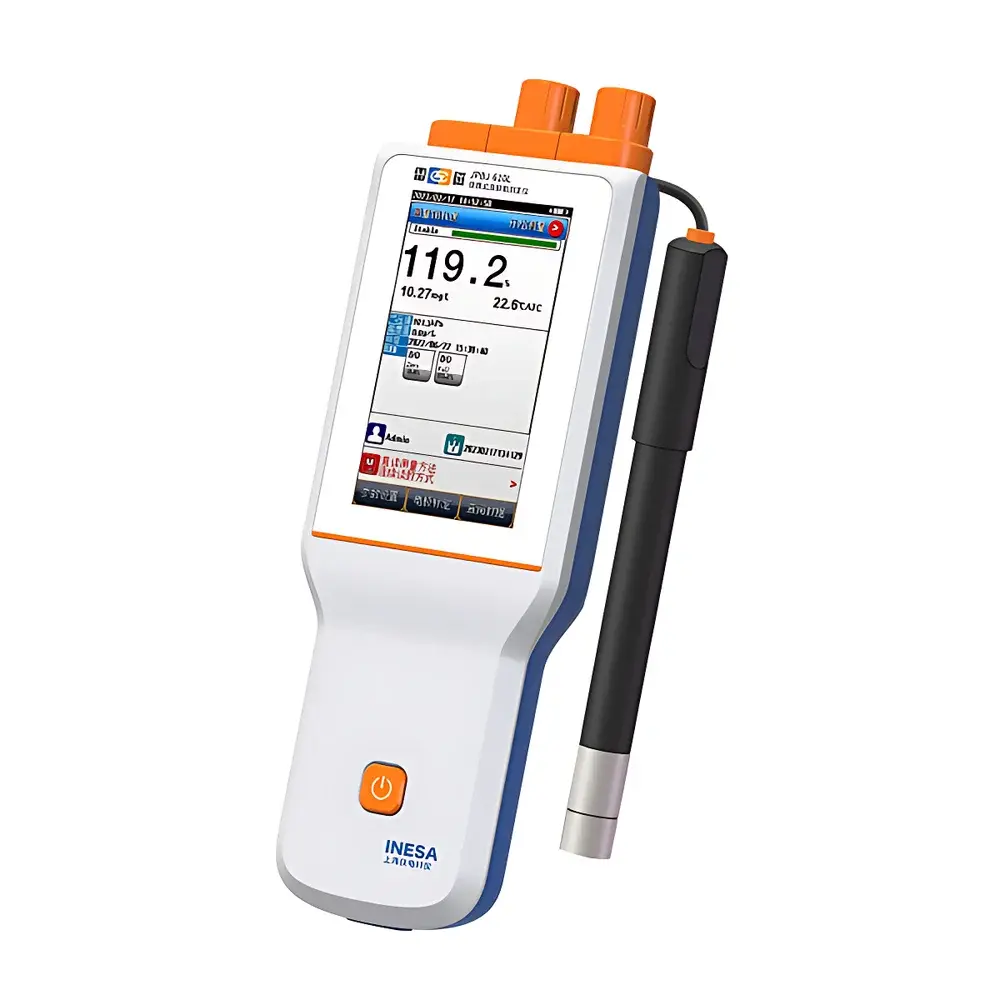
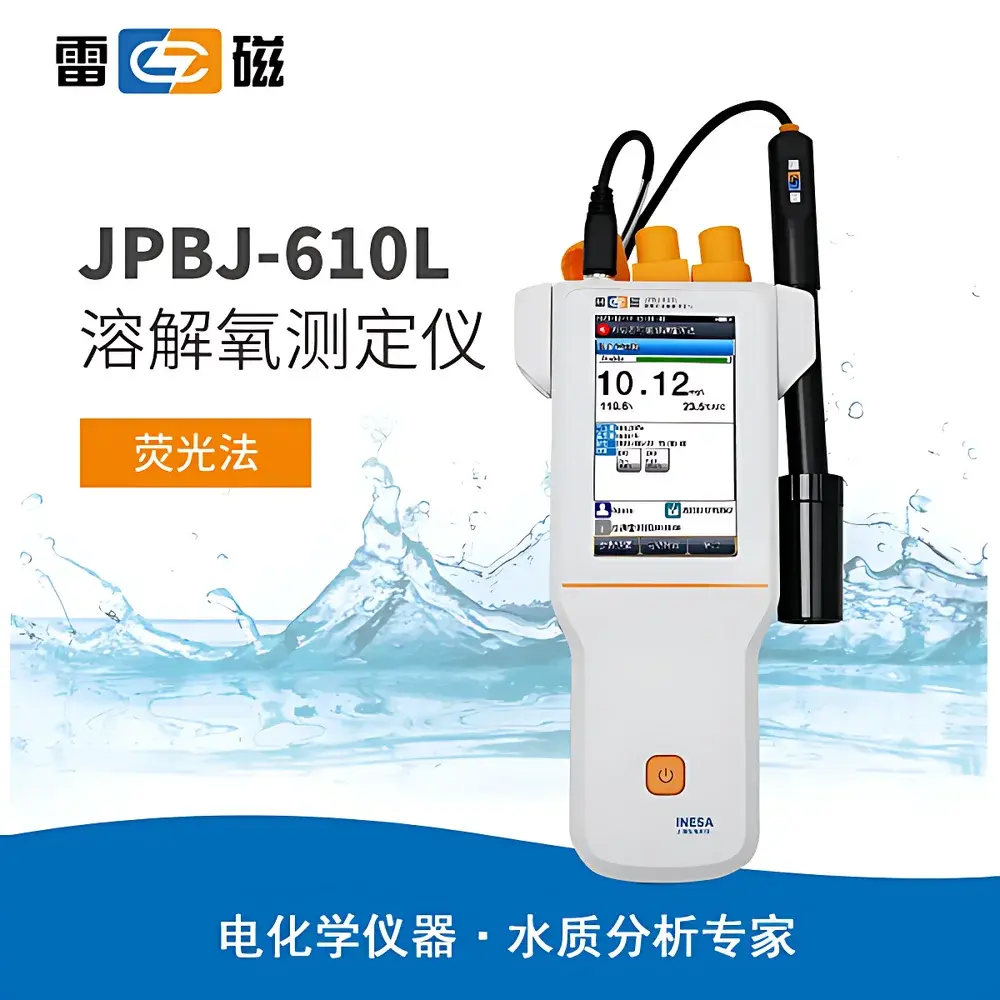
Leichi JPBJ-610L Portable Fluorescence-Based Dissolved Oxygen Meter
| Brand | Leichi |
|---|---|
| Origin | Shanghai, China |
| Manufacturer Type | Direct Manufacturer |
| Country of Origin | China |
| Model | JPBJ-610L |
| Instrument Type | Portable |
| Measurement Principle | Fluorescence Quenching |
| DO Range | (0.00–20.00) mg/L |
| Accuracy | ±0.30 mg/L (reading error) |
| Resolution | 0.01 mg/L |
| Repeatability | 0.15 mg/L |
| Zero Oxygen Error | ≤0.1 mg/L |
| Response Time | ≤60 s (90% response at 20 °C) |
| DO Saturation Range | (0.0–200.0)% |
| Saturation Accuracy | ±10.0% |
| Temperature Range | (0.0–50.0) °C |
| Temp. Resolution | 0.1 °C |
| Temp. Accuracy | ±0.3 °C |
| Salinity Compensation | Manual, (0.0–50.0) g/L |
| Atmospheric Pressure Compensation | Auto/Manual, (50.0–110.0) kPa |
| IP Rating | IP65 |
| Power | Rechargeable Li-ion battery |
| Dimensions | 90 × 255 × 40 mm |
| Weight | 0.5 kg |
Overview
The Leichi JPBJ-610L is a field-deployable, fluorescence-based dissolved oxygen (DO) meter engineered for high-reliability water quality assessment in environmental monitoring, wastewater treatment, aquaculture, and ecological research applications. Unlike traditional Clark-type electrochemical sensors, the JPBJ-610L employs optical fluorescence quenching technology—where molecular oxygen modulates the intensity and lifetime of fluorescent emission from a ruthenium-based sensing layer immobilized on the probe surface. This principle eliminates membrane fouling, electrolyte depletion, and electrode polarization, enabling stable, maintenance-light operation without routine membrane replacement or warm-up periods. The instrument delivers direct, temperature-compensated DO concentration readings in mg/L and saturation (%), with built-in algorithms correcting for salinity and atmospheric pressure—critical for accurate field measurements across diverse aquatic environments including estuaries, rivers, reservoirs, and coastal zones.
Key Features
- 4.3-inch high-resolution color TFT touchscreen with intuitive icon-driven interface supporting both English and Chinese languages
- IP65-rated enclosure ensuring dust-tightness and protection against low-pressure water jets—suitable for outdoor and humid field conditions
- Integrated rechargeable lithium-ion battery providing extended operational runtime; supports charging via PC USB port or external 5V power bank
- Real-time battery status indicator, low-voltage warning, and adaptive backlight control for optimal visibility under variable ambient lighting
- Intelligent endpoint detection with multiple reading modes: auto-hold, timed interval, manual trigger, and continuous monitoring
- Comprehensive compensation framework: automatic or manual temperature (0.0–50.0 °C), atmospheric pressure (50.0–110.0 kPa, with unit options: kPa, mbar, Torr, atm), and salinity (0.0–50.0 g/L)
- Two-point calibration workflow—zero-oxygen (via sodium sulfite solution) and full-scale (air-saturated water or saturated aqueous standard)—with configurable calibration reminders and failure alerts
Sample Compatibility & Compliance
The JPBJ-610L is compatible with natural waters, treated effluents, surface runoff, groundwater, and process streams across pH 4–10 and conductivity up to 20 mS/cm. Its non-consumptive optical sensor exhibits minimal interference from hydrogen sulfide, chlorine, or heavy metal ions commonly found in industrial or municipal samples. All measurement data comply with Good Laboratory Practice (GLP) requirements: each record includes timestamp, operator ID (via three-tier user authentication), calibration history, sensor serial number, environmental parameters (T, P, S), and instrument firmware version. Audit trails are preserved internally and exportable for regulatory review per ISO/IEC 17025 and EPA Method 4500-O G guidelines.
Software & Data Management
- On-device storage capacity for up to 1,000 complete measurement records—including DO concentration, saturation, temperature, pressure, salinity, and calibration metadata
- Graphical data review with time-series plotting, statistical summaries (mean, SD, min/max), and trend analysis
- USB-C interface for direct connection to Windows PCs using proprietary Leichi DataLink software; supports CSV export and LIMS integration via HL7 or ASTM E1384-compliant protocols
- Bluetooth 5.0 module enabling wireless transmission to mobile devices or cloud platforms (e.g., Microsoft Azure IoT Edge-compatible gateways)
- U-disk read/write capability and optional barcode scanner support for sample ID traceability in multi-site monitoring programs
- Firmware upgradeable in-field via USB or Bluetooth—ensuring long-term adaptability to evolving method requirements and cybersecurity standards
Applications
The JPBJ-610L serves as a primary tool in regulatory compliance monitoring (e.g., WHO drinking water guidelines, EU WFD reporting, US Clean Water Act Tier 1 assessments), biological oxygen demand (BOD) incubation verification, activated sludge process control in WWTPs, and real-time DO profiling during algal bloom investigations. Its portability and rapid response (<60 s) make it ideal for grab sampling campaigns, mobile lab deployments, and citizen science initiatives requiring traceable, GLP-aligned data acquisition. The absence of consumables reduces total cost of ownership and ensures consistent inter-laboratory comparability—particularly valuable in multi-agency watershed studies and transboundary water quality networks.
FAQ
Does the JPBJ-610L require membrane replacement or electrolyte refilling?
No—the fluorescence-based sensor contains no membranes, electrolytes, or cathodes; it requires only periodic cleaning and two-point calibration.
Can the instrument compensate for altitude-related barometric pressure changes?
Yes—users may select automatic pressure sensing via integrated barometer or manually enter local atmospheric pressure in kPa, mbar, Torr, or atm.
Is the device compliant with FDA 21 CFR Part 11 for electronic records?
While not certified for pharmaceutical GMP environments, its audit-trail architecture, user-role permissions, and electronic signature-ready export formats align with core Part 11 principles for environmental data integrity.
What is the recommended calibration frequency for field use?
Calibration is advised before each sampling session or after exposure to extreme temperature shifts (>10 °C); the system logs all calibrations and triggers configurable alerts at user-defined intervals.
Can the JPBJ-610L connect to third-party LIMS without proprietary software?
Yes—CSV exports and USB mass-storage mode enable direct ingestion into most LIMS platforms; Bluetooth API documentation is available under NDA for custom middleware development.
Related Products







