
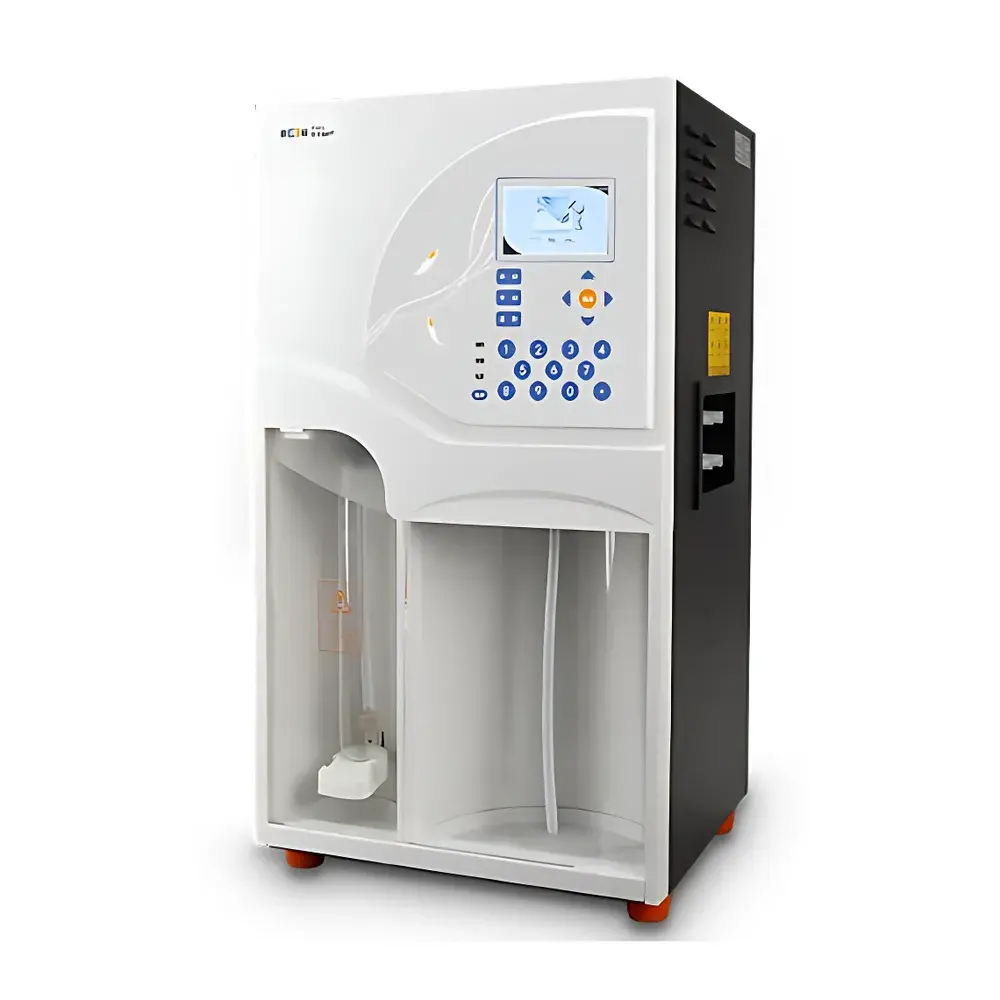
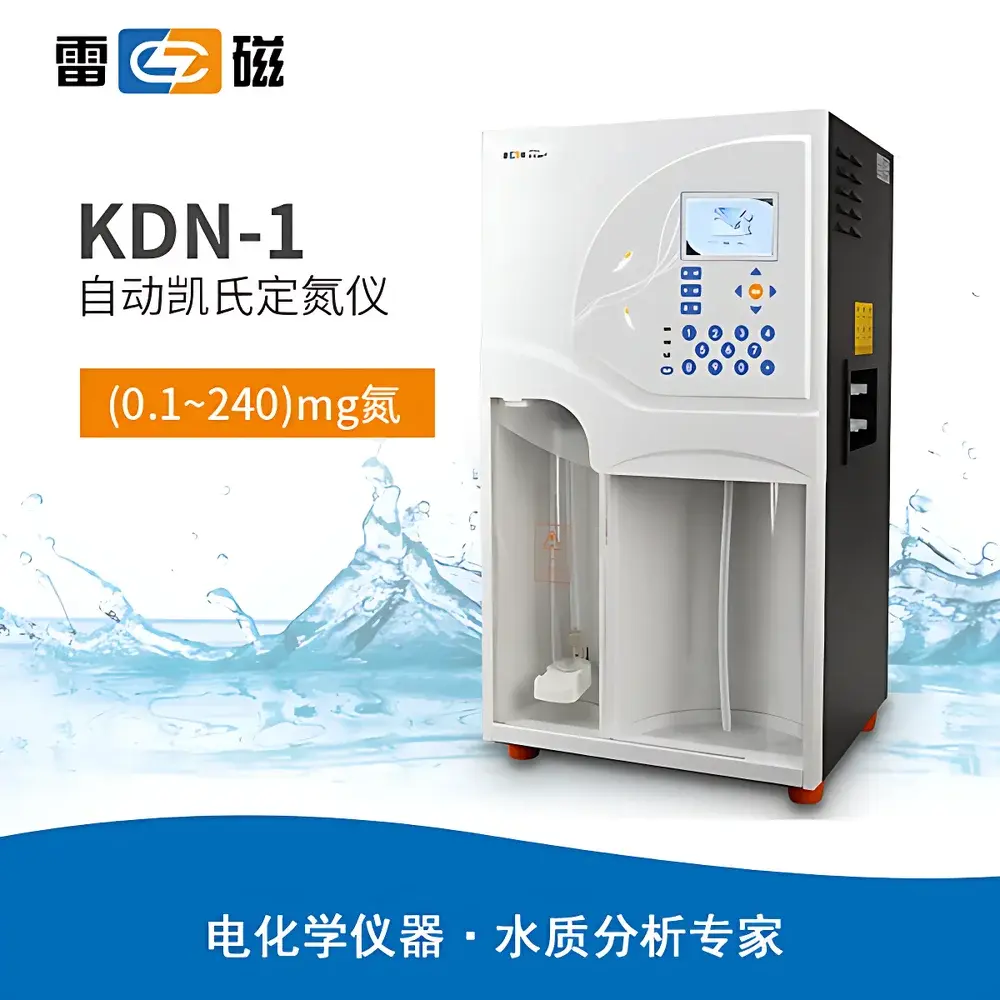
Leichi KDN-1 Automatic Kjeldahl Nitrogen Analyzer
| Brand | Leichi |
|---|---|
| Origin | Shanghai, China |
| Manufacturer Type | Direct Manufacturer |
| Origin Category | Domestic (China) |
| Model | KDN-1 |
| Pricing | Upon Request |
| Display | 4.3-inch high-resolution color LCD |
| Operation Mode | Dual automatic/manual |
| Alkali Reagent Delivery | Automated quantitative dosing |
| Boric Acid Solution Delivery | Automated quantitative dosing |
| Diluent Addition | Manual or automatic selection |
| Distillation Time Setting | Programmable up to 60 min |
| Distillation Speed | 3–6 min per sample |
| Nitrogen Measurement Range | 0.1–240 mg |
| Nitrogen Recovery Rate | ≥99.5% |
| Sample Capacity | ≤6 g (solid) or ≤16 mL (liquid) |
| Condensate Water Consumption | 1.5 L/min |
| Heating Tube Temperature Monitoring | Real-time |
| Rinse Control System | Automated post-distillation tubing rinse |
| Safety Features | Digestion tube presence detection, emergency stop, fault self-diagnosis with audible/visual alarm |
| Cooling Water Flow Sensing | Integrated flow sensor |
| Power Supply | 220 VAC ±10%, 50 Hz |
| Rated Power | 1.3 kW |
| Dimensions (W×D×H) | 400 × 385 × 735 mm |
| Net Weight | 30 kg |
Overview
The Leichi KDN-1 Automatic Kjeldahl Nitrogen Analyzer is a fully integrated, benchtop instrument engineered for precise and reproducible total nitrogen determination in organic and inorganic samples via the classical Kjeldahl digestion–distillation–titration method. Based on standardized wet-chemical decomposition—where nitrogenous compounds are catalytically digested in concentrated sulfuric acid at elevated temperature—the KDN-1 automates the critical distillation and absorption stages to eliminate operator variability and improve analytical throughput. The system quantifies ammonia liberated during alkaline distillation by capturing it in boric acid solution, followed by back-titration or direct titrimetric analysis (when interfaced with an external titrator). Designed for routine QC/QA laboratories in food, feed, agricultural, environmental, and pharmaceutical sectors, the KDN-1 complies with core international standards including ISO 8968-1 (milk), ISO 1871 (cereals), AOAC 981.10 and 984.27, and USP & EP monographs requiring Kjeldahl-based nitrogen content verification.
Key Features
- 4.3-inch high-resolution color LCD interface with intuitive navigation and real-time parameter visualization
- Dual operation mode: seamless switching between fully automated sequences and manual step-by-step control for method development or troubleshooting
- Precise per-sample reagent metering: independent motor-driven pumps deliver alkali and boric acid solutions with volumetric accuracy calibrated against gravimetric validation protocols
- Programmable distillation timing (1–60 minutes), with end-of-cycle acoustic and visual alert plus automatic power-down sequence
- Intelligent rinse module: post-distillation automated flushing of condenser outlet tubing minimizes carryover and ensures inter-sample integrity
- Digestion tube safety interlock: optical and mechanical sensing confirms proper placement before initiating distillation; immediate halt if tube is misaligned or absent
- Real-time heating element temperature monitoring with thermal cutoff at preset safety thresholds (≥450 °C)
- Integrated flow sensor continuously verifies condenser cooling water supply status—halting distillation if flow falls below 1.2 L/min
- Comprehensive diagnostics engine: self-checks pump actuation, valve sequencing, temperature stability, and sensor responsiveness; faults logged with descriptive codes and LED indicators
- Emergency stop button with hardwired circuit interruption for immediate de-energization of all high-power components
Sample Compatibility & Compliance
The KDN-1 accommodates standard 100–500 mL digestion tubes (e.g., Kjeldahl pear-shaped or round-bottom variants) and supports solid samples up to 6 g or liquid matrices up to 16 mL without dilution. Its nitrogen measurement range (0.1–240 mg N) covers applications from low-protein dairy products (e.g., whey permeate) to high-nitrogen fertilizers and sewage sludge. Recovery performance (≥99.5% using ammonium sulfate reference material per ISO 5983-1) meets GLP requirements for method validation. Instrument design aligns with IEC 61010-1 safety standards for laboratory electrical equipment. While the analyzer itself does not perform titration, its output data (ammonia volume or titrant consumption) can be exported to LIMS or ELN systems compliant with 21 CFR Part 11 when paired with validated third-party titrators and audit-trail-enabled software.
Software & Data Management
The embedded firmware provides non-volatile storage for up to 100 method templates, each configurable with distinct alkali/boric acid volumes, distillation duration, rinse duration, and delay intervals. All run logs—including date/time stamp, sample ID (user-input alphanumeric), measured ammonia volume (mL), calculated %N, and any triggered alarms—are retained onboard for 30 days and exportable via USB 2.0 to CSV format. No proprietary cloud platform or subscription service is required; raw data files are human-readable and compatible with Excel, LabArchives, or custom Python/R scripts for statistical process control (SPC) charting. Firmware updates are delivered as signed .bin files via Leichi’s authorized distributor portal, with version history and checksum verification included.
Applications
- Protein quantification in cereals, legumes, meat, and dairy products using the 6.25 conversion factor
- Nitrogen balance studies in soil science and fertilizer efficacy trials
- Verification of declared protein content in nutritional labeling (FDA 21 CFR 101.9)
- Regulatory testing of animal feedstuffs per AAFCO guidelines
- Environmental monitoring of total Kjeldahl nitrogen (TKN) in wastewater and biosolids (EPA Method 351.2)
- Pharmaceutical excipient qualification where residual ammonium salts must be controlled
- Academic research requiring trace-level nitrogen recovery in novel biomaterials
FAQ
Does the KDN-1 include a built-in titrator?
No—the KDN-1 performs only distillation and ammonia capture. Titration must be conducted separately using a compatible burette system or automated titrator.
Can the instrument be integrated into a laboratory information management system (LIMS)?
Yes—via USB export of CSV-formatted run logs; no native API or Ethernet port is provided.
What digestion apparatus is compatible with the KDN-1?
Standard 100–500 mL Kjeldahl digestion tubes with ISO-defined neck geometry (24/29 or 29/32 taper); no proprietary tube requirement.
Is calibration traceable to national standards?
User-performed calibration uses certified reference materials (e.g., NIST SRM 2380); factory calibration certificates are available upon request with accredited metrology documentation.
What maintenance intervals are recommended?
Monthly inspection of pump tubing elasticity, quarterly cleaning of condenser coil and steam trap, annual verification of temperature sensor drift and flow sensor zero point.





