
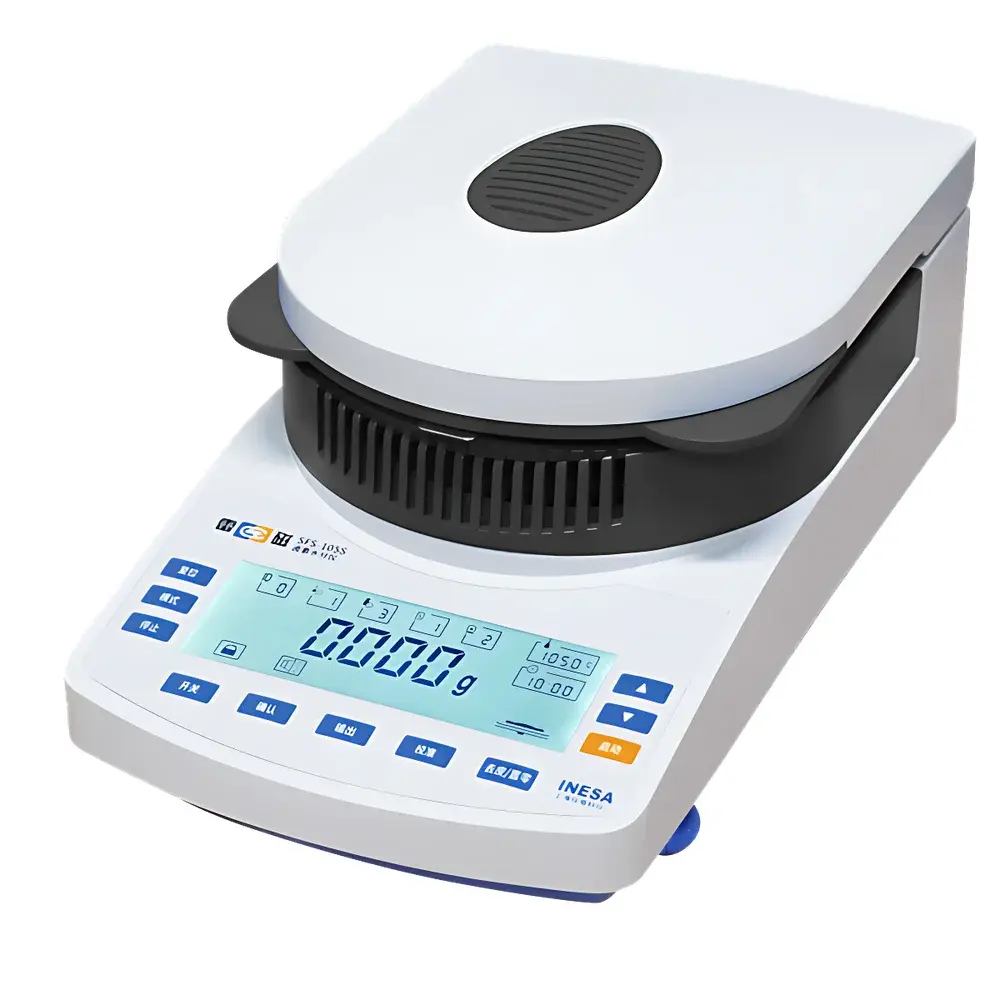
Leichi SFS-105S Halogen Moisture Analyzer
| Brand | Leichi |
|---|---|
| Origin | Shanghai, China |
| Manufacturer Type | Authorized Distributor |
| Country of Origin | China |
| Model | SFS-105S |
| Price | USD 445 (FOB Shanghai) |
| Weighing Range | 0.2 g to 110 g |
| Readability (d) | 5 mg |
| Verification Scale Interval (e) | 10 mg |
| Moisture Readability | 0.02 % |
| Accuracy Class | II (per OIML R76) |
| Minimum Sample Mass | 1 g |
| Heating Source | Circular Halogen Lamp |
| Temperature Control Range | Ambient to 180 °C |
| Heating Chamber Material | Heat-Resistant Polymer Housing |
| Sample Pan Diameter | 90 mm |
| Display | High-Resolution LCD with Real-Time Parameters |
| Drying Modes | Standard, Rapid, and Custom Timed |
| End Point Detection | Auto, Manual, and Semi-Automatic |
| Moisture Result Units | % Moisture, % Dry Weight, ATRO Dry Basis, ATRO Wet Basis |
| Interface | RS-232 Serial Port for Thermal Printer Output |
| Power Supply | 220 V ±10 %, 50/60 Hz |
| Dimensions (W×D×H) | 310 × 180 × 157 mm |
| Net Weight | 2.6 kg |
| Operating Environment | 10–30 °C, ≤80 % RH non-condensing |
Overview
The Leichi SFS-105S Halogen Moisture Analyzer is a precision gravimetric instrument engineered for rapid, repeatable determination of moisture content in solid and semi-solid materials via thermogravimetric loss-on-drying (LOD) methodology. It operates on the principle of controlled halogen lamp heating—delivering uniform radiant energy across the sample surface—to drive off volatile components while continuously monitoring mass loss with a high-stability electromagnetic force restoration balance. Designed for routine quality control laboratories, raw material inspection workflows, and production line verification, the SFS-105S complies with core regulatory expectations for LOD-based moisture testing as referenced in ASTM D4457, ISO 11885, USP <921>, and EP 2.2.32. Its architecture prioritizes operational robustness, thermal stability, and measurement traceability—critical for GLP-compliant documentation and internal audit readiness.
Key Features
- High-resolution LCD interface with intuitive navigation, supporting real-time display of temperature, elapsed drying time, dynamic moisture %, and mass trend curves
- Circular halogen heating system ensuring radial thermal uniformity and minimized edge overheating—reducing measurement bias in heterogeneous samples
- Triple-stage safety monitoring: audible/visual alerts for lid-open detection, out-of-range temperature deviation, and unstable weighing conditions
- Configurable drying protocols—including Standard (gradual ramp), Rapid (pre-set high-power burst), and User-Defined (custom ramp-hold profiles)—enabling method optimization per matrix type
- Four standardized reporting formats: moisture % (w/w), dry weight %, ATRO dry basis, and ATRO wet basis—facilitating direct integration with feedstock specifications and formulation databases
- Three endpoint logic modes: fully automated (mass change threshold ≤0.1 mg/5 s), manual (user-triggered stop), and semi-automatic (time-limited with auto-hold)
- RS-232 serial interface compliant with standard ESC/POS printer command sets—enabling timestamped, tamper-evident hardcopy output for batch records
Sample Compatibility & Compliance
The SFS-105S accommodates diverse sample types including pharmaceutical granules, food powders, polymer pellets, agricultural grains, and ceramic precursors—provided minimum mass requirements (≥1 g) are met and thermal degradation onset remains above 180 °C. Its polymer-based heating chamber meets IEC 61010-1 insulation and thermal containment requirements for Class II laboratory equipment. While not certified for hazardous area use, it conforms to CE marking directives (EMC 2014/30/EU, LVD 2014/35/EU) and supports documented method validation per ICH Q2(R2) guidelines. Calibration traceability aligns with national metrological standards through optional external weights (class M2 or better) and built-in calibration routines.
Software & Data Management
No proprietary PC software is bundled; however, the RS-232 interface enables seamless integration with third-party LIMS or ELN platforms via ASCII protocol (9600 baud, 8N1). All measurements retain embedded metadata—including date/time stamp, operator ID (manually entered), method name, temperature setpoint, and duration—within each printout or serial stream. Audit trail integrity is maintained through deterministic endpoint logic and non-volatile memory retention of the last 20 test records. For regulated environments, users may implement 21 CFR Part 11-compliant data capture using validated middleware that logs user actions, edits, and electronic signatures externally.
Applications
- Pharmaceutical: Excipient moisture screening prior to tablet compression (e.g., microcrystalline cellulose, lactose monohydrate)
- Food & Beverage: Routine QC of flour, coffee beans, dried fruits, and dairy powders against Codex Alimentarius moisture limits
- Chemicals: Verification of desiccant activity, catalyst hydration state, and solvent residue in specialty intermediates
- Agriculture: Field-to-lab grain moisture analysis aligned with ISO 6540 and ASABE S358.2 standards
- Plastics & Polymers: Pre-drying validation for hygroscopic resins (e.g., PA6, PET) before extrusion or injection molding
FAQ
What calibration standards are recommended for daily verification?
Use certified M2-class stainless steel weights (e.g., 10 g and 100 g) traceable to NIM or BIPM. Perform zero calibration before first use and span calibration at least once per shift when operating under ISO/IEC 17025 conditions.
Can the SFS-105S be used for volatile organic compound (VOC) quantification?
No—it measures total volatile loss, not compound-specific volatiles. For VOC identification and quantification, GC-MS or headspace-GC is required.
Is the halogen lamp replaceable by the end user?
Yes—the lamp module is field-replaceable using standard Torx T10 tools; typical service life exceeds 5,000 hours under continuous operation at ≤160 °C.
Does the instrument support password-protected method locking?
No native user-level access control exists; method security must be enforced externally via LIMS-level permissions or physical key-locking of the front panel during unattended operation.
How is thermal drift compensated during long-duration assays?
The balance employs active temperature compensation algorithms and a dual-sensor thermal feedback loop—monitoring both pan base and chamber ambient—to minimize drift-induced error below ±0.03 % over 60-minute runs.
Related Products







