
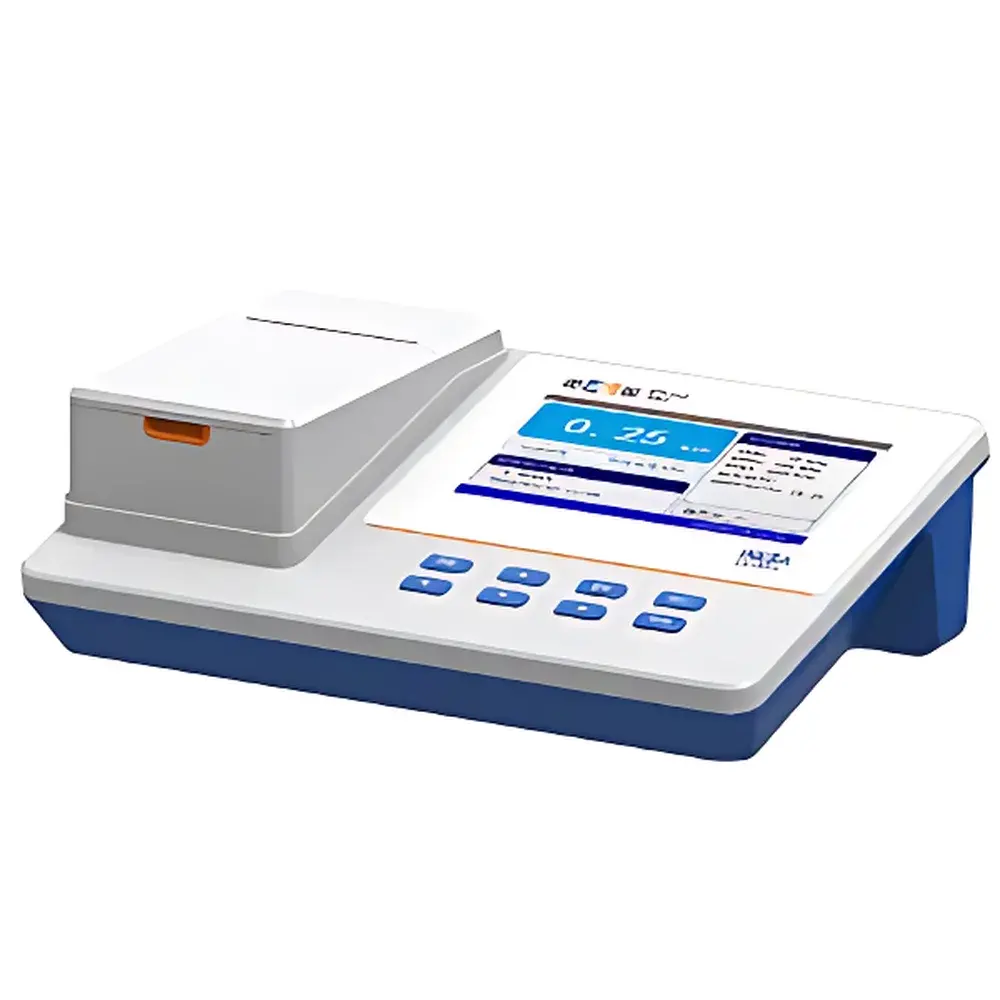
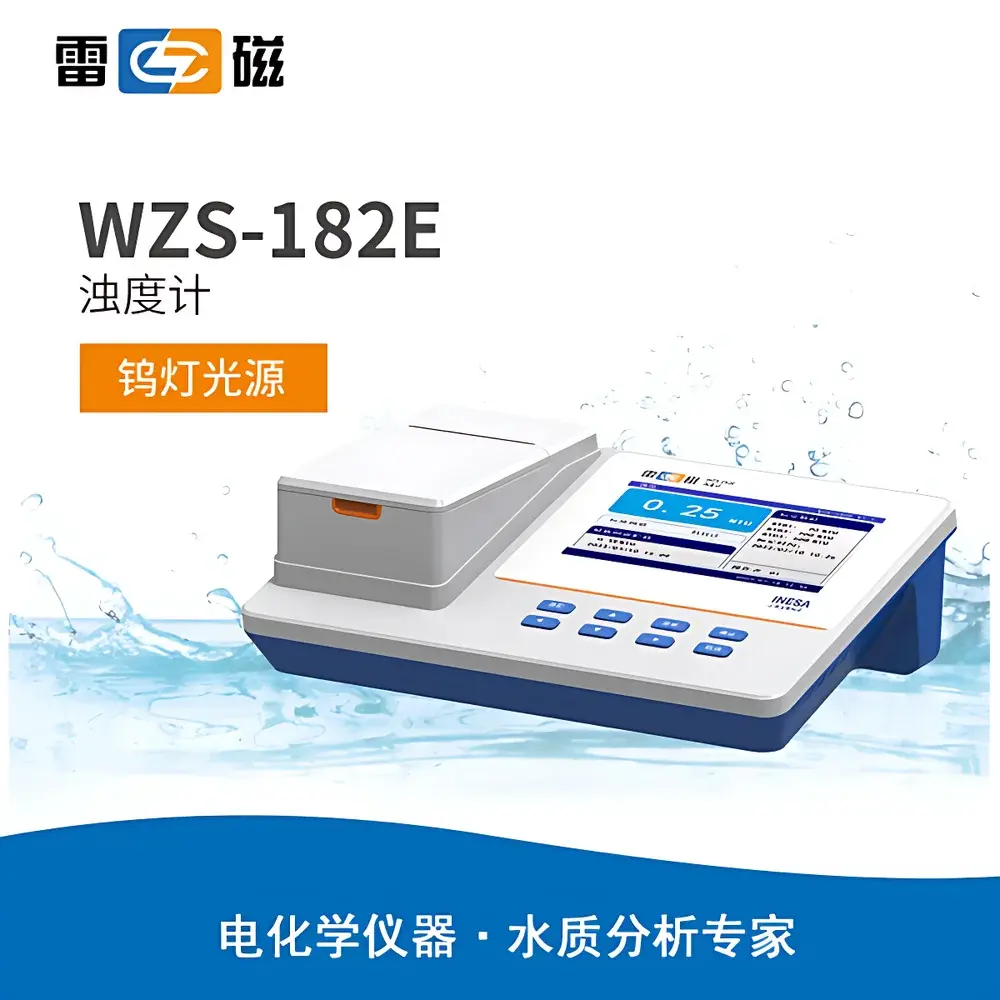
Leichi WZS-182E Benchtop Turbidimeter
| Brand | Leichi |
|---|---|
| Origin | Shanghai, China |
| Manufacturer Type | Direct Manufacturer |
| Regional Classification | Domestic (China) |
| Model | WZS-182E |
| Form Factor | Benchtop / Laboratory |
| Measurement Range | (0.00–9.99) NTU, (10.0–99.9) NTU, (100–500) NTU |
| Resolution | 0.01 / 0.1 / 1 NTU |
| Accuracy | ±6% |
| Light Source | Tungsten-Halogen Lamp |
| Measurement Principle | Nephelometric (90° scattered light) and Ratio (scattered + transmitted light) methods |
| Compliance | EPA Method 180.1, HJ 1075-2019 |
| Display | 5.7-inch high-resolution color LCD |
| Protection Rating | IP54 |
| Calibration Standards Included | Long-life turbidity standards at 20, 200, and 500 NTU |
| Data Management | Internal storage with USB and RS-232 interfaces |
| Regulatory Support | GLP-compliant data traceability, audit trail capability, user-accessible calibration history |
Overview
The Leichi WZS-182E Benchtop Turbidimeter is a precision optical instrument engineered for reliable, repeatable turbidity measurement in laboratory and quality control environments. It operates on the fundamental principles of nephelometry—detecting 90° scattered light intensity—and ratio turbidimetry, which simultaneously evaluates both scattered and transmitted light to minimize interference from color, absorbance, or particle size distribution anomalies. This dual-mode architecture ensures robust performance across diverse sample matrices, including drinking water, wastewater effluents, pharmaceutical process streams, and beverage formulations. Designed in strict accordance with USEPA Method 180.1 and China’s HJ 1075-2019 standard for turbidity determination, the WZS-182E delivers metrologically traceable results suitable for regulatory reporting and internal QC documentation.
Key Features
- 5.7-inch high-resolution color LCD interface with intuitive icon-based navigation and real-time graphical display of measurement dynamics
- Dual optical measurement modes: selectable 90° scattering (nephelometric) and ratio (scattered + transmitted) methods to accommodate colored or highly absorbing samples
- Auto-ranging capability across three calibrated ranges: 0.00–9.99 NTU (0.01 NTU resolution), 10.0–99.9 NTU (0.1 NTU resolution), and 100–500 NTU (1 NTU resolution)
- Integrated zero-point correction and multi-point calibration support—including single-point verification or full 3-point calibration using supplied long-life standards (20, 200, and 500 NTU)
- IP54-rated enclosure ensuring resistance to dust ingress and low-pressure water splashes—suitable for shared lab benches and non-sterile wet environments
- GLP-compliant data handling: time-stamped measurements, operator ID logging (via configurable user profiles), automatic storage of calibration events, and full audit trail export capability
Sample Compatibility & Compliance
The WZS-182E accepts standard 25-mm round glass cuvettes (supplied) and is compatible with ASTM D6508, ISO 7027-1:2016, and USP turbidity reference protocols when used with certified formazin or styrene divinylbenzene (SDVB) standards. Its optical design minimizes stray light errors and compensates for minor variations in cell positioning or surface imperfections. The instrument meets the photometric stability and repeatability requirements defined in EPA 180.1 for field-deployable and fixed-lab turbidimeters. All firmware and calibration parameters are stored in non-volatile memory, preserving integrity during power interruption (power-loss protection).
Software & Data Management
Data generated by the WZS-182E is stored internally with timestamp, unit selection (NTU, FNU, or EBC), measurement mode, and calibration status metadata. Up to 2,000 records can be retained and reviewed directly on-device. Export is supported via USB 2.0 (mass storage class) or RS-232 serial connection to legacy printers or PCs. Leichi’s proprietary communication software enables secure bidirectional data transfer, batch export in CSV format, and generation of GLP-compliant PDF reports—including calibration certificates, measurement logs, and deviation alerts. The system supports 21 CFR Part 11–aligned user authentication when deployed in regulated pharmaceutical or biotech labs.
Applications
- Drinking water treatment plants: raw intake monitoring, coagulation/flocculation optimization, and finished water compliance verification per WHO and national standards
- Pharmaceutical manufacturing: clarity testing of parenteral solutions, filter integrity validation, and cleaning verification rinse water analysis
- Environmental laboratories: wastewater discharge monitoring, stormwater runoff assessment, and sediment transport studies
- Food & beverage R&D: colloidal stability evaluation in juices, dairy emulsions, and fermented products
- Educational institutions: undergraduate analytical chemistry labs requiring EPA-validated turbidity methodology and hands-on calibration training
FAQ
Does the WZS-182E comply with EPA Method 180.1 for regulatory reporting?
Yes—the optical path geometry, detector linearity, and calibration traceability align with all instrumental performance criteria specified in EPA Method 180.1.
Can the instrument store calibration curves beyond the factory-default settings?
Yes—users may save up to five custom calibration curves, each with associated date, operator ID, and standard values, accessible via the Settings > Calibration History menu.
Is the USB interface compatible with modern Windows and macOS systems?
The device appears as a removable drive; no driver installation is required on Windows 7+ or macOS 10.14+. Data files are plain-text CSV and open natively in Excel or Numbers.
What is the recommended recalibration frequency under GLP conditions?
Per typical GLP practice, recalibration is advised before each analytical session or at least every 24 hours when performing continuous measurements—verified using the included 20 NTU standard.
Does the WZS-182E support password-protected user access levels?
Yes—three configurable roles (Operator, Supervisor, Administrator) control access to calibration, method editing, and data deletion functions, supporting ALCOA+ data integrity principles.





