
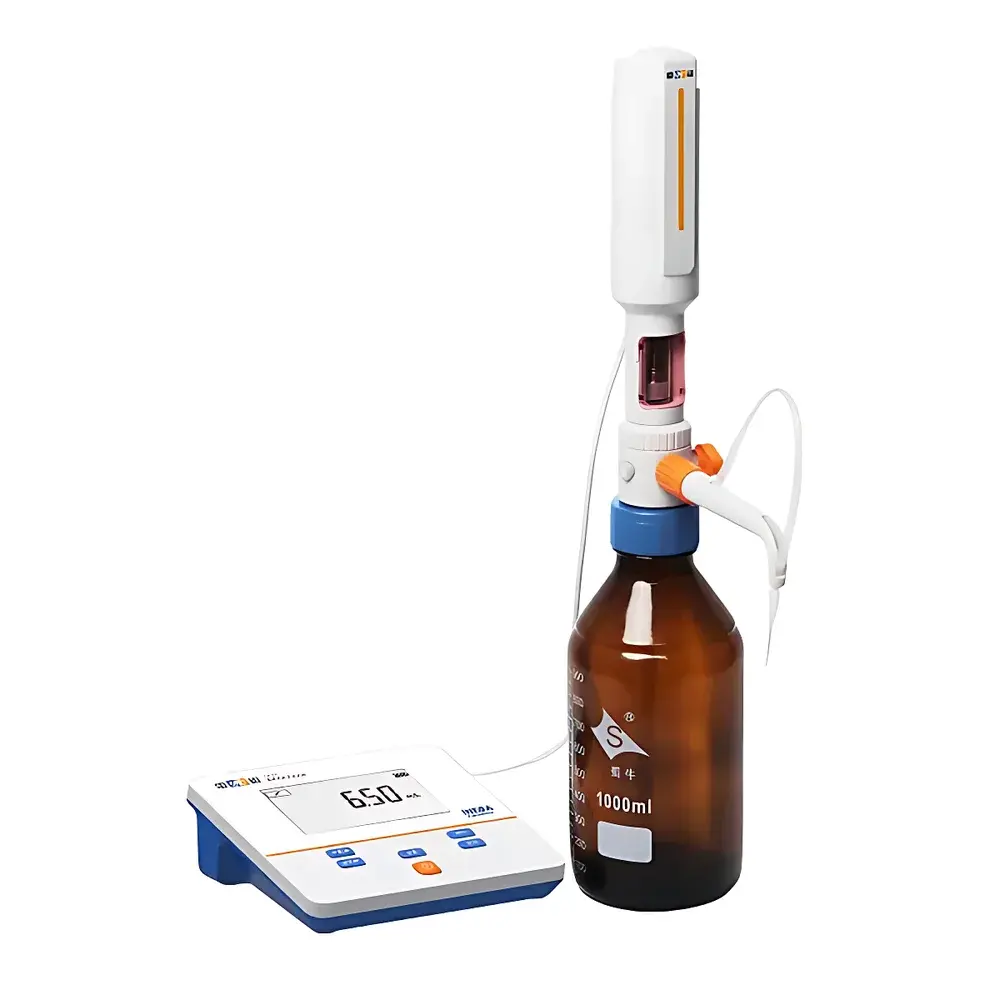
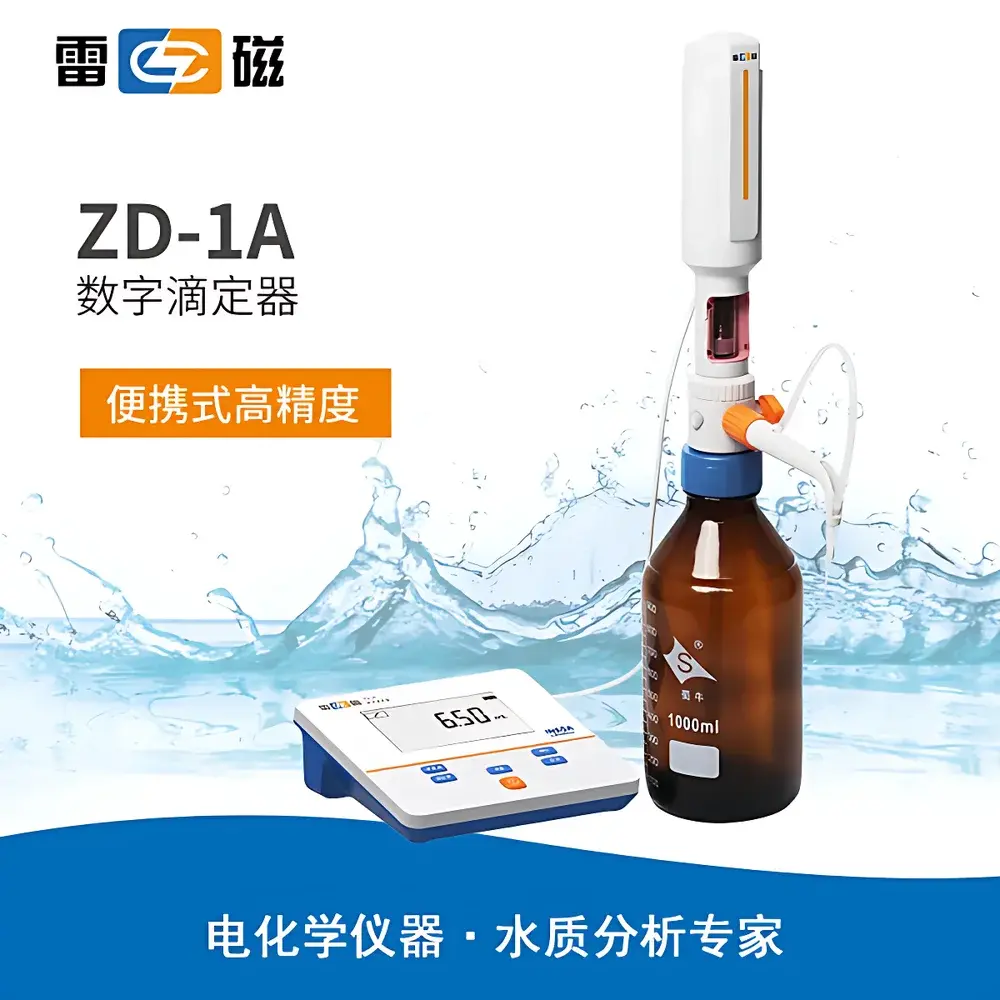
Leichi ZD-1A Portable Digital Burette
| Brand | Leichi |
|---|---|
| Origin | Shanghai, China |
| Manufacturer Type | Direct Manufacturer |
| Region of Origin | Domestic (China) |
| Model | ZD-1A |
| Price Range | USD 700 – 1,400 |
| Burette Capacity | 10 mL |
| Volume Measurement Range | 0.01–99.99 mL |
| Accuracy (Volume Error) | ±0.025 mL |
| Repeatability | ≤0.01 mL |
| Minimum Increment | 0.01 mL |
| Operating Temperature | 5–35 °C |
| Relative Humidity | ≤85% RH |
| Control Unit Dimensions | 170 × 160 × 60 mm |
| Dispensing Unit Dimensions (incl. 1 L reagent bottle) | 200 × 100 × 470 mm |
| Net Weight | ~1.5 kg |
| Power Supply | Rechargeable Li-ion battery |
| AC/DC adapter (Input | 100–240 V AC, Output: 5 V DC) |
| Liquid Handling Modes | Fixed-volume dispensing & Dynamic titration mode |
| Valve Functionality | Bidirectional (titration / reflow) |
| Adjustable Parameters | Rinse cycles (user-defined), refill speed (3 levels), drain speed (3 levels), burette calibration factor storage |
| Display | Backlit LCD with brightness adjustment |
| Power Management | Low-battery indicator, charging status feedback, auto-power-off |
Overview
The Leichi ZD-1A Portable Digital Burette is an electronically controlled, handheld titration instrument engineered for precision liquid delivery in field-deployable and benchtop laboratory environments. Unlike traditional manual burettes or fixed-installation automated titrators, the ZD-1A integrates a motor-driven dispensing unit with a standalone control module to deliver volumetric accuracy compliant with general analytical practice requirements for semi-quantitative and standardized titrimetric procedures. Its operational principle relies on stepper-motor-driven syringe-pump mechanics coupled with a calibrated glass or polymer 10 mL burette, enabling repeatable dispense increments down to 0.01 mL. The system supports both fixed-volume addition (e.g., for standard solution preparation or serial dilution) and dynamic titration (e.g., endpoint detection via external pH/mV sensor integration). Designed for robustness in variable ambient conditions (5–35 °C, ≤85% RH), the ZD-1A serves as a transitional tool between manual technique training and fully automated potentiometric titration systems—particularly where portability, battery operation, and rapid setup are prioritized over continuous high-throughput analysis.
Key Features
- Modular architecture: Physically and functionally decoupled control unit and dispensing unit—enabling independent replacement, recalibration, or firmware updates without system-level downtime.
- Bidirectional fluid path management via integrated solenoid valve: Supports forward titration and reflow mode, permitting recovery of unused reagent from the burette tip into the reservoir—reducing consumable waste by up to 30% in low-volume assays.
- Three-tier adjustable flow dynamics: Refill speed (Level 1–3), drain speed (Level 1–3), and programmable rinse cycles allow optimization for viscous reagents, volatile solvents, or particulate-containing solutions.
- On-device calibration factor storage: Each burette’s volumetric correction coefficient is retained in non-volatile memory; interchangeable units retain traceable volume metrology without recalibration upon swap.
- Extended operational autonomy: Integrated rechargeable lithium-ion battery provides ≥8 hours of continuous use under typical titration duty cycles; real-time battery level display and charging-status LED ensure workflow continuity.
- User-centric interface: Backlit monochrome LCD with adjustable brightness and auto-dimming logic; tactile membrane keypad designed for gloved operation and resistance to chemical splash exposure.
Sample Compatibility & Compliance
The ZD-1A accommodates aqueous, alcoholic, and moderately polar organic solvents (e.g., ethanol, acetone, acetonitrile) compatible with standard PTFE and borosilicate glass wetted materials. It is not rated for strong oxidizers (e.g., concentrated HNO₃, KMnO₄ solutions), hydrofluoric acid, or highly viscous media (>500 cP) without optional pump head modification. While not certified to ISO/IEC 17025 or ASTM E2028 for primary metrological traceability, its volume repeatability (≤0.01 mL) and accuracy (±0.025 mL) align with CLSI EP10-A3 guidelines for intermediate precision assessment in routine QC testing. The device meets IEC 61010-1:2010 safety requirements for electrical equipment used in laboratory settings and complies with RoHS 2011/65/EU directive on hazardous substances.
Software & Data Management
The ZD-1A operates as a standalone instrument with no embedded data logging or PC connectivity. All operational parameters—including volume setpoints, flow rates, rinse counts, and calibration factors—are stored locally in EEPROM and persist across power cycles. For laboratories requiring audit-ready records, manual transcription into LIMS or ELN systems is recommended. When deployed alongside external sensors (e.g., Leichi PHB-4 pH meter or DDS-307A conductivity meter), users may document titration events manually with time-stamped endpoint annotations. Though lacking FDA 21 CFR Part 11-compliant electronic signatures or audit trail functionality, the device supports GLP-aligned workflows when paired with procedural SOPs defining calibration frequency (recommended daily before first use), verification checks (e.g., gravimetric delivery test per ISO 8655-3), and environmental monitoring logs.
Applications
- Field-based water quality testing: Alkalinity, chloride, and hardness titrations per APHA Standard Methods 2320, 4500-Cl⁻, and 2340-C.
- Educational laboratories: Undergraduate chemistry courses teaching volumetric technique fundamentals, endpoint recognition, and error propagation analysis.
- Pharmaceutical QC labs: Assay validation support, reference standard dilution, and buffer preparation where GMP-grade automation is not mandated.
- Food & beverage QA: Titratable acidity (TA) determination in fruit juices and dairy products per AOAC 942.05 and IDF 14C:2003 protocols.
- Environmental screening: On-site soil extract titrations (e.g., exchangeable acidity in agricultural samples) using portable pH electrodes.
FAQ
Is the ZD-1A compatible with third-party burettes or dispensing tips?
No—the system is mechanically and electronically optimized for its proprietary 10 mL calibrated burette assembly. Substitution with non-Leichi components voids metrological validity and may damage the drive mechanism.
Can the instrument be calibrated using certified reference standards?
Yes. Users may perform volumetric calibration per ISO 8655-3 using Class A volumetric flasks or certified weight measurements. The calibration factor is entered directly via the keypad and stored in device memory.
Does the ZD-1A support RS-232, USB, or Bluetooth communication?
No. It is a closed-architecture instrument with no digital output interface. Data capture requires manual entry or external recording devices.
What maintenance intervals are recommended for long-term reliability?
Rinse the burette and valve manifold with deionized water after each use; perform full disassembly and O-ring inspection every 6 months or after 500 operating cycles. Store with burette empty and cap sealed.
Is the battery replaceable by the end user?
Yes—the Li-ion pack is accessible via two screws on the control unit baseplate. Replacement batteries must meet original specifications (3.7 V, ≥2600 mAh, UL1642-certified cell).



