
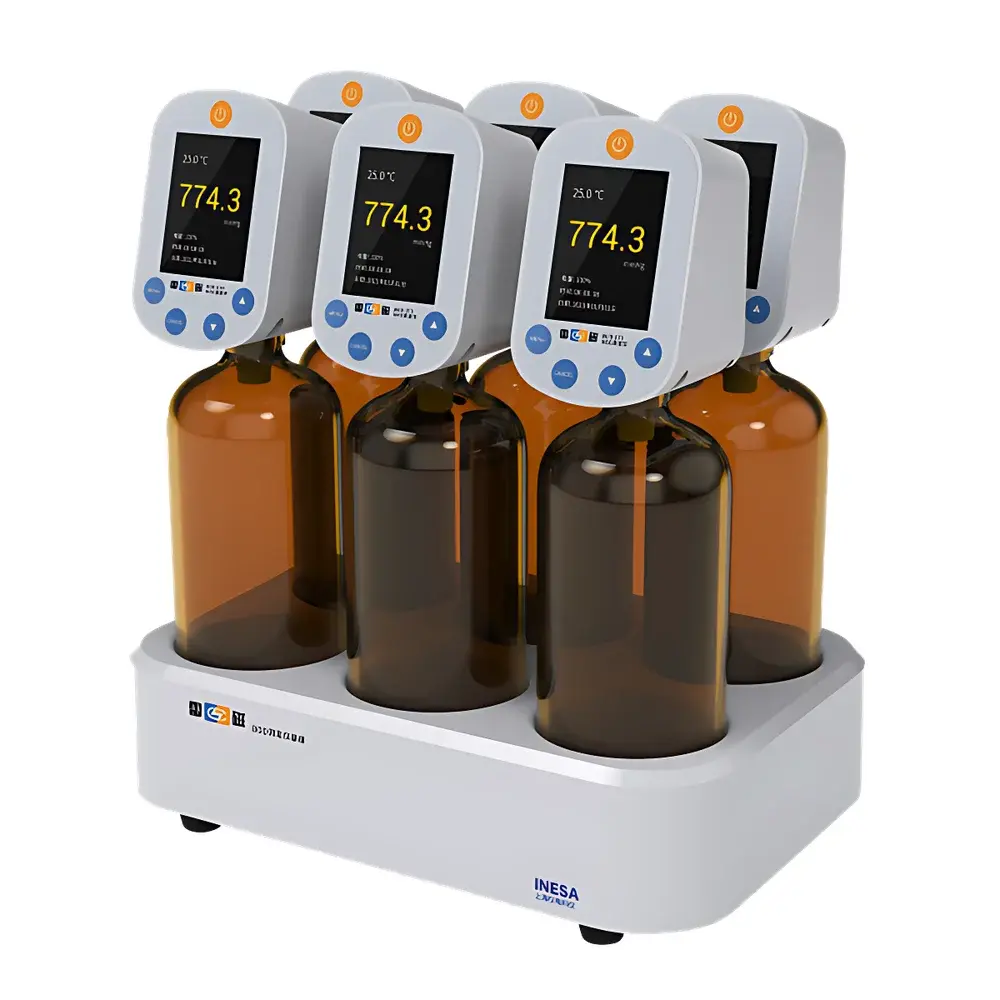
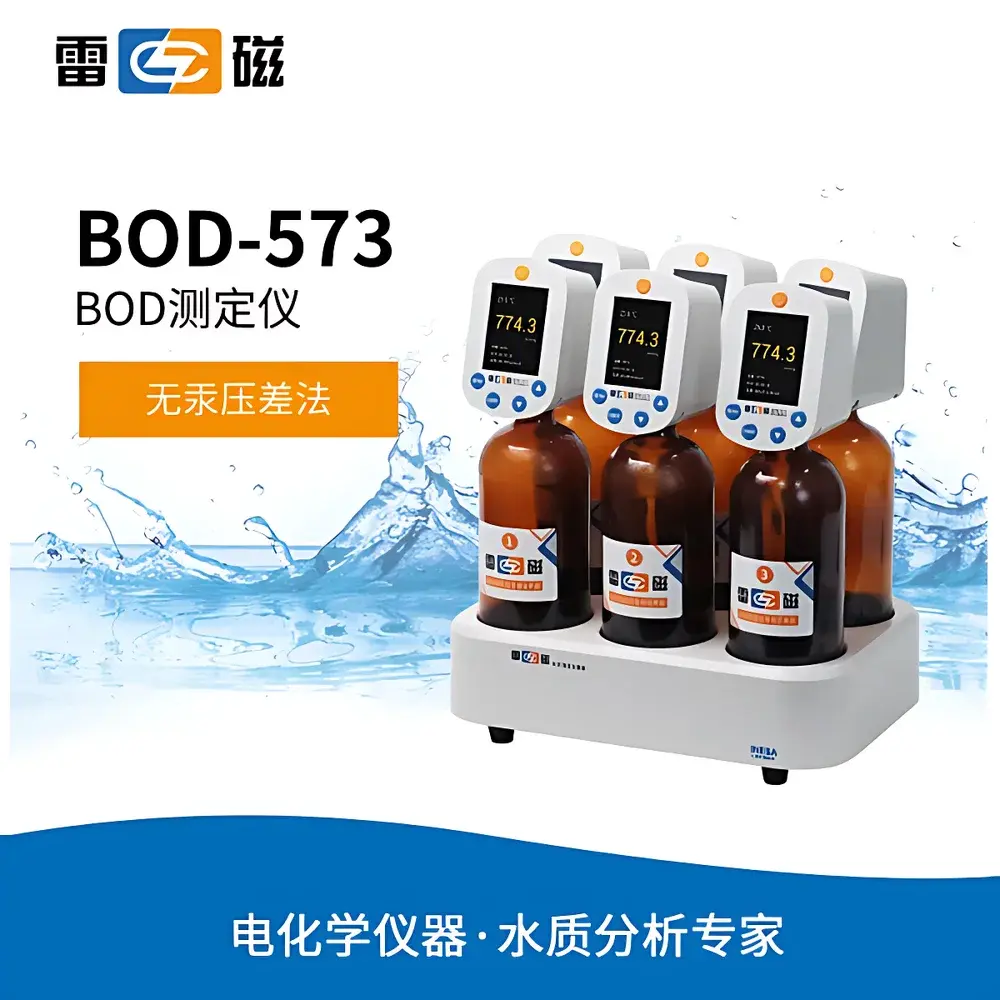
LeiCi BOD-573 Advanced Differential Pressure BOD Analyzer
| Brand | LeiCi |
|---|---|
| Origin | Shanghai, China |
| Manufacturer Type | Direct Manufacturer |
| Region Category | Domestic (China) |
| Model | BOD-573 |
| Price Range | USD 1,400 – 7,200 |
| Instrument Type | Laboratory BOD Analyzer |
| Measurement Principle | Differential Pressure Method |
| Measurement Range | 0–4000 mg/L |
| Accuracy | Compliant with HJ 505–2009 and ISO 5815-1:2019 for BOD₅ determination (validated using glucose-glutamic acid standard solution, BOD₅ = 180–230 mg/L) |
| Sample Capacity | Up to 6 samples per run |
| Incubation Duration | Programmable from 1 to 30 days |
| Data Retention | 10 years of BOD₅ result records |
| Cultivation Vessel Volume | 580 mL |
| Temperature Control | 20 ± 1 °C |
| Power Supply | AC 110–220 V, 50/60 Hz |
| Rated Power | 10 W |
| Dimensions (W × D × H) | 272 × 185 × 75 mm |
| Net Weight | 2.4 kg |
Overview
The LeiCi BOD-573 Advanced Differential Pressure BOD Analyzer is a fully automated, laboratory-grade instrument engineered for precise, reproducible biochemical oxygen demand (BOD) measurement in accordance with HJ 505–2009 (Chinese Environmental Protection Standard) and aligned with the fundamental principles of ISO 5815-1:2019. It employs a mercury-free differential pressure sensing methodology—replacing legacy manometric techniques—to quantitatively assess the dissolved oxygen consumed by aerobic microorganisms during the biodegradation of organic matter in water samples over defined incubation periods (1–30 days). Unlike dilution-based or titrimetric methods, the BOD-573 continuously monitors headspace pressure differentials induced by CO₂ absorption in a sealed, alkali-filled chamber adjacent to the sample vessel. This real-time, non-invasive approach eliminates operator intervention, minimizes analytical error sources (e.g., manual titration variability, reagent handling), and ensures traceable, auditable data generation under GLP-compliant workflows.
Key Features
- Mercury-free differential pressure transduction system with integrated high-precision barometric compensation—eliminates health and regulatory hazards associated with mercury-based manometry while maintaining sub-mbar resolution.
- Simultaneous parallel analysis of up to six 580 mL BOD bottles within a single temperature-controlled incubation chamber maintained at 20 ± 1 °C per ISO 5815-1 requirements.
- Programmable incubation duration (1–30 days) with automatic start trigger based on thermal equilibration—temperature delay logic ensures stable thermal conditions prior to assay initiation, reducing drift-related uncertainty.
- Onboard non-volatile memory storing ≥10 years of BOD₅ result datasets, including timestamped raw pressure differentials, calculated oxygen consumption curves, and final BOD values in mg/L.
- Automated data logging with full temporal resolution: users may review real-time progress, historical session traces, and comparative trend analysis without external software dependency.
- Zero-conversion reporting: results are directly output in standardized mg/L BOD units—no manual dilution factor application or unit conversion required.
- Low-power architecture (10 W nominal) enables continuous unattended operation; system auto-shuts down post-analysis and preserves all data integrity.
Sample Compatibility & Compliance
The BOD-573 accommodates a broad spectrum of aqueous matrices—including raw sewage, treated effluent, surface water, drinking water pre-filtrates, and industrial process streams—provided samples meet standard pretreatment criteria (e.g., pH adjustment, chlorine quenching, nitrification inhibition where applicable). Its pressure-based detection mechanism inherently tolerates moderate turbidity and suspended solids that may interfere with optical or electrochemical BOD sensors. The instrument’s performance validation protocol adheres to the glucose-glutamic acid (GGA) reference standard (BOD₅ = 180–230 mg/L), satisfying the precision and accuracy requirements specified in HJ 505–2009 and supporting equivalency assessments under US EPA Method 405.1 and ASTM D5210. All firmware and calibration routines are designed to support audit-ready documentation for ISO/IEC 17025-accredited laboratories and routine regulatory submissions to environmental authorities.
Software & Data Management
Data acquisition, storage, and export are managed via an embedded real-time operating system with local LCD interface and tactile navigation controls. No proprietary PC software is required for basic operation; however, optional USB-C data export enables CSV-formatted transfer for integration into LIMS platforms or statistical analysis suites (e.g., R, Python pandas, Minitab). Each stored record includes: unique session ID, sample ID, incubation start/end timestamps, ambient and chamber temperature logs, pressure differential time-series (1-min intervals), calculated BOD curve fit parameters (R² ≥ 0.995 typical), and final reported value with confidence flagging for outlier detection. Audit trails comply with ALCOA+ principles—data cannot be edited or deleted; only appended or archived. Firmware supports periodic calibration verification and user-accessible diagnostic logs for preventive maintenance scheduling.
Applications
The BOD-573 serves as a core analytical tool across multiple operational contexts: municipal wastewater treatment plants performing daily influent/effluent compliance monitoring; environmental monitoring stations conducting river basin load assessments; third-party testing laboratories delivering accredited BOD₅ reports for discharge permit renewals; food and beverage manufacturers verifying process water biodegradability prior to release; and academic research groups investigating microbial kinetics, bioremediation efficiency, or wastewater toxicity screening. Its robust design, low maintenance footprint, and absence of consumables (beyond standard NaOH pellets and GGA standards) make it especially suitable for high-throughput labs operating under budget and space constraints.
FAQ
Does the BOD-573 require daily manual intervention during incubation?
No. Once samples are loaded, parameters configured, and incubation initiated, the system operates autonomously—monitoring pressure differentials, applying temperature compensation, calculating BOD, and archiving results without user input.
Can the instrument validate compliance with US EPA or EU Water Framework Directive requirements?
While calibrated and verified per HJ 505–2009 and ISO 5815-1:2019, method equivalency documentation and site-specific validation are required for formal regulatory acceptance under US EPA or EU frameworks; the instrument provides the necessary metrological traceability and data structure to support such validation.
What maintenance is required beyond routine cleaning?
Annual verification of pressure sensor linearity and temperature chamber uniformity is recommended; no consumable sensors or electrolytes need replacement—the system relies on solid-state transducers and passive CO₂ absorption chemistry.
Is remote monitoring or network connectivity supported?
The base model features standalone operation only; Ethernet or Wi-Fi modules are not integrated but can be implemented via optional industrial IoT gateway interfaces for enterprise-level telemetry integration.
How is data integrity ensured during power interruption?
Non-volatile flash memory retains all active and historical datasets through power loss; the system resumes measurement from last valid timestamp upon restoration without data corruption or gap formation.
Related Products







