
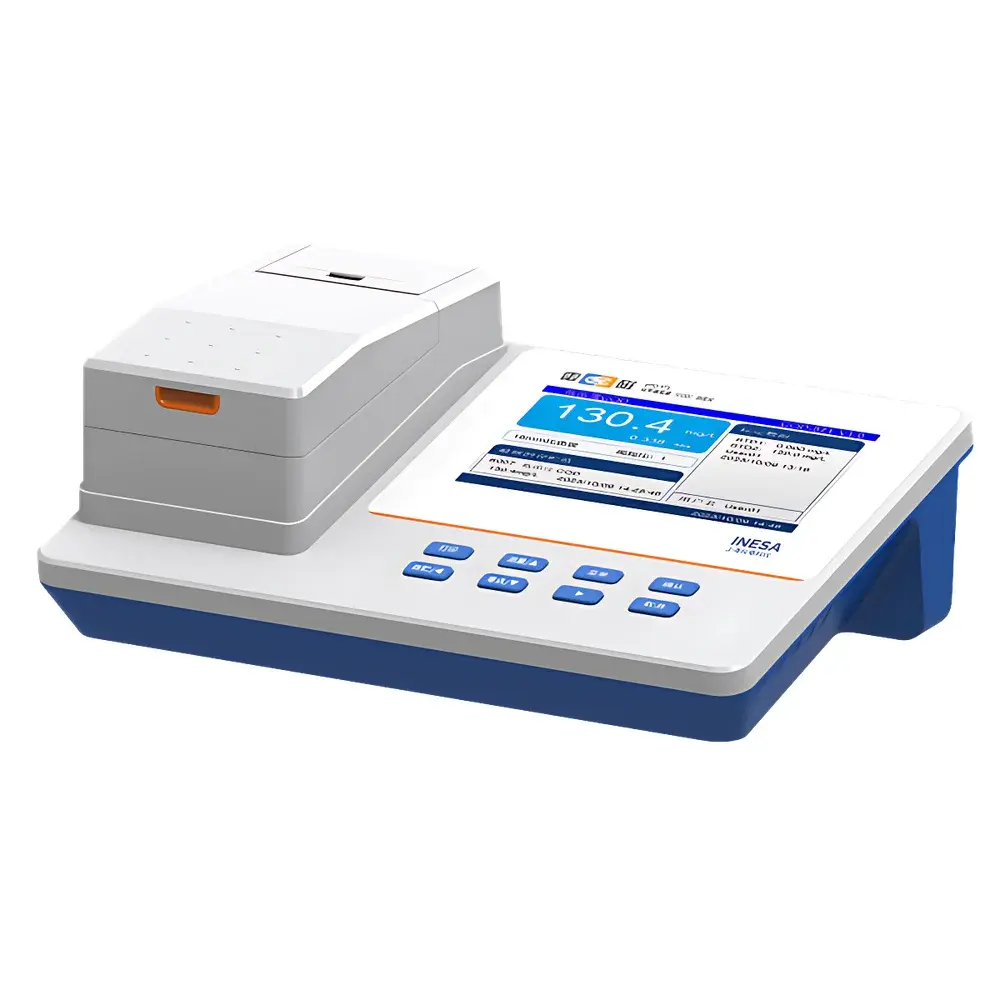
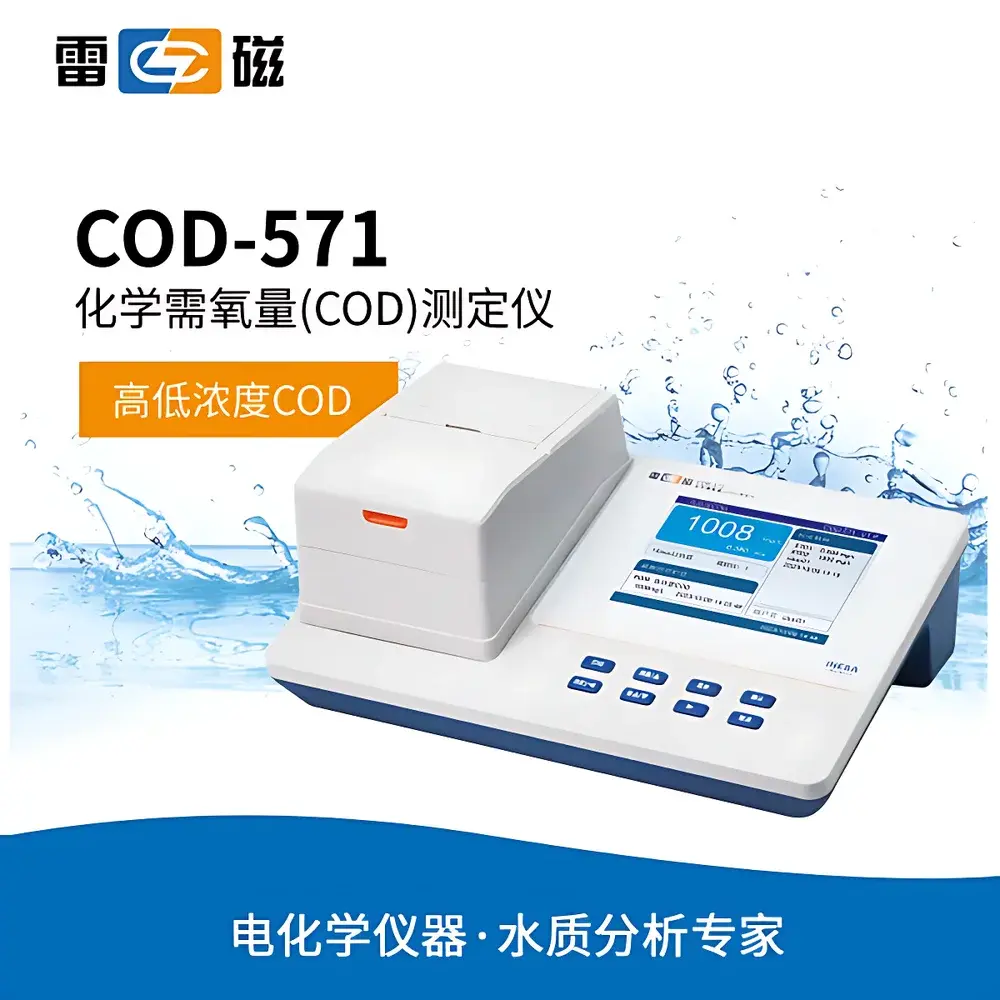
Leici COD-571 Chemical Oxygen Demand Analyzer
| Brand | Leici |
|---|---|
| Origin | Shanghai, China |
| Manufacturer Type | Direct Manufacturer |
| Regional Classification | Domestic (China) |
| Model | COD-571 |
| Instrument Type | Benchtop Laboratory Analyzer |
| Measurement Principle | Dichromate Digestion Method (2-hour standard digestion per ISO 6060 / HJ 828–2017) |
| Wavelengths | 420 nm and 620 nm |
| Measurement Ranges | 0–150 mg/L (low-range), 0–1500 mg/L (high-range) |
| Accuracy | ±8% of reading |
| Repeatability | ≤3% RSD |
| Measurement Time | ~20 min post-digestion |
| Throughput | Batch analysis of multiple water samples |
| Absorbance Range | 0.000–2.000 Abs |
| Absorbance Accuracy | ±0.01 Abs or ±5% |
| Absorbance Repeatability | ≤0.005 Abs or 2% |
| Wavelength Accuracy | ±4 nm |
| Transmittance Error | ±2% |
| Transmittance Repeatability | ≤0.5% |
| Cuvette Compatibility | 10 mm square cuvettes and 16 mm round test tubes |
| Data Storage | 2000 measurement records with timestamp, sample ID, dilution factor, and calibration metadata |
| Connectivity | RS-232, USB-B, optional U disk export |
| Power Supply | AC 100–240 V input / DC 24 V output adapter |
| Dimensions | 302 × 205 × 122 mm |
| Weight | 1.33 kg |
Overview
The Leici COD-571 Chemical Oxygen Demand Analyzer is a benchtop spectrophotometric instrument engineered for precise, compliant determination of chemical oxygen demand in municipal, industrial, and environmental water samples. It implements the standardized dichromate oxidation method (aligned with ISO 6060 and China’s HJ 828–2017), requiring prior 2-hour reflux digestion of samples with potassium dichromate under acidic conditions. Post-digestion, the analyzer quantifies Cr³⁺ formation photometrically at two discrete wavelengths—420 nm for low-concentration COD (0–150 mg/L) and 620 nm for high-concentration COD (150–1500 mg/L, extendable to 15,000 mg/L via programmable dilution). The dual-wavelength optical architecture eliminates interferences from turbidity and colored matrixes, improving robustness across diverse wastewater matrices. Designed for routine laboratory use, the COD-571 integrates digestion-ready sample handling with automated endpoint detection, eliminating subjective visual endpoint judgment and enhancing inter-operator reproducibility.
Key Features
- High-resolution color LCD interface with intuitive icon-driven navigation and multilingual on-screen prompts (English default)
- Dual-LED optical system: long-life, thermally stabilized 420 nm and 620 nm sources with ±4 nm wavelength accuracy and <0.5% transmittance repeatability
- Intelligent endpoint recognition algorithm that detects reaction completion during photometric measurement, enabling reliable automatic readout
- Programmable dilution ratio application: user-defined or auto-applied dilution factors trigger real-time back-calculation of original sample concentration
- Flexible calibration architecture: 1–5 point calibration for high-range COD; 2–5 point for low-range, with individual point re-calibration capability without full curve reset
- Built-in GLP-compliant data management: time-stamped records include operator ID, sample ID, digestion batch ID, calibration status, and audit trail metadata
- Integrated thermal printer with configurable print templates (summary report, raw absorbance, calibration log) and direct USB/U-disk export for LIMS integration
Sample Compatibility & Compliance
The COD-571 accommodates standard 10 mm square quartz or glass cuvettes and 16 mm round borosilicate test tubes—compatible with common digestion vial formats used in EPA 410.4 and HJ 828 workflows. It supports both domestic and international regulatory frameworks: fully traceable measurements meet GLP requirements for environmental testing labs; data structure and audit logs align with principles of FDA 21 CFR Part 11 (when paired with validated PC software); and methodology conforms to ISO 6060:1989 and Chinese national standard HJ 828–2017. All stored results retain full contextual metadata—including digestion temperature/time validation flags when interfaced with compatible external digesters—ensuring full chain-of-custody integrity.
Software & Data Management
Onboard firmware enables storage of up to 2000 complete measurement records, each containing absorbance values at both wavelengths, calculated COD concentration, dilution factor, calibration curve ID, date/time stamp, and operator code. Data export is supported via RS-232 serial link (ASCII protocol), USB-B host connection (mass storage mode), or direct U-disk transfer in CSV format. Optional Leici LabLink™ PC software provides advanced functions: trend analysis across batches, calibration curve visualization, statistical QC charting (X-bar/R), electronic signature capture, and automated report generation compliant with ISO/IEC 17025 documentation requirements. All data modifications are logged with immutable timestamps and user attribution.
Applications
The COD-571 serves core QA/QC functions across municipal wastewater treatment plants (influent/effluent monitoring), industrial effluent compliance labs (textile, pharmaceutical, food processing), environmental monitoring stations, and academic research laboratories conducting limnological or biodegradability studies. Its dual-range design supports both low-COD surface waters (e.g., rivers, reservoirs) and high-COD industrial discharges (e.g., brewery waste, landfill leachate). The instrument is routinely deployed in accreditation audits under CNAS (China National Accreditation Service) and supports method validation per ISO/IEC 17025 clause 7.2.2 for spectrophotometric COD determination.
FAQ
Does the COD-571 perform digestion internally?
No. The COD-571 is a post-digestion spectrophotometer only. Sample digestion must be conducted externally using a certified reflux digester or block heater per HJ 828–2017 or ISO 6060.
Can it measure COD without dichromate digestion?
No. This instrument is designed exclusively for the standard dichromate-based method. It does not support alternative oxidants (e.g., permanganate) or rapid digestion protocols.
Is the 15,000 mg/L upper limit achievable without manual dilution?
The 15,000 mg/L range requires user-defined dilution prior to analysis; the instrument applies the configured dilution factor automatically during result calculation.
How is GLP compliance implemented?
GLP adherence is enforced through mandatory operator login, immutable timestamped records, full calibration history retention, and electronic audit trails for all critical actions—including data deletion and factory reset.
What validation documentation is provided?
Each unit ships with a Factory Calibration Certificate traceable to NIM (National Institute of Metrology, China), optical performance verification report, and software validation summary per IEC 62304 Class B guidelines.







