
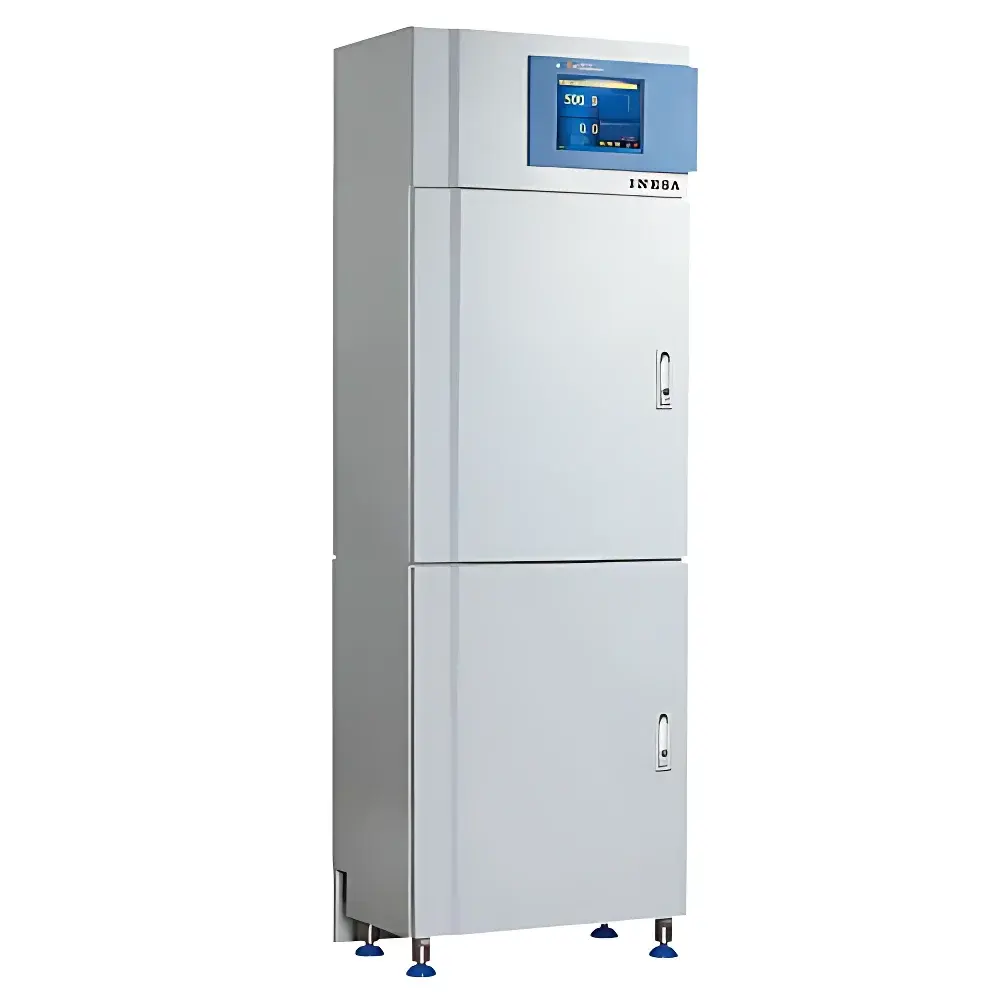
Leici COD-580 Online Chemical Oxygen Demand Analyzer
| Brand | Leici |
|---|---|
| Origin | Shanghai, China |
| Manufacturer Type | Direct Manufacturer |
| Regional Classification | Domestic (China) |
| Model | COD-580 |
| Instrument Type | Online Analyzer |
| Measurement Principle | Electrochemical Oxidation (Hydroxyl Electrode Method) |
| Measurement Range | 10.0–1000 mg/L |
| Resolution | 0.1 mg/L |
| Accuracy | ±5% of Full Scale (FS) |
| Repeatability | ≤3% FS |
| Zero Drift | ±5 mg/L per 24 h |
| Span Drift | ±10% per 24 h |
| Power Supply | AC 220 V ±10%, 50 Hz ±1% |
| Dimensions (W×D×H) | 600 × 455 × 720 mm |
| Weight | 50 kg |
| Interface Options | RS-232 standard |
| Display | 7-inch color touchscreen with Chinese UI |
Overview
The Leici COD-580 Online Chemical Oxygen Demand Analyzer is an industrial-grade, continuous-monitoring instrument engineered for real-time quantification of chemical oxygen demand in aqueous matrices. Unlike traditional laboratory-based COD analyzers relying on hazardous wet-chemistry digestion (e.g., dichromate reflux), the COD-580 implements a patented electrochemical oxidation methodology centered on hydroxyl radical generation at a specialized anode surface. This principle enables rapid, reagent-free oxidation of organic pollutants—without requiring concentrated sulfuric acid, potassium dichromate, or mercury sulfate—thereby eliminating hazardous waste generation, operator exposure risk, and regulatory handling burdens associated with Class 1 oxidants. The system operates under controlled flow conditions with precise electrode potential regulation and temperature-compensated current measurement, delivering traceable, stable output proportional to the oxidizable organic load. Designed for unattended operation in demanding environmental and process environments, it meets the functional requirements of continuous emission monitoring systems (CEMS) and integrated water quality surveillance networks.
Key Features
- Reagent-free electrochemical oxidation using hydroxyl electrode technology—no Cr(VI), Hg(II), or concentrated H2SO4 required
- Immunity to optical interferences: unaffected by sample color, turbidity, suspended solids, or humic substances
- Rapid cycle time: complete measurement in ≤6 minutes, enabling high-frequency monitoring (up to 10 samples/hour)
- Integrated anti-clogging sampling module with self-flushing valves and particle filtration—validated for wastewater with TSS up to 200 mg/L
- Automatic calibration sequence with dual-point (zero/span) verification using certified standard solutions
- Non-volatile memory with timestamped data logging (≥30 days at 15-min intervals); built-in power-fail recovery and state retention
- 7-inch capacitive touchscreen display with intuitive menu navigation and real-time trend visualization
- Dual communication architecture: native RS-232 for local diagnostics; field-upgradable to RS-485 Modbus RTU or MOSEM protocol for SCADA integration
Sample Compatibility & Compliance
The COD-580 accepts raw influent, treated effluent, surface water, and process streams across municipal, industrial, and utility applications. It maintains performance stability in pH ranges from 4.0 to 9.5 and conductivity up to 5 mS/cm. While not a direct replacement for ISO 6060 or ASTM D1252 (which mandate dichromate digestion), the analyzer is validated per Leici’s internal method Q/SHLJ 001–2023 and demonstrates strong correlation (R² ≥ 0.985) against reference dichromate results across 100–1000 mg/L in interlaboratory trials. Its design supports compliance with China’s HJ 353–2019 and HJ 354–2019 standards for online water quality monitoring equipment. For regulated environments, audit-trail functionality (user login, parameter change logs, calibration records) satisfies basic GLP documentation requirements; optional firmware upgrade enables 21 CFR Part 11–compliant electronic signatures and data integrity controls.
Software & Data Management
The embedded firmware supports local configuration via touchscreen or serial terminal. All operational parameters—including measurement interval, alarm thresholds (high/low/COD rate-of-change), auto-clean frequency, and calibration schedules—are programmable and password-protected. Data export is supported via CSV over USB or serial dump. When connected to a central SCADA platform via RS-485, the device transmits live COD values, status flags (e.g., “flow fault”, “electrode saturation”, “calibration due”), and diagnostic codes in real time. Remote firmware updates and configuration push are possible through secure MOSEM tunneling. No cloud dependency or proprietary software installation is required for core functionality—only standard Modbus-compatible HMIs or historian systems.
Applications
- Municipal wastewater treatment plants: real-time influent screening, bioreactor load balancing, and discharge compliance verification
- Industrial pretreatment monitoring: electroplating, petrochemical, pharmaceutical, and food processing facilities subject to local discharge permits
- Surface water quality networks: automated river/lake monitoring stations feeding national environmental information systems (e.g., China’s National Surface Water Monitoring Network)
- Power plant cooling water circuits: early detection of organic contamination from upstream sources or biofilm degradation
- Drinking water treatment: tracking NOM (natural organic matter) breakthrough after coagulation/filtration stages
FAQ
Does the COD-580 require daily reagent replenishment?
No—this is a reagent-free system. Electrode conditioning is performed automatically during idle periods; no consumables other than deionized water for rinsing are needed.
Can it replace laboratory COD testing for regulatory reporting?
It serves as a robust trending and early-warning tool. For official compliance submissions, confirm acceptance with local environmental authorities; many jurisdictions accept correlated online data when paired with periodic lab verification per QA/QC protocols.
What maintenance intervals are recommended?
Electrode polishing every 3 months; flow path inspection and filter cleaning every 2 weeks; full system validation (with certified standards) every 30 days.
Is the instrument suitable for seawater or brackish influents?
Not recommended for salinity >10,000 µS/cm without pre-dilution—high chloride concentrations accelerate electrode passivation and reduce measurement linearity.
How is sensor fouling mitigated during long-term deployment?
The system employs timed ultrasonic vibration of the electrode surface combined with reverse-flow backflush cycles triggered by pressure differential thresholds—proven effective in sludge-laden or fiber-rich wastewaters.
Related Products







