
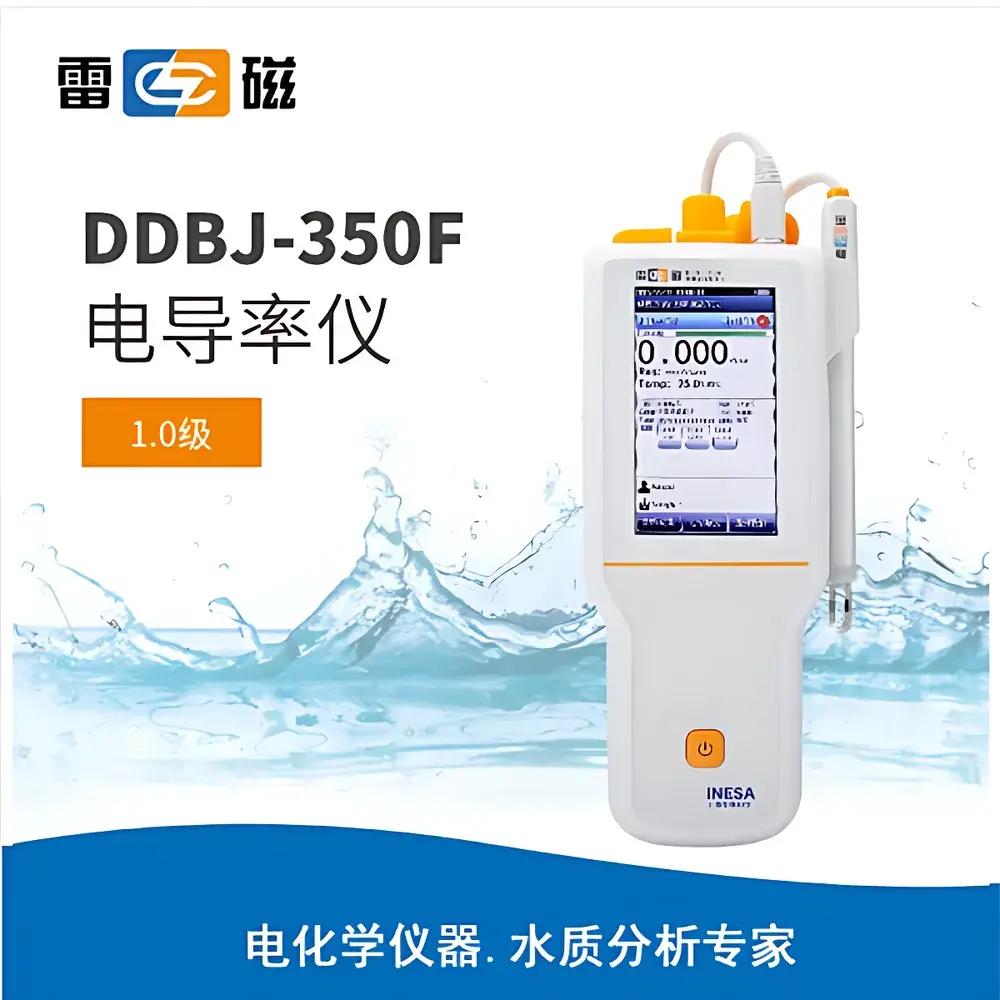
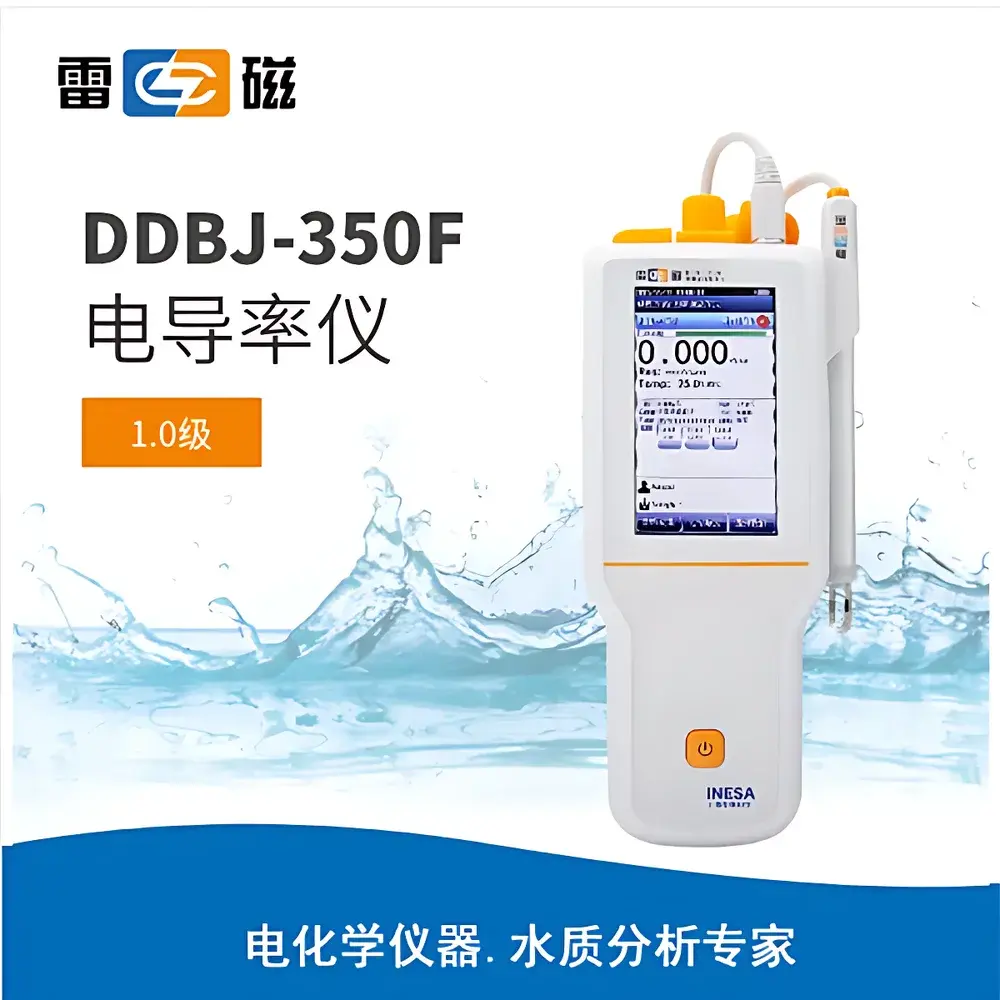
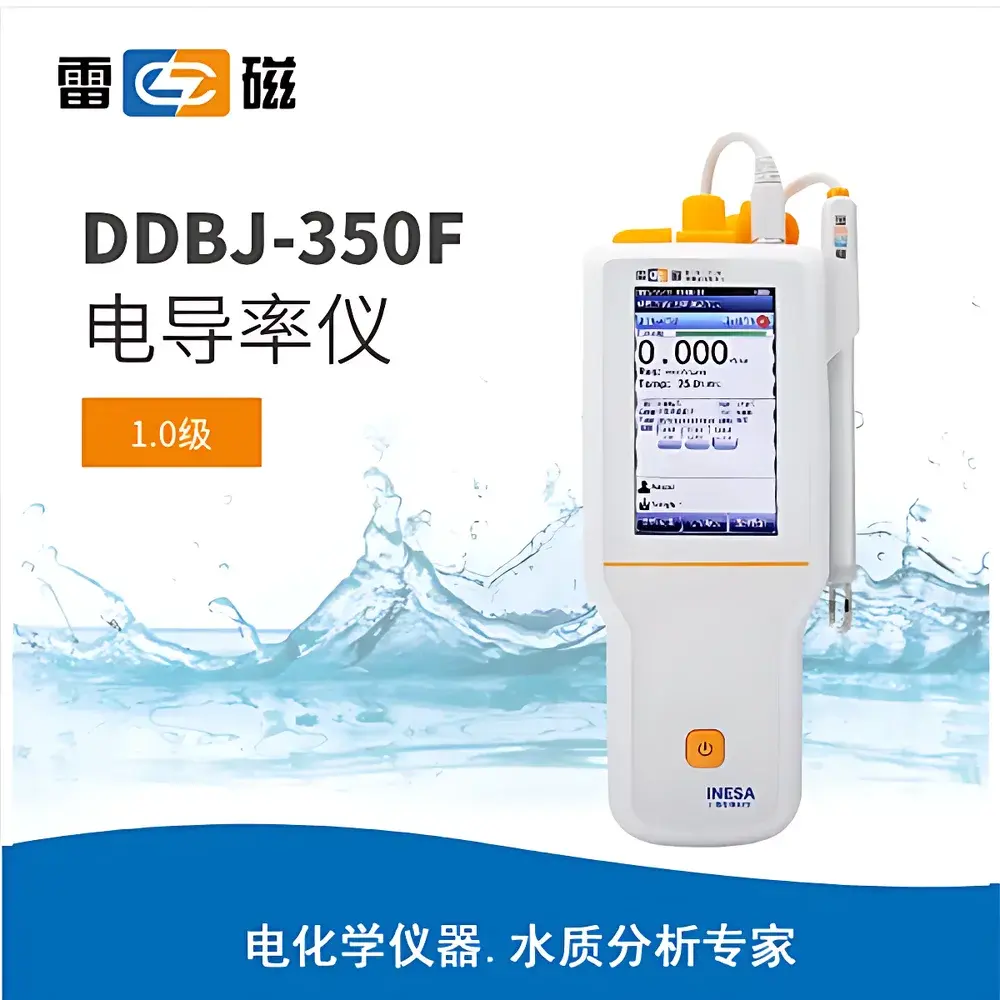
Leici DDBJ-350F Portable Conductivity Meter
| Key | Brand: Leici |
|---|---|
| Model | DDBJ-350F |
| Type | Portable Conductivity Meter |
| Measurement Parameters | Conductivity, Resistivity, TDS, Salinity, Temperature |
| Conductivity Range | 0.000 µS/cm to 1000 mS/cm |
| TDS Range | 0.000 mg/L to 300 g/L |
| Resistivity Range | 5.00 Ω·cm to 20.00 MΩ·cm |
| Salinity Range | 0.00–8.00 % |
| Temperature Range | −5.0–110.0 °C (23.0–230.0 °F) |
| Accuracy | ±1.0 % FS (Conductivity/Resistivity/TDS), ±0.2 % FS (Salinity), ±0.2 °C (Temperature) |
| Resolution | 0.001 µS/cm (Conductivity), 0.01 Ω·cm (Resistivity), 0.001 mg/L (TDS), 0.01 % (Salinity), 0.1 °C/°F (Temperature) |
| Auto-Ranging Resolution Switching | Yes |
| Temperature Compensation | Automatic/manual, linear/pure-water/non-compensated modes |
| Calibration | 1–3 point, auto-recognition of 4 GB standard solutions |
| IP Rating | IP65 |
| Data Storage | 1000 datasets per parameter |
| Interface | USB, RS-232 |
| Power | Rechargeable Li-ion battery, AC adapter (100–240 V AC input / 5 V DC output) |
| Dimensions | 90 × 258 × 42 mm |
| Weight | 0.5 kg |
Overview
The Leici DDBJ-350F Portable Conductivity Meter is a field-deployable, multi-parameter electrochemical analyzer engineered for high-precision measurement of conductivity, resistivity, total dissolved solids (TDS), salinity, and temperature in aqueous samples. Built on four-electrode conductivity measurement principles with automatic frequency switching and electrode constant adaptation (K = 0.01, 0.1, or 1.0 cm⁻¹), the instrument delivers trace-level resolution across six decades of dynamic range—from ultra-pure water (≥5.00 Ω·cm) to highly conductive industrial brines (up to 1000 mS/cm). Its design adheres to IEC 60746-3 and GB/T 6682–2008 standards for laboratory water quality analysis and supports configurable reference temperatures (20 °C or 25 °C), enabling compliance with ASTM D1125 and ISO 7888 protocols for standardized reporting. The meter operates independently of mains power, making it suitable for on-site monitoring in environmental sampling, wastewater treatment plants, pharmaceutical water systems, and food & beverage process control.
Key Features
- High-resolution 4.3-inch color TFT touchscreen with adjustable backlight and intuitive icon-based navigation
- IP65-rated enclosure for dust resistance and protection against low-pressure water jets—validated for use in humid or outdoor environments
- Intelligent endpoint detection with multiple read modes: auto-hold, timed reading, interval logging, and manual capture
- Auto-recognition of four national standard conductivity reference solutions (GB/T 11025–2021), supporting 1–3 point calibration with real-time electrode diagnostics
- Multi-mode temperature compensation: linear (α = 0.02/°C default), non-linear pure-water model (per ISO 7888 Annex B), and no-compensation options
- Dynamic range optimization via automatic frequency selection (1 kHz to 100 kHz), ensuring stable readings across low- and high-conductivity matrices
- Integrated data integrity safeguards: timestamped storage, user ID tagging, and electronic audit trail compliant with GLP requirements
Sample Compatibility & Compliance
The DDBJ-350F is validated for direct immersion measurement in liquid samples ranging from ultrapure water (e.g., WFI, PW) to seawater, brine, cooling tower water, boiler feedwater, and process rinse solutions. It accommodates both standard K = 1.0 cm⁻¹ electrodes for general-purpose applications and optional low-conductance probes (K = 0.1 or 0.01 cm⁻¹) for sub-20 µS/cm measurements—critical for pharmacopeial water testing (USP , EP 2.2.38). All measurement algorithms conform to ISO/IEC 17025 traceability frameworks. The device meets electromagnetic compatibility (EMC) requirements per IEC 61326-1 and carries CE marking under the EU Low Voltage Directive. Its firmware architecture supports future regulatory alignment with FDA 21 CFR Part 11 when paired with validated PC software and LIMS integration.
Software & Data Management
Data handling follows ALCOA+ principles: attributable, legible, contemporaneous, original, accurate, complete, consistent, enduring, and available. Each stored dataset includes measurement values, electrode ID, calibration history, ambient temperature, operator ID (if configured), and GPS coordinates (when connected to external GNSS module via USB). Up to 1000 records per parameter are retained in non-volatile memory. Export formats include CSV and XML, compatible with Microsoft Excel, LabArchives, and enterprise LIMS platforms. USB communication uses CDC ACM class drivers (no proprietary installers required), while RS-232 output enables direct connection to thermal strip printers supporting ESC/POS command sets. Firmware updates are performed via signed binary packages over USB, preserving configuration integrity and cryptographic verification.
Applications
- Environmental fieldwork: surface water, groundwater, and effluent monitoring per EPA Method 120.1 and ISO 13395
- Pharmaceutical water system validation: PW, WFI, and purified steam condensate testing aligned with USP and EU GMP Annex 1
- Food & beverage QC: conductivity-based concentration checks for brines, syrups, and cleaning-in-place (CIP) rinse verification
- Power generation: boiler feedwater purity assessment and condensate leak detection
- Academic teaching labs: hands-on electrochemistry instruction with real-time curve visualization and statistical summary functions
- Industrial maintenance: rapid verification of deionized water quality in semiconductor fab tools and electroplating baths
FAQ
Does the DDBJ-350F support FDA 21 CFR Part 11 compliance?
Yes—when used with Leici’s validated PC software (v3.2+), the instrument provides electronic signatures, role-based access control, and immutable audit trails meeting Part 11 requirements for regulated laboratories.
Can the meter measure conductivity below 1 µS/cm accurately?
With a certified K = 0.01 cm⁻¹ electrode and proper cell conditioning, the DDBJ-350F achieves ±1.0 % FS accuracy down to 0.001 µS/cm in ultrapure water—subject to calibration using NIST-traceable 0.5 µS/cm standard solution.
Is the battery replaceable by the end user?
No—the sealed Li-ion battery is service-replaceable only by authorized Leici technical centers to maintain IP65 integrity and calibration stability.
What happens during a power interruption while logging data?
The device implements write-caching and power-fail detection; all buffered measurements are committed to flash memory before shutdown, preventing data loss.
How often does the instrument require recalibration?
Per ISO/IEC 17025, calibration frequency depends on usage intensity and risk assessment—but typical practice is daily verification with a mid-range standard prior to critical measurements, with full multi-point calibration every 72 operational hours or after electrode cleaning.
Related Products




