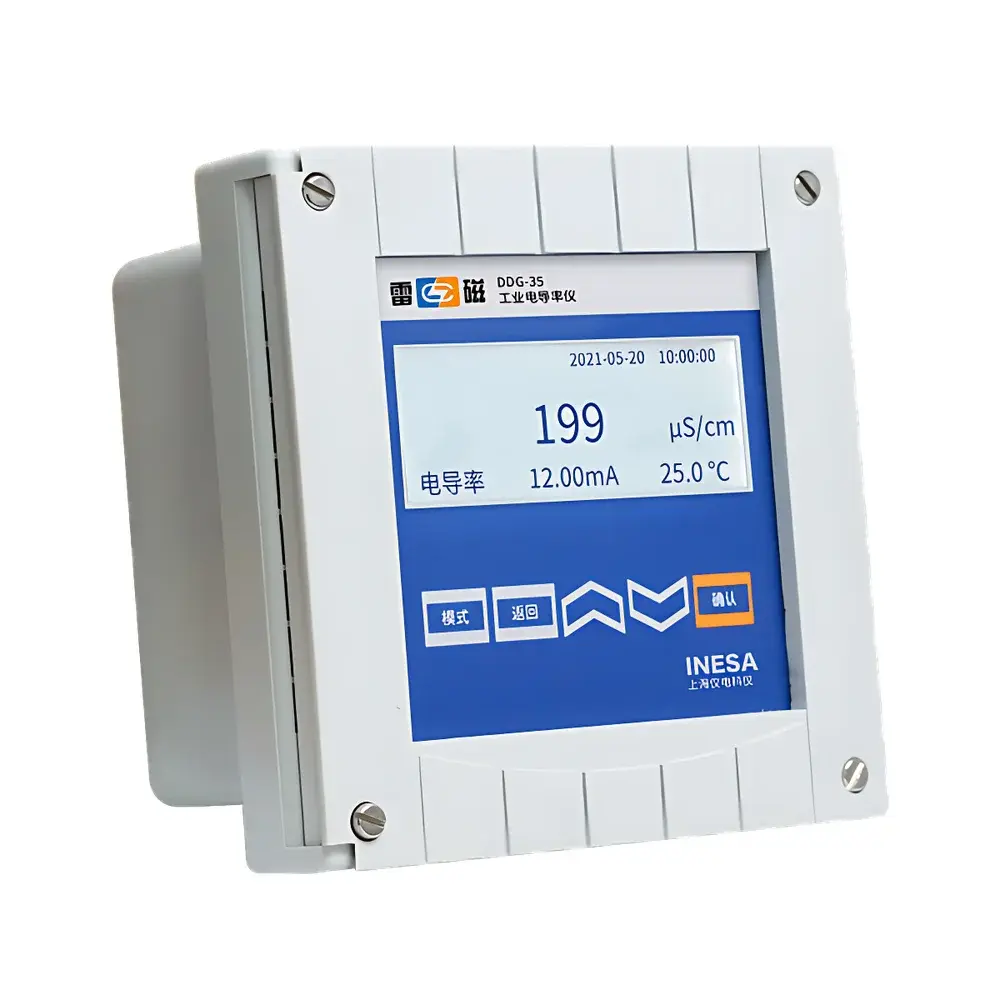
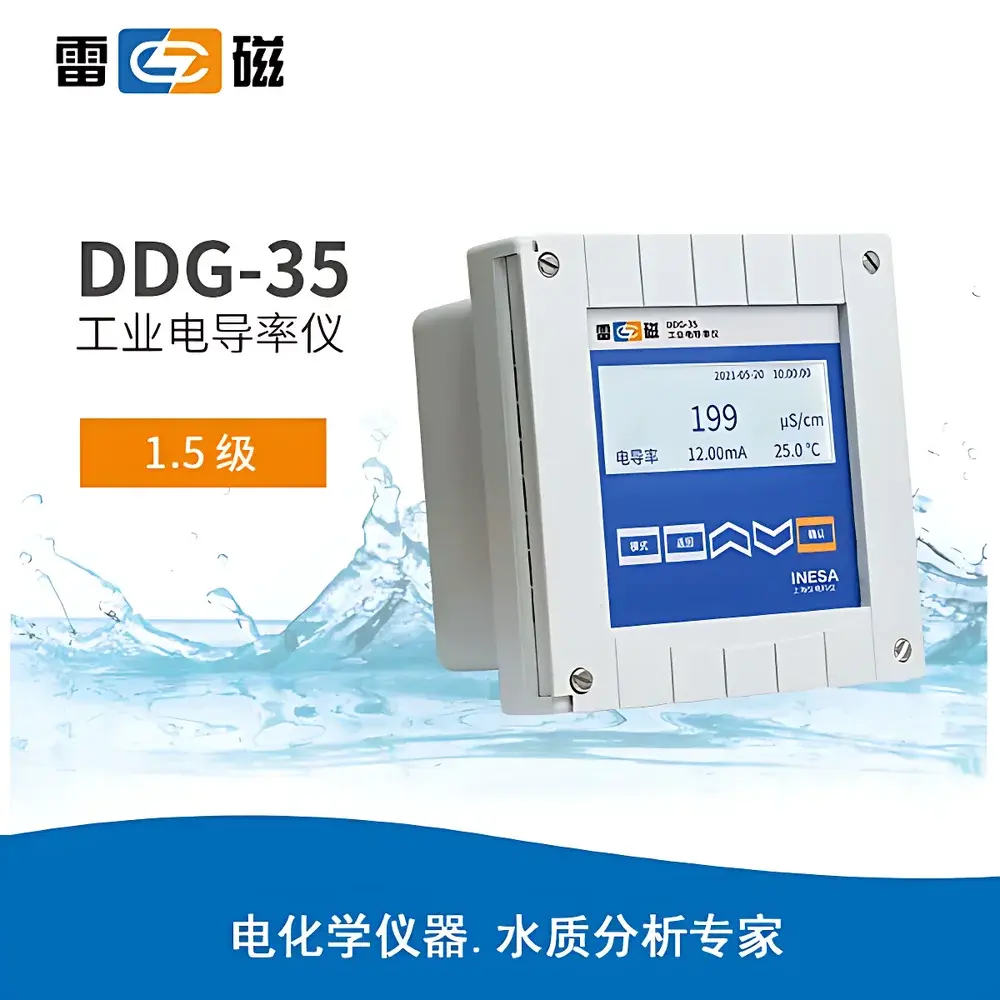
Leici DDG-35 Online Conductivity Analyzer
| Brand | Leici |
|---|---|
| Origin | Shanghai, China |
| Manufacturer | Leici (Shanghai Inesa Scientific Instrument Co., Ltd.) |
| Type | DDG-35 |
| Conductivity Range | 0.0 µS/cm to 200 mS/cm |
| Resistivity Range | 5.00 Ω·cm to 20 MΩ·cm |
| TDS Range | 0.0 mg/L to 100 g/L |
| Salinity Range | 0.00–8.00 % |
| Temperature Range | −10.0 to 120.0 °C |
| Basic Instrument Error | ±2.0 % FS (Conductivity) |
| Temperature Error | ±0.5 °C (0.0–60.0 °C), ±1.0 °C (other ranges) |
| Conductivity Resolution | 0.001 µS/cm (selectable: 0.001 / 0.01 / 0.1 / 1 µS/cm) |
| Temperature Resolution | 0.1 °C |
| Repeatability | 1.0 % FS (instrument), 0.3 % FS (electronic unit) |
| Auto-Temperature Compensation Range | −10 to 120 °C |
| Temp. Coefficient Adjustment | 0.0–10.0 %/°C |
| Output Signals | Isolated 4–20 mA DC (configurable span), Isolated RS-485 (Modbus RTU) |
| Enclosure Rating | IP65 |
| Dimensions | 166 × 166 × 110 mm |
| Weight | 2 kg |
| Standard Sensor Cable Length | 10 m |
| Mounting Cutout | 140 × 140 mm |
| Power Supply | AC 220 V ±10 %, 50 Hz ±1 % |
Overview
The Leici DDG-35 Online Conductivity Analyzer is an industrial-grade, microprocessor-controlled conductivity measurement system engineered for continuous, high-stability monitoring of aqueous process streams in demanding environmental and industrial applications. It operates on the principle of two- or four-electrode conductometric measurement—where electrical conductivity is derived from the reciprocal of solution resistance measured across a known cell constant—enabling accurate quantification of ionic concentration in real time. Designed specifically for high-conductivity media—including wastewater effluents, seawater intake, brine solutions, cooling tower water, and industrial discharge streams—the DDG-35 integrates robust sensor interface architecture with intelligent signal conditioning to minimize polarization errors and electrode fouling effects. Its dual-mode electrode compatibility (two-ring and four-ring conductivity cells) ensures optimal performance across wide dynamic ranges—from ultrapure water resistivity monitoring up to 20 MΩ·cm, to highly conductive saline or chemical process fluids exceeding 100 mS/cm.
Key Features
- Four-ring conductivity cell included as standard—designed to eliminate polarization effects and deliver stable readings in high-conductivity, high-fouling environments such as municipal wastewater and desalination pre-treatment systems
- Large dot-matrix LCD display showing simultaneous real-time values of conductivity, resistivity, TDS, salinity, and temperature—without requiring menu navigation
- Intelligent auto-ranging and automatic full-scale calibration support, reducing manual intervention and operator dependency
- Configurable temperature compensation using linear or non-linear (NaCl-based) algorithms, with adjustable temperature coefficient (0.0–10.0 %/°C)
- Dual isolation: galvanically isolated 4–20 mA analog output (user-defined upper/lower limits) and opto-isolated RS-485 serial interface supporting Modbus RTU protocol for SCADA and DCS integration
- IP65-rated front-panel enclosure—resistant to water jetting and dust ingress—suitable for wall-mount or panel-mount installation in wet or corrosive plant environments
- Data logging capability: stores up to 2,000 measurement records with configurable sampling intervals; supports recall and time-stamped review via front-panel interface
- Programmable alarm functions: independent high/low limit triggers for conductivity, TDS, salinity, or temperature—with relay outputs (optional external module) and visual/audio alerts
- Power-fail safeguard: retains configuration settings and last valid measurement during brief AC interruptions
- Optional automatic electrode cleaning control output (dry-contact relay) compatible with pneumatic or ultrasonic cleaning systems
Sample Compatibility & Compliance
The DDG-35 is validated for use with a broad spectrum of aqueous samples encountered in municipal, marine, power generation, food & beverage, and chemical processing facilities. Its four-ring cell design meets ASTM D1125 and ISO 7888 requirements for conductivity measurement in high-salinity and high-turbidity waters. The instrument’s electronic unit conforms to IEC 61326-1 (EMC for industrial environments) and IEC 61000-4 series immunity standards. While not certified for SIL or ATEX zones, its IP65 housing and isolated outputs enable safe deployment in non-hazardous classified areas per NEC Class I, Division 2 guidelines. Calibration traceability aligns with NIST-traceable standards when used with certified KCl reference solutions (e.g., 0.01 mol/kg, 0.1 mol/kg). For regulated environments—including wastewater treatment plants subject to EPA Clean Water Act reporting or pharmaceutical utilities operating under cGMP—the DDG-35 supports audit-ready operation when paired with external data acquisition systems compliant with FDA 21 CFR Part 11 requirements.
Software & Data Management
The DDG-35 operates autonomously without proprietary PC software; all configuration, calibration, and data review are performed directly via its intuitive keypad and LCD interface. However, its RS-485/Modbus RTU port enables seamless integration into third-party supervisory systems—including Ignition SCADA, Siemens Desigo CC, Honeywell Experion PKS, and custom LabVIEW or Python-based data loggers. Modbus register mapping includes live process variables (conductivity, temp, TDS), status flags (alarm states, calibration due), and configuration parameters (cell constant, temp coefficient, output scaling). For laboratories requiring GLP-compliant recordkeeping, the device’s internal memory provides timestamped storage with cycle-accurate resolution (down to 1-second intervals), though long-term archival and electronic signature functionality must be implemented at the host system level.
Applications
- Continuous monitoring of influent and effluent conductivity in municipal and industrial wastewater treatment plants
- Seawater desalination pretreatment and post-treatment quality assurance (e.g., RO feed and permeate conductivity verification)
- Cooling water system management—detecting chloride breakthrough, scaling potential, and leak detection in closed-loop circuits
- Boiler feedwater and condensate purity surveillance in thermal power generation
- Process control in electroplating, anodizing, and etching baths where ionic strength directly impacts reaction kinetics
- Environmental compliance monitoring at NPDES outfalls and stormwater discharge points
- Salinity tracking in aquaculture recirculating systems and marine research buoys
FAQ
What types of conductivity sensors are compatible with the DDG-35?
The analyzer supports both two-electrode and four-electrode conductivity cells with standardized BNC or DIN connectors. The included four-ring cell (model-specific, e.g., DJS-1C-4) is optimized for high-conductivity, high-fouling applications.
Does the DDG-35 support automatic temperature compensation for non-aqueous solutions?
No—it implements temperature compensation algorithms calibrated for aqueous electrolytes only, per ISO 7888 and ASTM D1125. Use is restricted to water-based samples.
Can the 4–20 mA output be scaled to represent resistivity instead of conductivity?
Yes—the user may assign any linear range (e.g., 0–20 MΩ·cm) to the analog output, independent of the primary displayed parameter.
Is firmware upgrade possible in the field?
Firmware updates require connection to a Leici service tool via RS-232 (not provided with standard shipment); upgrades are performed by authorized service centers only.
What maintenance intervals are recommended for long-term reliability?
Electrode cleaning frequency depends on sample fouling rate; quarterly verification against traceable KCl standards is advised. Annual inspection of cable integrity and connector corrosion is recommended in coastal or chemically aggressive installations.
Related Products