
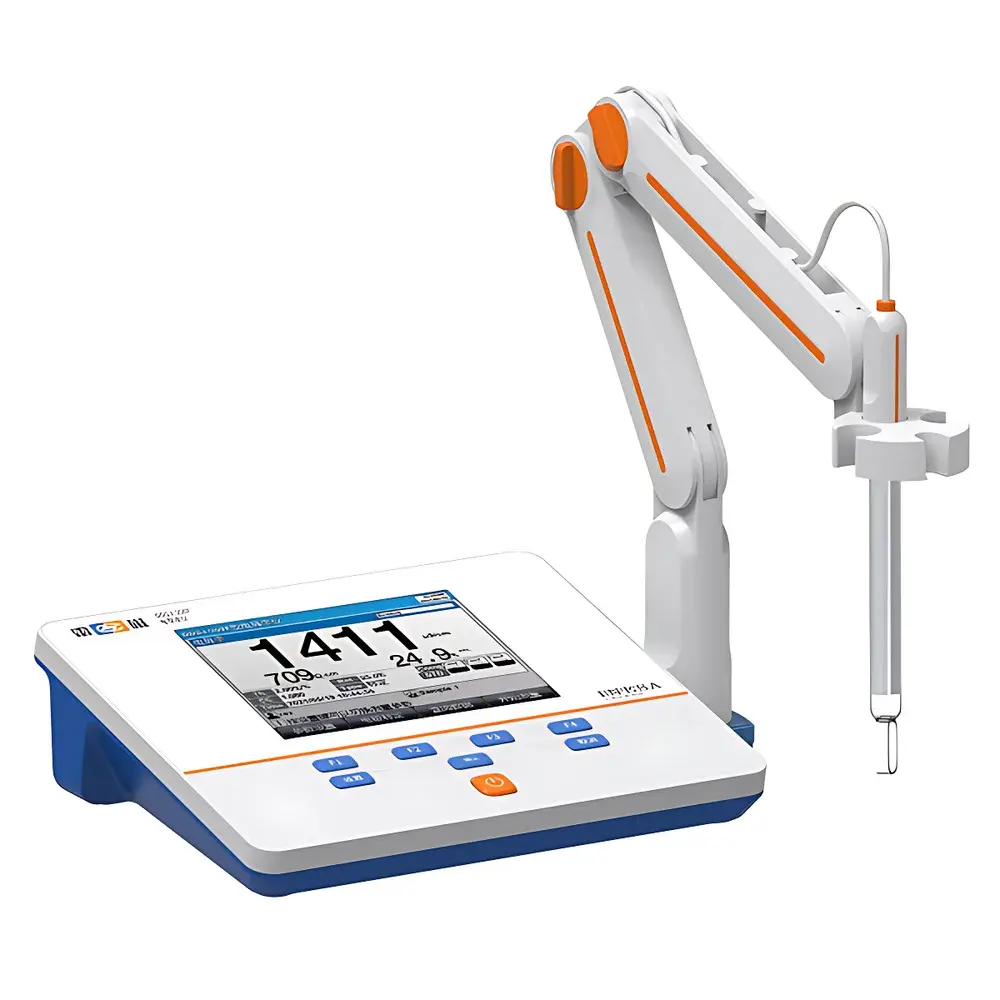
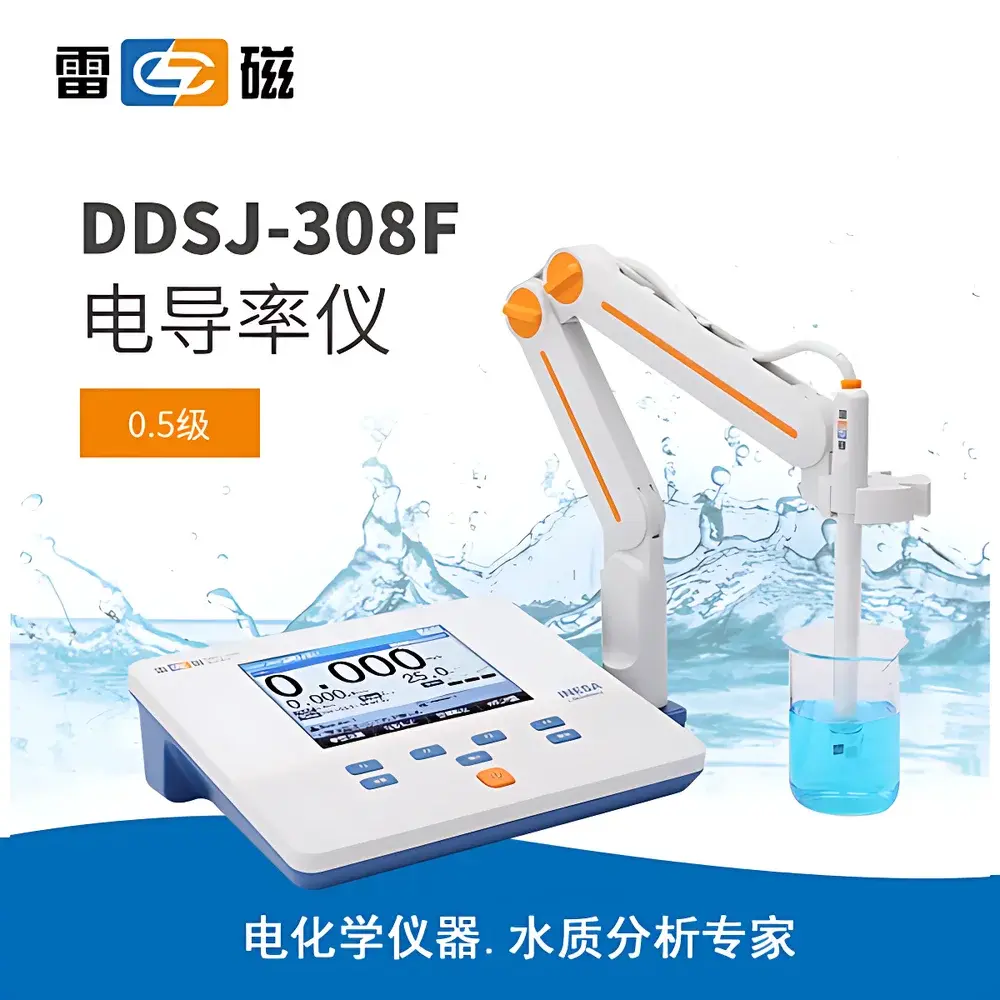
Leici DDSJ-308F Benchtop Conductivity Meter
| Key | Brand: Leici |
|---|---|
| Origin | Shanghai, China |
| Manufacturer Type | OEM Manufacturer |
| Instrument Type | Benchtop Laboratory Conductivity Meter |
| Model | DDSJ-308F |
| Conductivity Range | 0.000 μS/cm to 1000 mS/cm |
| TDS Range | 0.000 mg/L to 1000 g/L |
| Resistivity Range | 5.00 Ω·cm to 100.0 MΩ·cm |
| Salinity Range | 0.00–8.00% |
| Temperature Range | −10.0–135.0 °C |
| Accuracy | ±0.5% FS (Conductivity, Resistivity, TDS), ±0.1% FS (Salinity), ±0.1 °C (Temperature) |
| Resolution | 0.001 μS/cm (auto-ranging), 0.01 Ω·cm, 0.001 mg/L, 0.01%, 0.1 °C |
| Temperature Compensation | Automatic/manual, with selectable reference temperatures (20 °C or 25 °C) |
| Calibration | 1–3 point, auto-recognition of 4 GB-standard conductivity solutions |
| Data Storage | 500 datasets per parameter |
| Interface | RS-232 (for printer), USB (for PC connectivity) |
| Protection Rating | IP54 |
| Power Supply | AC 100–240 V input, DC 9 V output |
| Dimensions | 242 × 195 × 68 mm |
| Weight | 0.9 kg |
Overview
The Leici DDSJ-308F is a high-precision benchtop conductivity meter engineered for routine and advanced electrochemical analysis in regulated laboratory environments. It operates on the principle of two-electrode or four-electrode conductometric measurement—applying an alternating current across a conductive cell and quantifying the resulting conductance, from which conductivity (σ), resistivity (ρ), total dissolved solids (TDS), and salinity are derived using standardized conversion algorithms. The instrument conforms to Chinese national metrological verification regulation JJG 376–2007 and aligns with international practices referenced in ISO 7888 (water quality — determination of electrical conductivity) and ASTM D1125 (standard test methods for electrical conductivity of water). Designed for GLP-compliant workflows, it supports traceable measurements through embedded audit trail metadata, timestamped calibration logs, and user-defined ID tagging—critical for pharmaceutical QC, environmental monitoring labs, and university research facilities requiring reproducible, defensible data.
Key Features
- High-resolution 4.3-inch color TFT LCD display with intuitive icon-driven interface and multi-language support (English, Chinese)
- Auto-ranging measurement engine with dynamic resolution switching: 0.001 μS/cm at low-conductivity ranges, scaling up to 0.1 mS/cm at high-end intervals
- Configurable temperature compensation models: non-compensated, linear (α = 2.0%/°C default), or pure-water mode (per IAPSO formulation), with user-selectable reference temperatures (20 °C or 25 °C)
- Intelligent endpoint detection: supports auto-hold, timed reading (1–600 s intervals), and manual capture—optimized for unstable samples or kinetic studies
- Automatic electrode constant recognition for K = 0.01, 0.1, 1.0, and 10.0 cm−1 cells; full-range coverage with K = 1.0 sensor (recommended K = 0.1 or 0.01 for samples <20 μS/cm)
- Robust mechanical architecture rated IP54—dust-resistant and splash-protected—suitable for shared lab benches and humid environments
- Firmware-upgradable platform enabling future protocol expansion (e.g., custom TDS conversion factors, extended salinity algorithms)
Sample Compatibility & Compliance
The DDSJ-308F accommodates aqueous samples across broad physicochemical domains: ultrapure water (≥5.00 Ω·cm), process cooling water, boiler feedstock, seawater analogues (up to 8.00% salinity), and aggressive industrial effluents (up to 1000 mS/cm). Its dual-mode electrode compatibility allows seamless transition between general-purpose stainless-steel sensors and platinum black-coated or graphite electrodes for high-accuracy low-conductivity work. All measurement modes comply with GLP data integrity requirements: each stored record includes operator ID, calibration history, temperature at time of measurement, electrode constant, and ambient pressure (if externally logged). While not FDA 21 CFR Part 11–certified out-of-box, the instrument’s immutable log structure, password-protected configuration menus, and exportable CSV/Excel-compatible files support validation under GMP Annex 11 and ISO/IEC 17025 frameworks.
Software & Data Management
- Onboard storage capacity: 500 datasets per measured parameter (conductivity, resistivity, TDS, salinity, temperature), each tagged with date/time stamp and operator code
- Data review options: tabular listing, chronological scrolling, and trend visualization via built-in curve plotter (X-axis = time, Y-axis = parameter value)
- Direct thermal printing via RS-232 port using standard ESC/POS protocols; customizable print templates include header fields (lab ID, SOP number, analyst signature line)
- PC synchronization via USB-B port using Leici’s proprietary LeiciLab™ Communication Suite (Windows 10/11 compatible), enabling batch export, statistical summary (mean, SD, RSD), and PDF report generation with embedded calibration certificates
- Export formats: .csv (for LIMS integration), .xlsx (for Excel-based trending), and .pdf (for audit-ready documentation)
Applications
The DDSJ-308F serves as a primary metrology tool in multiple regulated and research contexts. In pharmaceutical manufacturing, it verifies conductivity of Water for Injection (WFI) and Purified Water per USP <645>, supporting Stage 1–3 testing with automatic pass/fail flagging against pharmacopeial limits. Environmental labs deploy it for EPA Method 120.1 compliance in surface water and wastewater characterization. Academic users apply its multi-parameter correlation function to study ion exchange kinetics, membrane fouling thresholds, and electrolyte dissociation behavior across temperature gradients. Its stability over extended runtimes (±0.05% drift/24 h at 25 °C) and low-temperature capability (−10.0 °C) also enable cryo-analytical applications such as antifreeze solution titration and battery electrolyte formulation QA.
FAQ
Does the DDSJ-308F support four-electrode conductivity measurement?
No—it uses a two-electrode AC conductometric design optimized for general-purpose aqueous analysis. Four-electrode capability is available in Leici’s higher-tier DDSJ-318 series.
Can I use third-party conductivity standards for calibration?
Yes—while the instrument auto-recognizes four GB-coded standards (1413 μS/cm, 12.88 mS/cm, etc.), manual entry of certified reference material (CRM) values from NIST-traceable sources is fully supported.
Is temperature probe compensation mandatory during measurement?
No—compensation mode is configurable: users may select “none”, “linear”, or “pure water” depending on sample matrix and regulatory requirement.
What is the maximum allowable cable length between the meter and electrode?
For optimal signal integrity with K = 1.0 cells, Leici recommends ≤1.5 m. For K = 0.01 cells used in ultrapure water, keep leads ≤0.8 m and shielded.
How does the instrument handle electrode polarization errors at high conductivity?
The DDSJ-308F applies frequency-swept AC excitation (1–3 kHz range) and digital phase-sensitive demodulation to minimize polarization-induced offset, particularly critical above 100 mS/cm.






