
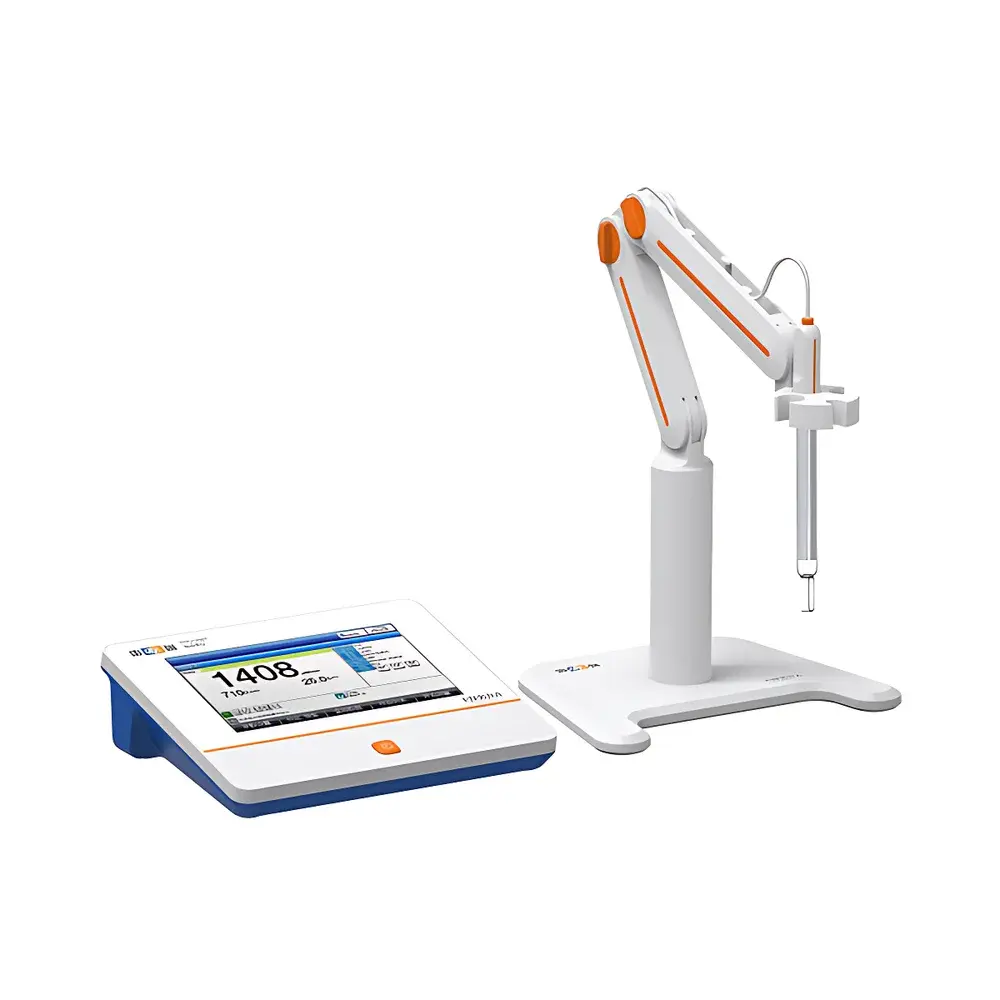
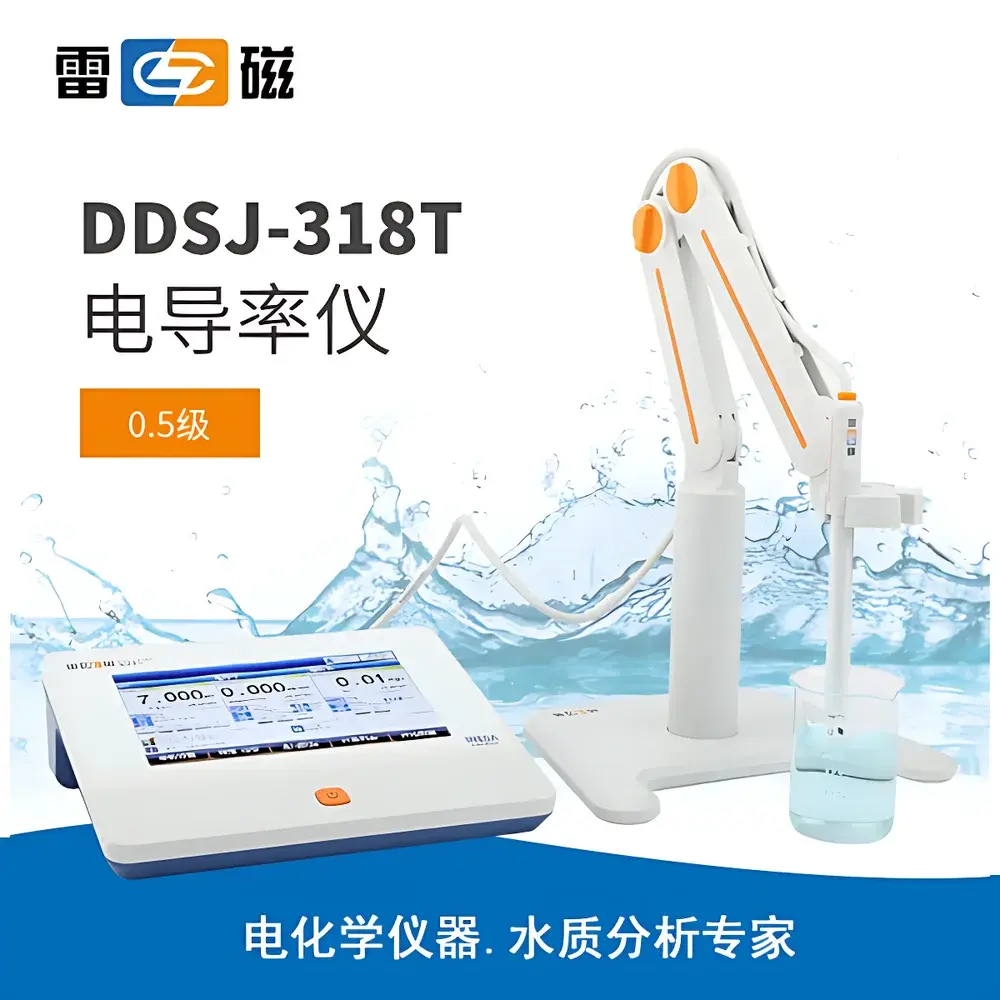
Leici DDSJ-318T Benchtop Conductivity Meter
| Brand | Leici |
|---|---|
| Origin | Shanghai, China |
| Manufacturer Type | OEM Manufacturer |
| Origin Category | Domestic (China) |
| Model | DDSJ-318T |
| Detection Parameters | Single-Parameter (Conductivity, Resistivity, TDS, Salinity, Ash, Temperature) |
| Portability | Benchtop |
| Application Environment | Laboratory |
| Conductivity Range | 0.000 µS/cm to 2000 mS/cm |
| TDS Range | 0.000 mg/L to 1000 g/L |
| Resistivity Range | 5.00 Ω·cm to 100.0 MΩ·cm |
| Salinity Range | 0.00–8.00 % |
| Temperature Range | −10.0 to 135.0 °C |
| Accuracy | ±0.5 % FS (Conductivity/Resistivity/TDS), ±0.1 % FS (Salinity), ±0.1 °C (Temperature) |
| Minimum Resolution | 0.001 µS/cm (Conductivity), 0.01 Ω·cm (Resistivity), 0.001 mg/L (TDS), 0.01 % (Salinity), 0.1 °C (Temperature) |
| IP Rating | IP54 |
| Compliance | GLP, GMP (21 CFR Part 11-ready audit trail via software), ASTM D1125, ISO 7888, USP <645> |
Overview
The Leici DDSJ-318T is a high-precision benchtop conductivity meter engineered for rigorous laboratory environments requiring trace-level accuracy and regulatory compliance in aqueous solution characterization. It operates on the principle of two-electrode or four-electrode AC conductivity measurement—applying a low-frequency alternating current across a conductive cell to determine solution conductance while minimizing polarization effects. The instrument simultaneously calculates derived parameters—including resistivity, total dissolved solids (TDS), salinity, ash content (per standardized methods for white sugar and high-fructose corn syrup), and temperature—with automatic temperature compensation (ATC) using either linear, non-linear, or pure-water compensation algorithms. Its wide dynamic range (0.000 µS/cm to 2000 mS/cm) supports applications from ultrapure water monitoring (e.g., pharmaceutical WFI, semiconductor rinse water) to concentrated brines and industrial process streams. Designed to meet international metrological standards, the DDSJ-318T conforms to ASTM D1125 (Standard Test Method for Electrical Conductivity of Water), ISO 7888 (Water Quality — Determination of Electrical Conductivity), and USP (Electrical Conductivity of Water for Pharmaceutical Use).
Key Features
- 7-inch full-color capacitive touchscreen with intuitive icon-based navigation and dual-language support (English & Chinese)
- Multi-mode temperature compensation: selectable reference temperatures (5.0, 10.0, 15.0, 18.0, 20.0, or 25.0 °C); configurable compensation models (none, linear, non-linear, pure water)
- Intelligent electrode management: auto-recognition of cell constant (K = 0.01, 0.1, 1.0 cm⁻¹); automatic frequency switching ensures optimal signal-to-noise ratio across full measurement range
- Comprehensive calibration protocol: 1–5 point conductivity standard calibration with auto-detection of GB and international (DIN, NIST-traceable) KCl standards; mandatory calibration alerts and verification prompts enforce data integrity
- IP54-rated enclosure for dust resistance and limited water ingress protection—suitable for controlled lab environments with moderate humidity
- Robust data governance architecture: 1000 measurement records stored with timestamp, operator ID, electrode ID, calibration history, and environmental metadata
- Security-compliant user management: three-tier permission levels (Administrator, Supervisor, Operator), password-protected access, and encrypted audit logs aligned with GLP/GMP requirements
Sample Compatibility & Compliance
The DDSJ-318T accommodates a broad spectrum of aqueous matrices—from deionized water and buffer solutions to seawater, wastewater effluents, food extracts, and electroplating baths. Its modular electrode interface supports interchangeable conductivity cells (including 0.01 cm⁻¹ for ultrapure water and 10 cm⁻¹ for high-conductivity slurries), enabling method-specific optimization. For regulatory submissions, the system supports 21 CFR Part 11-compliant electronic signatures and audit trails when used with Leici’s certified PC software (LISLink v3.2+). All measurements adhere to ISO/IEC 17025 traceability principles through documented calibration certificates and uncertainty budgets. The instrument satisfies routine QC/QA needs in pharmaceutical manufacturing (ICH Q5, Q7), environmental testing (EPA 120.1), and beverage quality control (AOAC 971.27).
Software & Data Management
- USB 2.0 and RS-232 interfaces enable direct connection to PCs, LIMS, or thermal printers (customizable print templates for SOP-aligned reporting)
- LISLink PC software provides full data export (CSV, PDF, XML), statistical analysis (mean, SD, RSD, trend charts), and batch report generation compliant with ALCOA+ principles
- U-disk read/write capability allows offline data backup and firmware updates without network dependency
- GMP mode enables operator-specific action logging—including calibration edits, result deletions, and parameter changes—with immutable timestamps and digital signatures
- Optional barcode scanner integration streamlines sample ID entry and eliminates manual transcription errors during high-throughput testing
Applications
The DDSJ-318T serves as a primary analytical tool in multiple regulated domains: monitoring conductivity of purified water systems per USP and EP 2.2.38; verifying TDS limits in bottled water production (FDA 21 CFR §165.110); quantifying ash content in sucrose and HFCS per AOAC Official Methods; assessing salinity in aquaculture and desalination plant influent/effluent; and validating cleaning-in-place (CIP) rinse endpoints in biopharma facilities. Its stability and repeatability (<0.2% RSD over 24 h) make it suitable for method validation studies under ICH Q2(R2) guidelines.
FAQ
What calibration standards are supported?
The instrument auto-identifies common KCl standards (e.g., 0.01 mol/L, 0.1 mol/L, 1.0 mol/L) per GB/T 6682 and ISO 3696, and supports custom standard entry with certified uncertainty values.
Can the DDSJ-318T be integrated into an existing LIMS?
Yes—via RS-232 or USB virtual COM port using ASTM E1384 or HL7-compatible ASCII message formats; Leici provides documented API specifications and validation protocols.
Is temperature measurement independently validated?
Yes—the integrated Pt1000 sensor is factory-calibrated against NIST-traceable references; users may perform field verification using certified thermometers per ISO 17025 clause 6.5.
How does the instrument handle low-conductivity samples (<1 µS/cm)?
By engaging the 0.01 cm⁻¹ cell constant mode with guarded electrode design and adaptive AC frequency (10–1000 Hz), minimizing stray capacitance and cable leakage errors.
Does the system support electronic signatures for audit-ready workflows?
When paired with LISLink v3.2+ and configured in GMP mode, it enforces role-based e-signatures, change history retention, and tamper-evident log files meeting FDA 21 CFR Part 11 Subpart B requirements.
Related Products




