
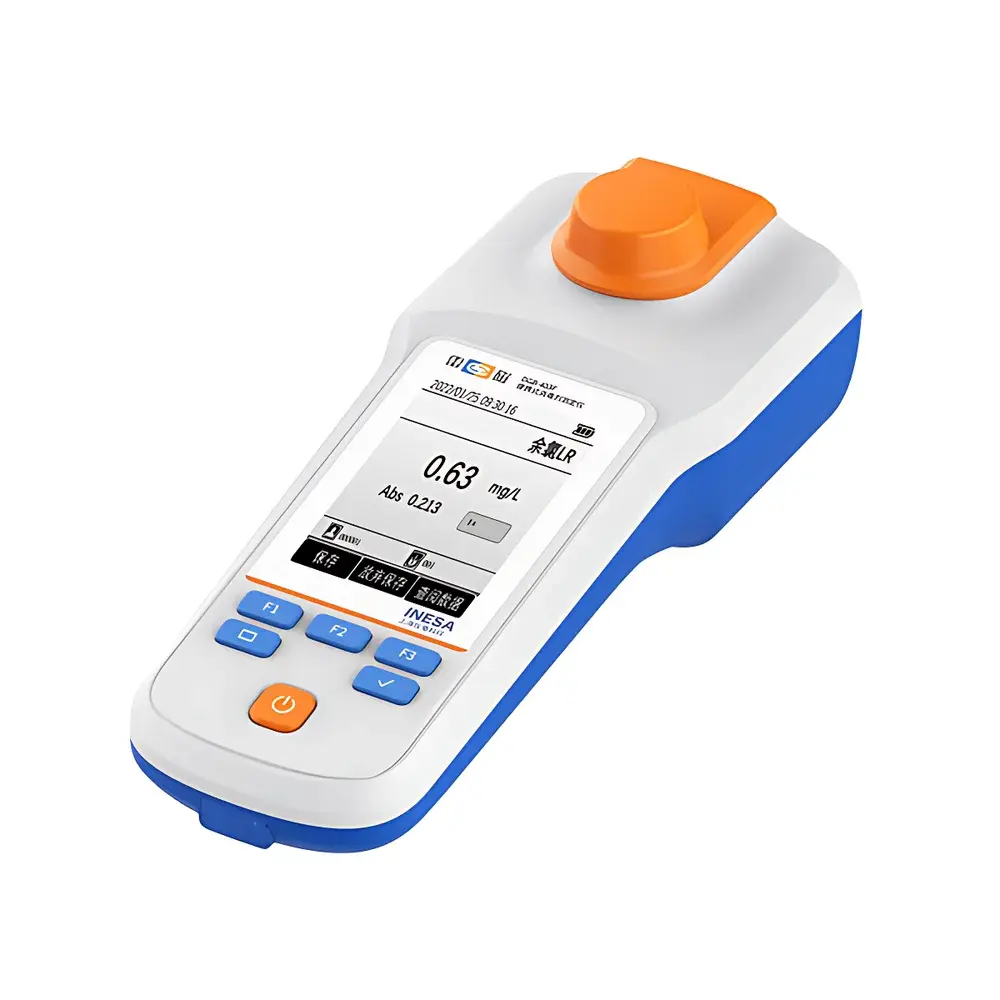
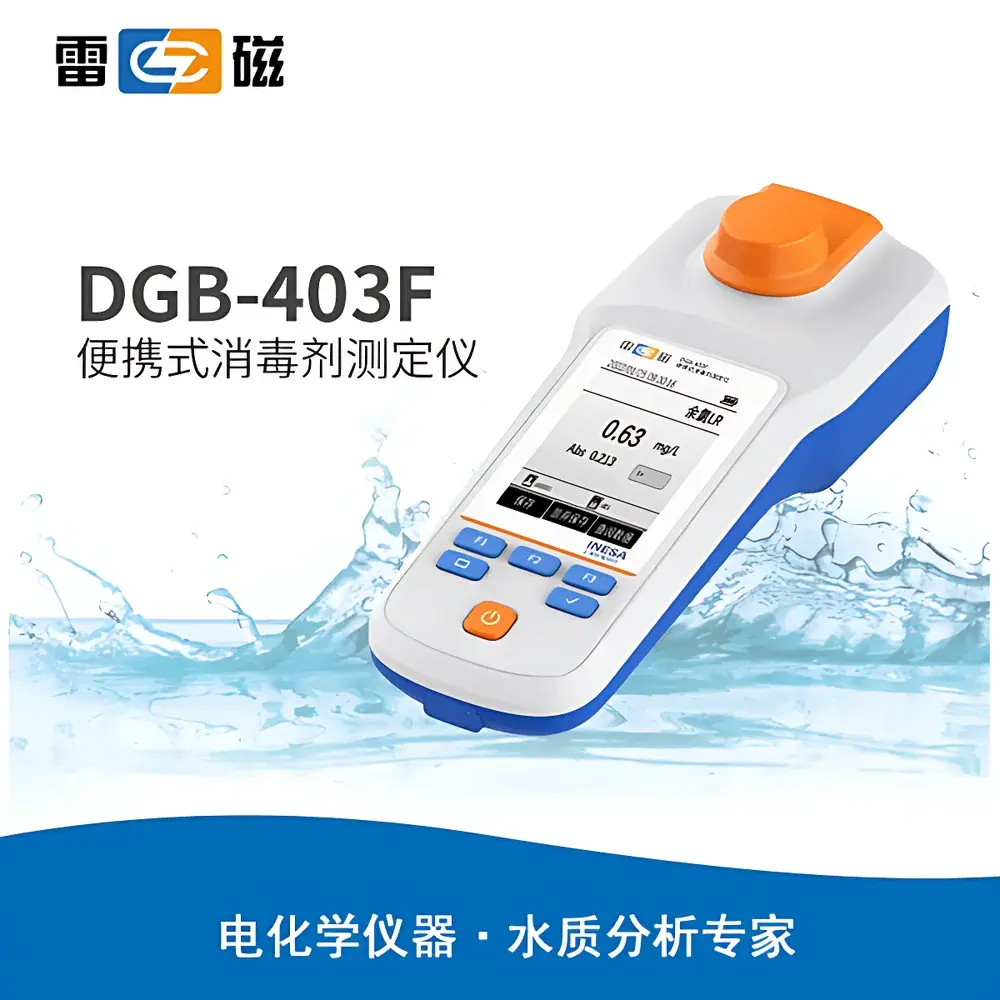
Leici DGB-403F Portable Residual Chlorine and Chlorine Dioxide Analyzer
| Brand | Leici |
|---|---|
| Origin | Shanghai, China |
| Manufacturer Type | Direct Manufacturer |
| Product Category | Domestic (China-Made) |
| Model | DGB-403F |
| Instrument Type | Portable |
| Measurement Principle | DPD Colorimetric Spectrophotometry (515 nm & 420 nm LED Sources) |
| Measured Parameters | Residual Chlorine (LR/HR), Total Chlorine (LR/HR), Chlorine Dioxide (LR/HR), Monochloramine (LR/HR), Chlorite, Chlorate, Hydrogen Peroxide |
| Residual Chlorine HR Range | 0.20–12.0 mg/L |
| Accuracy (Residual Cl₂ HR) | ±0.1 mg/L or ±5% |
| Repeatability (Residual Cl₂ HR) | ≤1% |
| Resolution (Residual Cl₂ HR) | 0.1 mg/L |
| LOD (Residual Cl₂ HR) | ≤0.2 mg/L |
Overview
The Leici DGB-403F Portable Residual Chlorine and Chlorine Dioxide Analyzer is a field-deployable, multi-parameter water quality instrument engineered for precise, on-site quantification of disinfectant residuals in drinking water, wastewater effluent, swimming pools, cooling towers, and distribution systems. It operates on the standardized N,N-diethyl-p-phenylenediamine (DPD) colorimetric method—fully compliant with ISO 7393-2, APHA Standard Methods 4500-Cl G, and ASTM D1253. Dual-wavelength LED photometry at 420 nm and 515 nm enables selective detection across low-range (LR) and high-range (HR) modes, minimizing interferences from turbidity, colored organics, and transition metal ions. The analyzer’s optical architecture features temperature-stabilized solid-state light sources with >100,000-hour lifetimes, eliminating lamp replacement and drift-related calibration drift. Its compact, rugged design integrates an embedded microprocessor-controlled spectrophotometer, automatic endpoint recognition algorithm, and real-time signal processing to ensure consistent photometric reproducibility under variable ambient conditions.
Key Features
- High-resolution 4.3-inch color TFT LCD with adjustable backlight and auto-dimming functionality
- Dual-LED optical system (420 nm and 515 nm) optimized for DPD-based chlorine, chlorine dioxide, monochloramine, chlorite, chlorate, and hydrogen peroxide assays
- Intelligent endpoint detection with adaptive kinetic sampling—automatically triggers measurement upon reaction stabilization
- Programmable dilution factor application: instrument computes original sample concentration post-dilution without manual recalculation
- Preloaded calibration curves for all 7 analytes; supports full factory curve reset, user-defined curve import/export via USB, and GLP-compliant curve validation logs
- Onboard data storage: 200 measurement records per parameter, each timestamped with operator ID, calibration status, and environmental metadata (ambient temperature, battery level)
- IP65-rated enclosure with shock-absorbing portable carry case—suitable for outdoor deployment, mobile labs, and emergency response vehicles
- Rechargeable lithium-ion battery (≥12 h continuous operation); supports USB-C charging from PCs, power banks, or AC adapters (5 V / 2 A)
Sample Compatibility & Compliance
The DGB-403F accepts standard 25 mm round glass cuvettes with 5 mm optical path length, compatible with EPA-accepted DPD reagent kits (e.g., Hach, Palintest, or equivalent). It meets functional requirements of ISO/IEC 17025 for field instrumentation used in accredited testing laboratories. Data integrity safeguards include electronic signature support, audit trail logging (per FDA 21 CFR Part 11 Annex 11 guidelines), and immutable record timestamps. All calibration and measurement events are traceable to NIST-traceable reference standards. The device conforms to electromagnetic compatibility (EMC) standards IEC 61326-1 and safety standard IEC 61010-1 for portable laboratory equipment.
Software & Data Management
Data transfer is enabled via USB 2.0 interface using Leici’s proprietary PC communication software (Windows 10/11 compatible), supporting batch export in CSV and PDF report formats. Software features include automated calibration verification reports, trend analysis dashboards, QC control chart generation (X-bar/R charts), and deviation flagging against user-defined action limits. All exported files retain embedded digital signatures and hash-verified metadata to satisfy GLP/GMP documentation requirements. No cloud dependency: local database management ensures data sovereignty and network-independent operation in remote or regulated environments.
Applications
- Drinking water utilities: routine residual chlorine monitoring at treatment plant outlets and distribution nodes
- Swimming pool & spa facility management: compliance verification per WHO Guidelines for Safe Recreational Water Environments
- Hospital central sterile supply departments (CSSD): verification of chlorine dioxide sterilant concentration in automated washer-disinfectors
- Food & beverage processing: sanitizer residual validation in CIP rinse cycles per NSF/ANSI 151
- Environmental field surveys: rapid assessment of disinfectant persistence in surface waters following municipal discharge
- Emergency response: post-disaster water safety screening during flood or infrastructure failure scenarios
FAQ
What regulatory standards does the DGB-403F comply with for disinfectant measurement?
It implements DPD methodology aligned with ISO 7393-2, APHA 4500-Cl G, and ASTM D1253; its data handling architecture satisfies GLP and FDA 21 CFR Part 11 requirements for audit trails and electronic records.
Can the instrument store calibration curves for multiple operators or sites?
Yes—up to 200 unique calibration sets can be saved onboard, each tagged with operator ID, location code, and date; curves are exportable and restorable via USB.
Is external reagent kit compatibility verified?
The analyzer is validated for use with commercially available DPD-based reagents meeting APHA-recommended purity and stability specifications; no proprietary consumables are required.
How is measurement repeatability ensured across varying ambient temperatures?
Internal thermal compensation algorithms adjust LED drive current and detector gain in real time, maintaining photometric stability across 5–40 °C operating range.
Does the device support firmware updates in the field?
Yes—USB-based firmware upgrades are supported through Leici’s certified software suite, with version rollback capability and checksum-verified installation packages.
Related Products







