
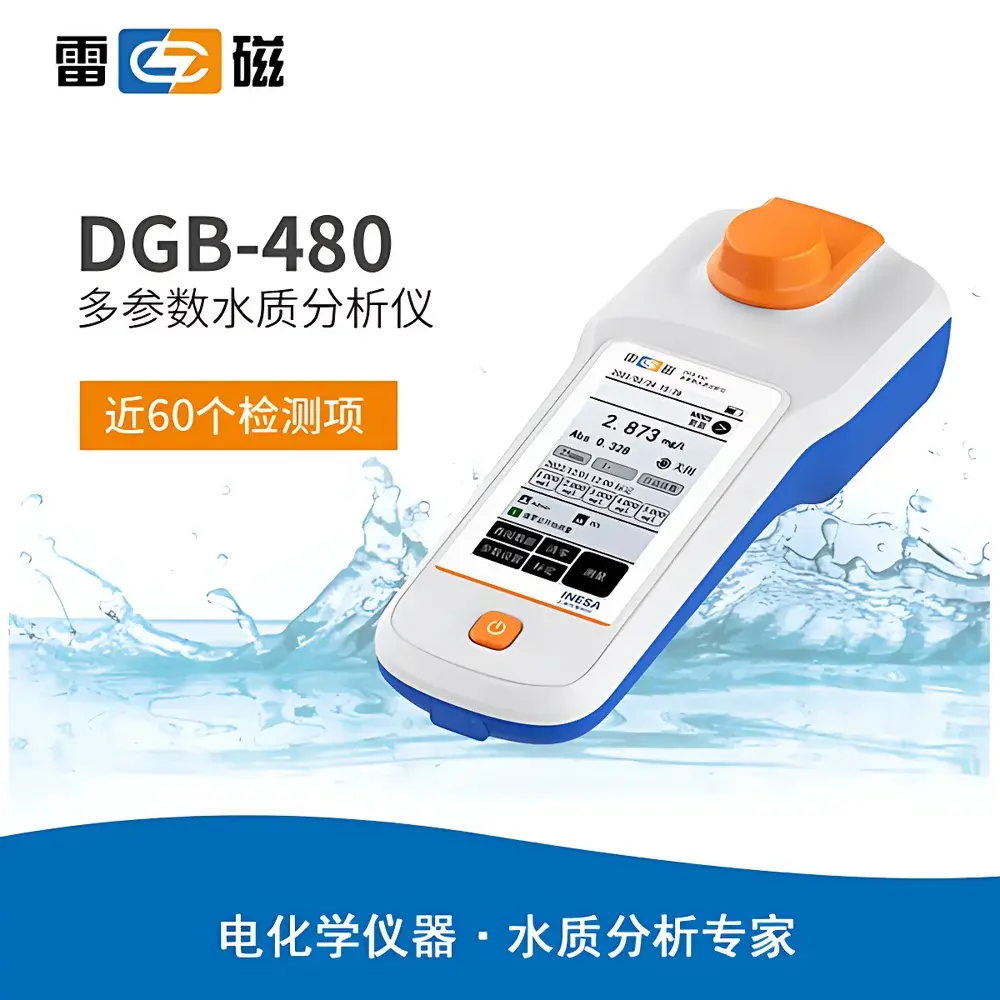
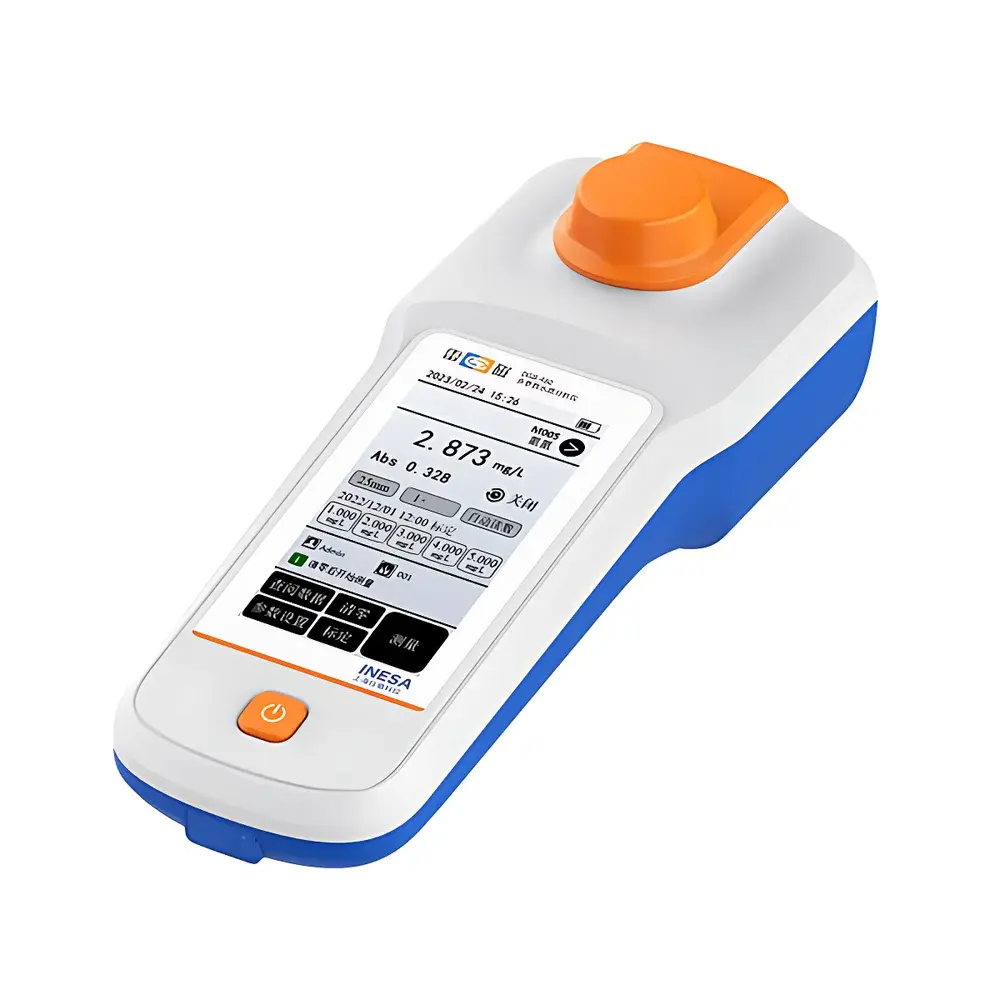
LeiCi DGB-480 Multi-Parameter Water Quality Analyzer
| [Brand | LeiCi |
|---|---|
| Origin | Shanghai, China |
| Model | DGB-480 |
| Instrument Type | Portable Water Quality Analyzer |
| Detection Parameters | Turbidity, Color, Transmittance, Ozone, Nitrite Nitrogen, Urea, Hexavalent Chromium, Manganese, Total Nitrogen, Nitrate Nitrogen, Nitrate, Formaldehyde, Water Hardness, Zinc, Nitrite, Free Chlorine, Total Chlorine, Chlorine Dioxide, Permanganate Index, Low-Concentration COD<sub>Cr</sub>, High-Concentration COD<sub>Cr</sub>, Cadmium, Ammonia Nitrogen, Ammonium Ion, Total Phosphorus, Total Phosphate, Nickel, Ferrous Ion, Iron, Sulfite |
| Wavelengths | 365 nm, 420 nm, 470 nm, 515 nm, 540 nm, 620 nm, 650 nm, 850 nm |
| Turbidity Measurement | 90° scattered light (ISO 7027 compliant) |
| Colorimetric Cell Compatibility | Φ16 mm cuvettes or Φ25 mm vials |
| Data Storage Capacity | 2000 measurement records |
| Power Supply | Rechargeable Li-ion battery (DC 5 V input support) |
| Dimensions | 105 × 241 × 90 mm |
| Weight | 0.6 kg |
| Compliance | GLP-compliant data traceability, ISO 7027 for turbidity] |
Overview
The LeiCi DGB-480 Multi-Parameter Water Quality Analyzer is a field-deployable, LED-based spectrophotometric instrument engineered for rapid, on-site quantification of over 55 water quality parameters across physical, inorganic, organic, disinfectant, and pollution-indicator categories. It operates on the principle of absorbance photometry using eight discrete, narrow-band LED light sources—each precisely centered at standardized analytical wavelengths (365, 420, 470, 515, 540, 620, 650, and 850 nm)—to enable simultaneous multi-analyte determination without mechanical filter wheels or moving optical components. Turbidity is measured via 90° nephelometric detection at 850 nm in strict conformance with ISO 7027, ensuring metrological equivalence to laboratory-grade benchtop turbidimeters. Color is assessed at 365 nm using UV-enhanced photodiode detection, while transmittance and absorbance are calculated from dual-beam referenced intensity measurements. Designed for both field deployment and lab-based verification, the DGB-480 supports method flexibility through compatibility with proprietary LeiCi reagent kits as well as user-prepared protocols, making it suitable for regulatory monitoring of drinking water, swimming pool water, surface water, and wastewater effluents.
Key Features
- Eight fixed-wavelength LED optical system with ±4 nm wavelength accuracy and thermal drift compensation
- ISO 7027-compliant turbidity measurement (0.50–500 NTU) with dual-range auto-scaling
- Color measurement in Platinum-Cobalt Units (PCU) across 0–100.0 PCU range, with ±3% or ±1 PCU accuracy
- High-fidelity photometric performance: absorbance linearity error ≤ ±0.008 (A ≤ 0.100), ≤ ±4.0% (A = 0.301–0.600)
- Support for Φ16 mm cuvettes and Φ25 mm vials—enabling use of standard EPA- and ISO-approved glassware
- Smart endpoint detection with auto-read and continuous-read modes; configurable read delay and averaging
- Flexible concentration units (mg/L, µg/L, mmol/L, %, etc.) and automatic dilution factor compensation
- Up to 20 user-defined methods with embedded calibration curve storage (1–5 point linear/non-linear fits)
- Three-tier user access control (admin/operator/guest) with up to 8 unique user IDs and sample ID tagging
- GLP-compliant audit trail: timestamped measurements, operator ID, method name, calibration history, and environmental metadata
Sample Compatibility & Compliance
The DGB-480 accommodates a broad spectrum of aqueous matrices—including potable water, recreational water, raw surface water, treated effluent, and industrial process streams—without requiring pre-filtration for most parameters. Its optical path design minimizes interference from suspended solids in low-to-moderate turbidity samples (<500 NTU). All photometric measurements adhere to fundamental principles outlined in ISO 7027 (turbidity), ISO 6226 (color), and ISO 8467 (permanganate index), while method-specific determinations align with established EPA, APHA, and Standard Methods frameworks where applicable. The device meets general requirements for portable instrumentation under ISO/IEC 17025:2017 for testing laboratories and supports full data traceability required under GLP and GMP environments. Though not FDA 21 CFR Part 11-certified out-of-the-box, its encrypted local database and immutable record structure facilitate validation for regulated QA/QC workflows.
Software & Data Management
Data acquisition and reporting are managed via an integrated 3.5-inch capacitive touchscreen interface with intuitive icon-driven navigation. All measurements—including raw absorbance/transmittance values, calculated concentrations, calibration coefficients, and QC flags—are stored locally in a non-volatile memory array (2000 records capacity). Each entry includes date/time stamp, operator ID, sample ID, method name, wavelength used, and dilution factor. Data export is supported via USB 2.0 connection to Windows PCs using LeiCi’s dedicated communication software, which enables batch transfer, CSV export, statistical summary (mean, SD, CV%), trend charting, and report generation compliant with internal QA templates. Optional RS-232 serial output allows direct printing to compatible label or thermal printers. Firmware updates are performed via USB drive, ensuring long-term method adaptability and regulatory alignment.
Applications
- Routine compliance monitoring of municipal drinking water per WHO Guidelines and national standards (e.g., GB 5749-2022)
- Swimming pool and spa water safety verification (free/total chlorine, combined chlorine, cyanuric acid, pH, turbidity)
- Environmental field surveys of rivers, lakes, and reservoirs for nutrients (NH₃-N, NO₃⁻-N, PO₄³⁻), heavy metals (Cr⁶⁺, Cd, Ni, Mn), and organic load indicators (CODCr, permanganate index)
- Wastewater treatment plant influent/effluent QC for BOD surrogate metrics and disinfection by-product precursors
- Industrial boiler feedwater and cooling tower analysis (hardness, Fe²⁺/Fe³⁺, silica, sulfite)
- Educational and research laboratories conducting method development or inter-laboratory comparison studies
FAQ
Is the DGB-480 suitable for regulatory reporting under US EPA or EU Drinking Water Directive requirements?
The instrument provides metrologically sound measurements aligned with core ISO and APHA methodologies, but formal regulatory acceptance depends on local accreditation status and method validation per jurisdiction-specific protocols. Users must perform site-specific verification per EPA Method 180.1 or EN ISO 7027 before submission of compliance data.
Can custom calibration curves be imported from external software?
Yes—calibration parameters (slope, intercept, polynomial coefficients) may be manually entered or imported via USB using the device’s built-in curve editor. Up to 20 user-defined curves can be stored simultaneously.
Does the analyzer support automatic temperature compensation?
No—temperature correction is not applied automatically during measurement. For parameters with known thermal sensitivity (e.g., chlorine residual), users are advised to record ambient and sample temperatures and apply correction factors post-acquisition per standard references.
What is the expected service life of the LED light sources?
The eight high-stability LEDs are rated for ≥50,000 hours of operation under typical field-use conditions, with negligible spectral shift over time due to integrated thermal regulation circuitry.
Is remote firmware update possible over Bluetooth or Wi-Fi?
No—firmware updates require physical USB connection and use of LeiCi’s desktop utility. No wireless connectivity is implemented to maintain data integrity and cybersecurity compliance in critical infrastructure applications.







