
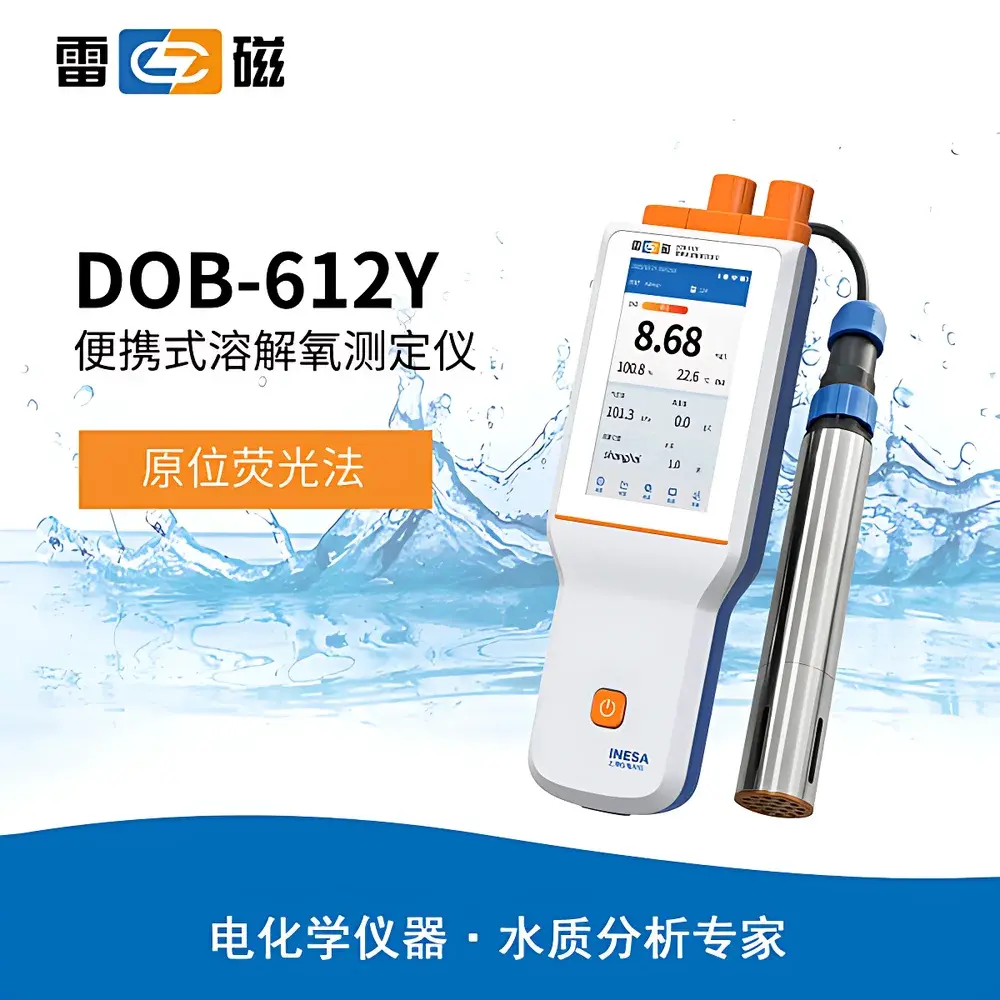
Leici DOB-612Y Portable Fluorescence-based Dissolved Oxygen Meter
| Brand | Leici |
|---|---|
| Origin | Shanghai, China |
| Manufacturer Type | Direct Manufacturer |
| Country of Origin | China |
| Model | DOB-612Y |
| Instrument Type | Portable |
| Measurement Principle | Fluorescence Quenching |
| Dissolved Oxygen Range | 0.00–20.00 mg/L |
| Accuracy | ±0.30 mg/L |
| Resolution (DO) | 0.01 mg/L |
| Repeatability | 0.15 mg/L |
| Zero Error | ≤0.1 mg/L |
| Response Time | ≤60 s (90% response at 20 °C) |
| DO Saturation Range | 0.0–200.0 % |
| Saturation Accuracy | ±10.0 % |
| Temperature Range | 0.0–50.0 °C |
| Temp. Accuracy | ±0.2 °C (10–30 °C) |
| Temp. Resolution | 0.1 °C |
| Salinity Compensation Error | ±2% |
| IP Rating | IP67 |
| Dimensions | 92 × 263 × 49 mm |
| Weight | ~0.6 kg |
| Power | Rechargeable Li-ion battery + DC 5 V adapter (AC 100–240 V input) |
Overview
The Leici DOB-612Y is a field-deployable, fluorescence-based dissolved oxygen (DO) meter engineered for high-reliability environmental water quality monitoring in rivers, lakes, reservoirs, wastewater treatment plants, aquaculture systems, and coastal zones. Unlike traditional electrochemical Clark-type sensors—prone to membrane fouling, oxygen consumption, and frequent calibration drift—the DOB-612Y employs optical fluorescence quenching technology. This principle relies on the dynamic interaction between molecular oxygen and a proprietary ruthenium-based luminophore immobilized on the sensor tip: as dissolved oxygen concentration increases, the luminescence lifetime and intensity of the excited fluorophore decrease predictably and reversibly. The instrument measures this lifetime decay with phase-modulation detection, delivering stable, zero-consumption, maintenance-light measurements independent of flow rate or stirring—critical for in-situ profiling and low-flow applications.
Key Features
- IP67-rated rugged housing with sunlight-readable color LCD display—optimized for prolonged outdoor operation under variable ambient lighting and precipitation conditions.
- Integrated fluorescence DO probe with automatic electrode recognition; enables plug-and-play calibration and measurement without manual configuration.
- Comprehensive environmental compensation suite: automatic temperature compensation (0.0–50.0 °C), real-time barometric pressure correction (via internal sensor), and user-configurable salinity adjustment (0.0–50.0 g/L).
- Robust calibration management: supports zero-oxygen (sodium sulfite) and full-scale (air-saturated water or Winkler-standard solution) calibration; includes scheduled calibration alerts, forced calibration enforcement, and traceable standard verification (zero and span checks) with timestamped audit logs.
- GMP-aligned data governance: three-tier user permission system (Operator / Supervisor / Administrator), full activity logging (login, calibration, measurement, configuration changes), and tamper-evident data integrity controls compliant with ALCOA+ principles.
- Embedded GNSS module enabling geotagged measurements: automatic GPS positioning, UTC time synchronization, depth metadata tagging (when paired with optional pressure transducer), and spatially referenced data export.
Sample Compatibility & Compliance
The DOB-612Y is validated for direct immersion in freshwater, brackish water, seawater, treated effluent, and aquaculture ponds. Its non-consumptive optical sensing eliminates interference from hydrogen sulfide, chlorine, or redox-active ions that commonly impair amperometric DO sensors. The instrument conforms to ISO 5814:2012 (Water quality — Determination of dissolved oxygen — Electrochemical probe method) for fluorescence-based equivalence, and supports method validation per EPA Method 4500-O G and ASTM D888-22. Data handling architecture meets FDA 21 CFR Part 11 requirements for electronic records and signatures, including secure user authentication, immutable audit trails, and electronic signature capability. All firmware and calibration history are digitally signed and cryptographically verifiable.
Software & Data Management
Measurement data—including DO concentration (mg/L), saturation (%), temperature (°C), GPS coordinates, depth (if applicable), calibration metadata, and operator ID—are stored internally (≥10,000 records) with ISO 8601 timestamps. Data export is supported via Wi-Fi (to cloud platforms or local networks), Bluetooth 5.0 (to mobile apps or field tablets), and USB-C (for direct PC transfer in CSV or PDF report formats). Integrated thermal printer support enables on-site, tamper-resistant hardcopy generation with embedded QR codes linking to raw digital records. The Leici DataLink desktop software provides advanced filtering (by location, date range, calibration status), statistical summary (min/max/mean/stdev), trend visualization, and GLP-compliant report generation with configurable headers, footers, and regulatory disclaimers.
Applications
- Regulatory compliance monitoring for municipal wastewater discharge permits (e.g., NPDES) and surface water quality standards (e.g., EU WFD, US Clean Water Act).
- In-situ profiling of hypolimnetic oxygen depletion in stratified lakes and reservoirs using depth-synchronized measurements.
- Real-time process control in activated sludge basins, aerated lagoons, and membrane bioreactors (MBRs).
- Aquaculture site assessment—tracking diurnal DO cycles, identifying critical hypoxia events, and validating aeration system performance.
- Environmental impact assessments (EIAs) and baseline studies requiring georeferenced, auditable DO datasets across distributed sampling points.
FAQ
How does fluorescence quenching differ from electrochemical DO measurement?
Fluorescence-based sensors do not consume oxygen during measurement, require no electrolyte refills or membrane replacements, and exhibit negligible flow dependence—making them ideal for static or low-flow environments where Clark electrodes yield unstable readings.
Does the DOB-612Y support automatic barometric pressure compensation?
Yes—the built-in absolute pressure sensor continuously adjusts DO calculations in real time, eliminating manual altitude or pressure entry errors common in field deployments.
Can calibration data be traced to national standards?
Calibration events are logged with operator ID, timestamp, standard lot numbers (if entered), measured values, and deviation metrics—all retained in an unalterable audit trail compatible with ISO/IEC 17025 laboratory accreditation requirements.
Is the device suitable for marine applications?
Yes—manual salinity compensation (0.0–50.0 g/L) and corrosion-resistant probe housing enable reliable use in estuarine and offshore environments; however, long-term immersion beyond 24 h requires periodic cleaning per manufacturer guidelines.
What battery life can be expected during continuous field use?
With backlight set to medium brightness and GPS enabled, typical runtime exceeds 18 hours; low-power mode extends operation to >36 hours, and battery health diagnostics are accessible via system settings.







