
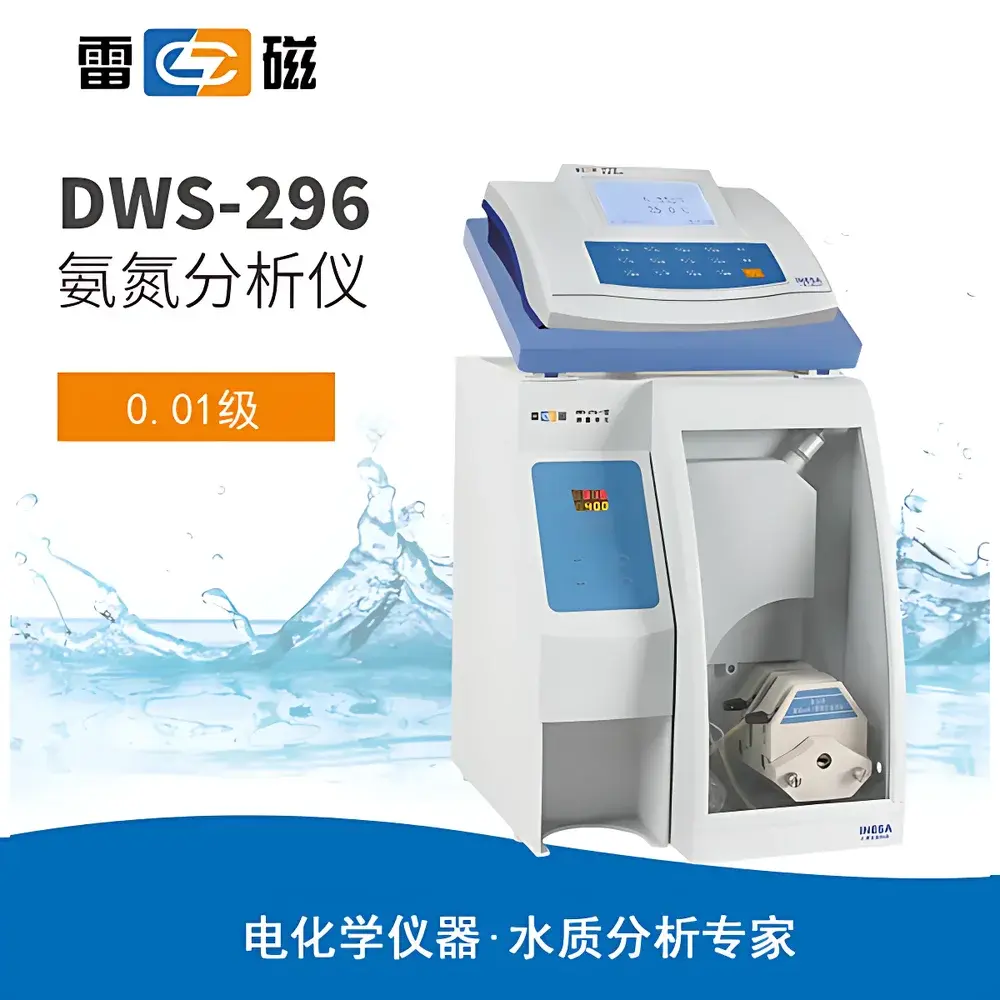
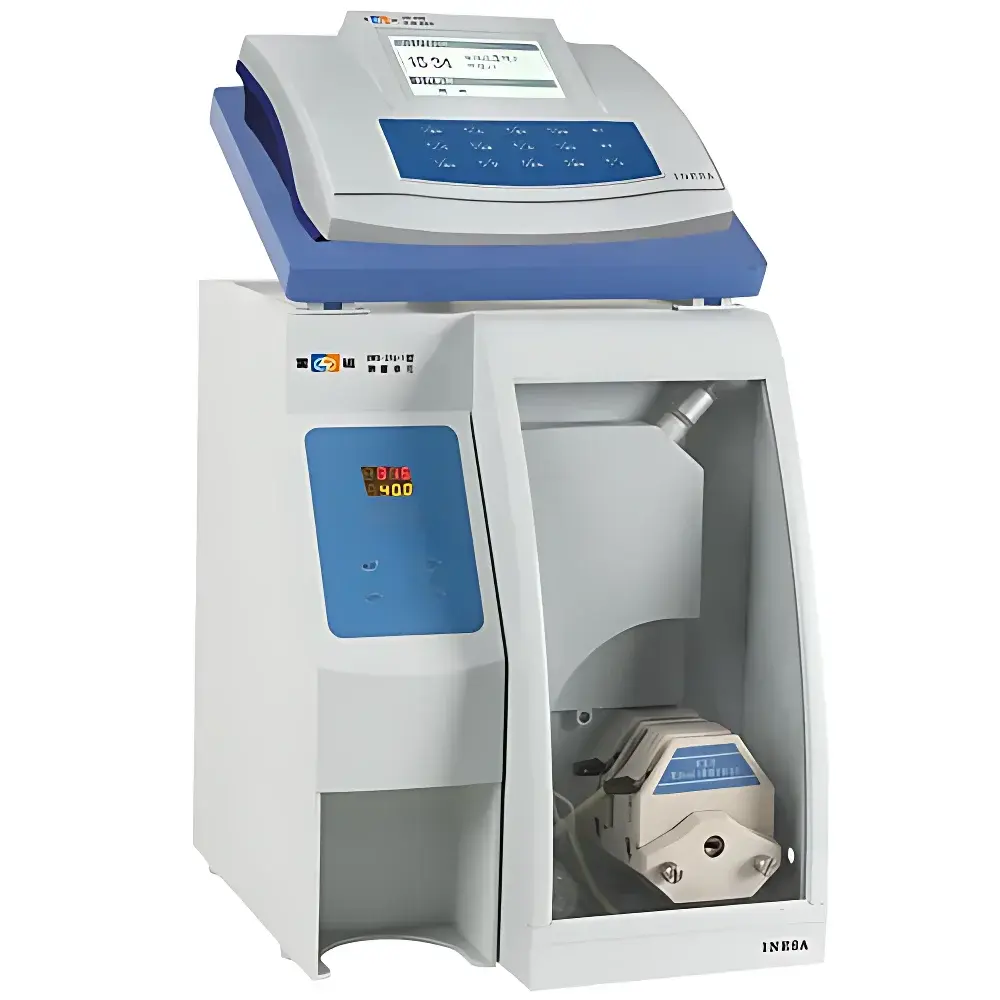
Leici DWS-296 Ammonia Nitrogen Analyzer
| Brand | Leici |
|---|---|
| Origin | Shanghai, China |
| Manufacturer Type | Authorized Distributor |
| Region of Manufacture | Domestic (China) |
| Model | DWS-296 |
| Price | USD 1,530 (approx.) |
| Instrument Type | Benchtop Laboratory Analyzer |
| Measurement Principle | Gas-Sensing Ion-Selective Electrode (ISE) Method |
| Measurement Range | 0.05–1000 mg/L NH₃–N |
| Accuracy | ±1% of reading |
| Detection Limit | 0.05 mg/L |
| Measurement Time | 5–10 minutes per sample |
| Sample Throughput | 1 sample per assay |
| Display | LCD with Chinese GUI |
| Readout Modes | Smart-Read (adaptive equilibrium), Timed-Read (fixed-interval or endpoint), Cont-Read (continuous kinetic monitoring) |
| Data Storage | Up to 200 measurement sets with timestamp, pN, mV, temperature, and NH₃–N concentration |
| Power Supply | Control Unit: 9 VDC, 500 mA (center-positive) |
| Measurement Unit | AC 220 V ±10%, 50 Hz |
| Dimensions & Weight | Control Unit: 300 × 220 × 80 mm, 1 kg |
| Measurement Unit | 370 × 380 × 510 mm, 13 kg |
| Interface | RS-232 serial port compliant with EIA/TIA-232 standard |
| Software Compatibility | REX Data Acquisition Software (Windows-based) |
| Printer Support | TP-16 thermal printer (optional) |
| Electrode Type | Integrated composite ammonia gas-sensing ISE with hydrophobic membrane and internal buffer |
| Temperature Compensation | Automatic (0.0–40.0 °C), NTC thermistor-based |
| Environmental Rating | Indoor laboratory use only, IP20 |
| Compliance | Designed in accordance with GB/T 27025–2019 (equivalent to ISO/IEC 17025), JJG 822–2019 (Chinese metrological verification regulation for ammonia analyzers) |
Overview
The Leici DWS-296 Ammonia Nitrogen Analyzer is a dedicated benchtop instrument engineered for precise, interference-resistant quantification of total ammonia nitrogen (NH₃–N) in aqueous environmental samples. It operates on the potentiometric gas-sensing ion-selective electrode (ISE) principle: dissolved ammonium ions (NH₄⁺) equilibrate across a pH-adjusted alkaline buffer layer into gaseous ammonia (NH₃), which diffuses through a hydrophobic membrane to modulate the potential of an internal reference system. This electrochemical transduction delivers direct, stable concentration readouts in mg/L without reliance on colorimetric reagents or optical path integrity—making it inherently immune to sample turbidity, colored organics, heavy metal cations (e.g., Cu²⁺, Fe³⁺), and suspended solids that commonly compromise spectrophotometric methods (e.g., Nessler or salicylate assays). The analyzer integrates an automated sample mixing mechanism and Peltier-assisted thermostatic control (0.0–40.0 °C) to ensure consistent reaction kinetics and minimize thermal drift—critical for reproducible results across variable ambient lab conditions.
Key Features
- Triple-mode electrochemical readout: Smart-Read (programmable equilibrium criteria: “Fast,” “Medium,” or “Strict” response stability thresholds), Timed-Read (user-defined endpoint or periodic interval acquisition), and Cont-Read (real-time analog trace logging for kinetic profiling).
- Dedicated composite ammonia ISE with integrated temperature sensor and sealed internal electrolyte—no daily refilling or membrane replacement required under routine operation.
- Full-parameter display: Simultaneous real-time readouts of pN (–log[NH₃]), mV potential, NH₃–N concentration (mg/L), and sample temperature (°C).
- Built-in data management: Stores up to 200 complete measurement records—including date/time stamp, calibration ID, raw mV, temperature-compensated pN, and final NH₃–N value—with recall, deletion, and export via RS-232.
- Robust hardware architecture: Dual-unit design isolates low-voltage control electronics (9 VDC) from high-voltage AC-powered measurement chamber (220 VAC), minimizing electrical noise and enhancing long-term signal stability.
- Compliance-ready functionality: Supports audit-trail-capable data export via REX software; compatible with GLP/GMP-aligned documentation workflows when paired with validated printer (TP-16) and secure PC storage.
Sample Compatibility & Compliance
The DWS-296 is validated for use with freshwater, wastewater effluent, surface water, groundwater, and treated drinking water matrices. Its electrode-based methodology eliminates matrix interferences common in regulatory testing—particularly per ISO 5667-3:2018 (Water quality — Sampling — Part 3: Guidance on preservation and handling of water samples) and US EPA Method 350.1 (Ammonia – Ion Selective Electrode). While not FDA 21 CFR Part 11–certified out-of-the-box, its RS-232 interface and REX software enable integration into validated laboratory information management systems (LIMS) when configured with electronic signature and change-control protocols. All electronic units comply with GB/T 18268.1–2010 (IEC 61326-1) for electromagnetic compatibility in laboratory environments.
Software & Data Management
REX Data Acquisition Software (Windows 10/11 compatible) provides bidirectional communication for configuration, calibration curve management, real-time graphing, and CSV/PDF report generation. Each stored record includes metadata essential for traceability: operator ID (manually entered), calibration date, electrode serial number, ambient lab temperature, and measurement duration. Data export supports ISO/IEC 17025 clause 7.5.2 requirements for result authenticity and retention. Optional TP-16 thermal printer produces hard-copy reports with header fields for QA/QC review and archival per local regulatory mandates.
Applications
- Wastewater treatment plant (WWTP) process control: Monitoring influent, aeration basin, and effluent NH₃–N to optimize nitrification/denitrification cycles.
- Environmental monitoring labs: Routine compliance testing against national discharge limits (e.g., China’s GB 8978–1996, EU Urban Wastewater Treatment Directive 91/271/EEC).
- Drinking water safety verification: Rapid screening for ammonia breakthrough in chloraminated distribution systems.
- Academic and research laboratories: Kinetic studies of ammonia volatilization, sediment-water interface fluxes, and inhibitor efficacy testing.
- Industrial pretreatment verification: Confirming ammonia removal efficiency prior to discharge into municipal sewers.
FAQ
What sample preparation is required prior to analysis?
Minimal preparation: Samples must be adjusted to pH ≥11.5 using sodium hydroxide solution (provided in optional reagent kit) to convert NH₄⁺ to volatile NH₃. Filtration (0.45 µm) is recommended for highly turbid or particulate-laden samples to prevent electrode fouling.
How often must the ammonia electrode be calibrated?
Calibration is recommended before each analytical session or after every 8 hours of continuous use. A two-point calibration (e.g., 1 mg/L and 100 mg/L NH₃–N standards) is sufficient for routine accuracy within ±1%.
Can the DWS-296 measure free ammonia (NH₃) separately from total ammonia nitrogen (TAN)?
No—the instrument reports total ammonia nitrogen (NH₃–N) as defined by standard methods. Free ammonia concentration can be calculated post-hoc using simultaneous pH and temperature measurements and established equilibrium equations (e.g., Emerson et al., 1975), but this requires external computation.
Is the RS-232 interface compatible with modern computers lacking legacy serial ports?
Yes—standard USB-to-RS-232 adapters (FTDI chipset recommended) are fully supported by REX software; driver installation is required prior to first connection.
What maintenance is required for long-term electrode performance?
The composite electrode requires monthly soaking in 10⁻³ mol/L NH₄Cl storage solution for 2 hours. Avoid prolonged exposure to strong oxidants, sulfides, or high concentrations (>5000 mg/L) of Ca²⁺/Mg²⁺ to prevent membrane degradation.
Related Products







