
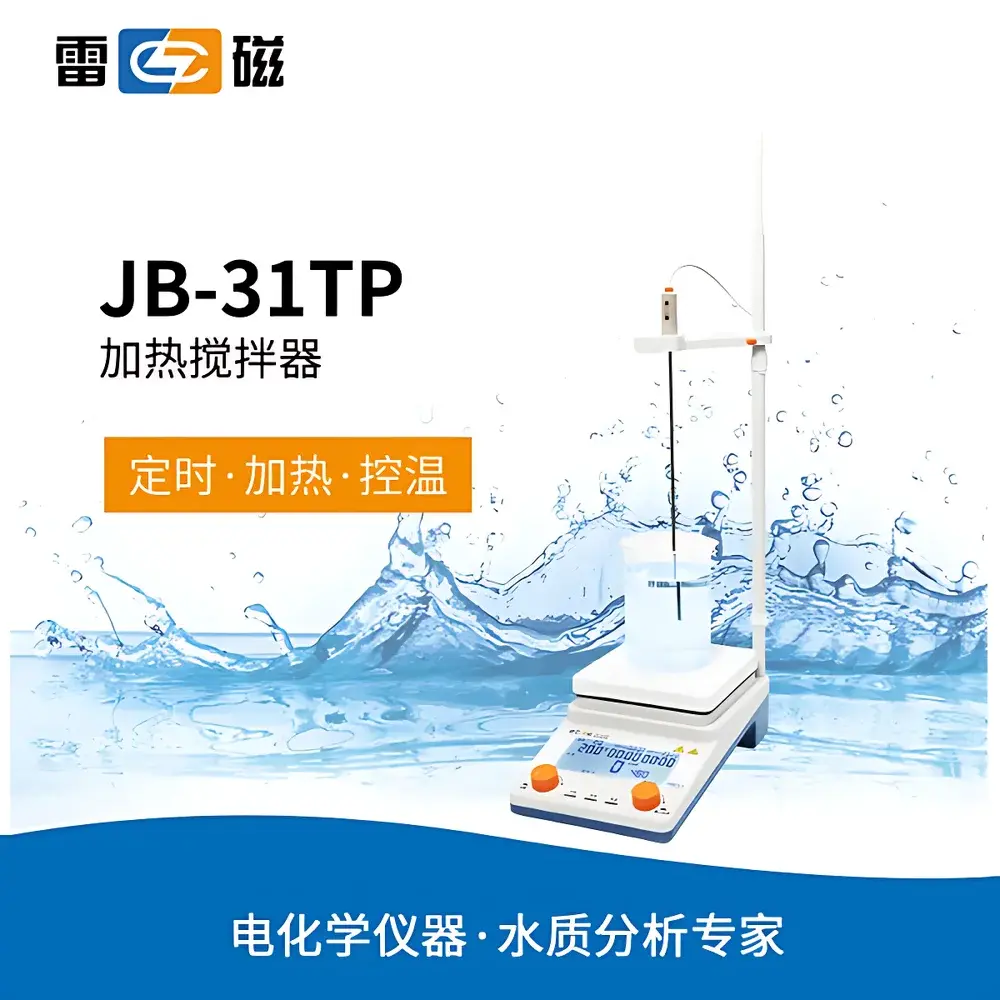
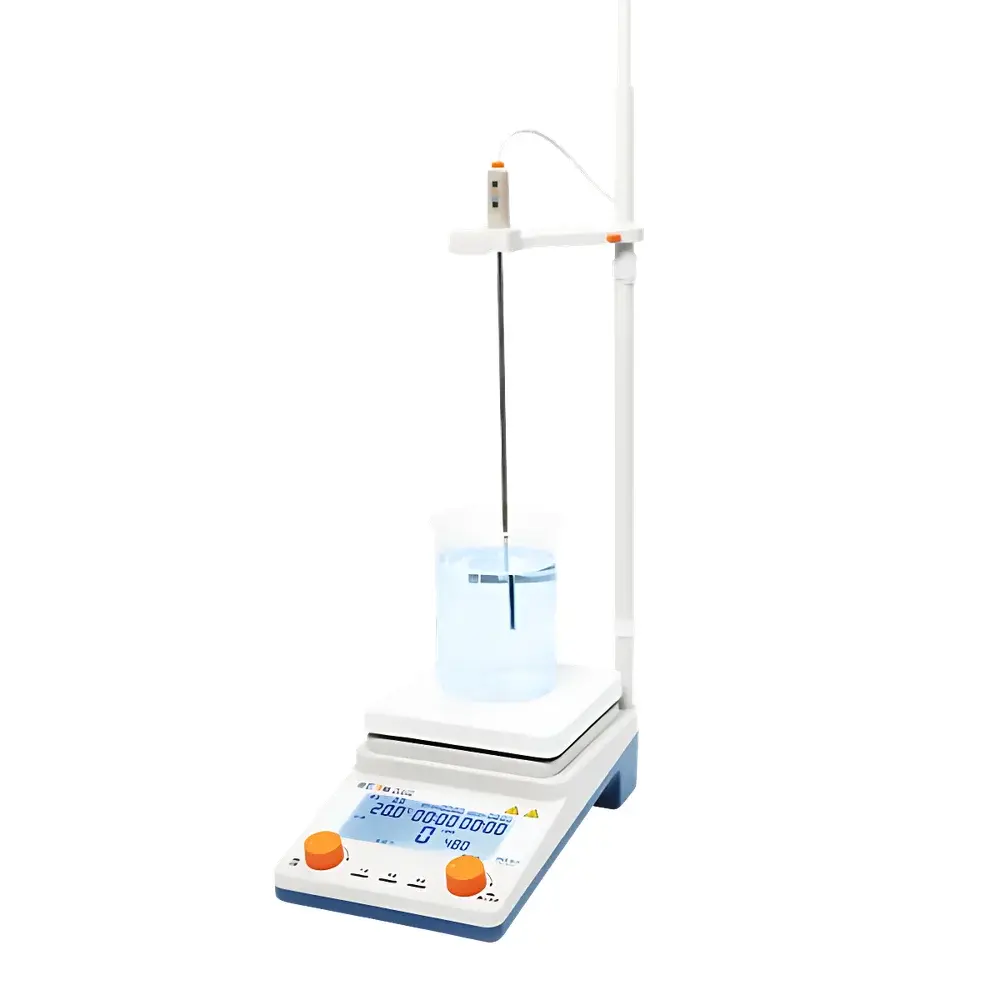
Leici JB-31TP Precision Heating Magnetic Stirrer
| Brand | Leici |
|---|---|
| Origin | Shanghai, China |
| Manufacturer Type | Direct Manufacturer |
| Product Category | Domestic (China-Made) |
| Model | JB-31TP |
| Instrument Type | Magnetic Stirrer |
| Maximum Stirring Volume | 5000 mL |
| Speed Range | 100–2000 rpm |
| Temperature Control Range (Hotplate Surface) | Ambient to 280 °C |
| Temperature Control Range (Solution) | Ambient to 180 °C |
| Speed Accuracy | ±10 rpm |
| Speed Stability | ±10 rpm over 4 h |
| Temperature Accuracy (Hotplate) | ±0.5 °C |
| Temperature Accuracy (Solution) | ±1.0 °C |
| Temperature Fluctuation (Solution) | ≤1.0 °C per 10 min |
| Heating Power | 700 W |
| Work Surface | 145 mm × 145 mm, Aluminum Alloy with Ceramic Coating |
| Dimensions | 160 × 280 × 95 mm |
| Weight | ~1.8 kg |
| Power Supply | AC 220 V ±10 %, 50 Hz |
| Operating Environment | 0–40 °C, RH ≤85 % |
| Timer Range | 0 min–99 h 59 min |
| Timer Accuracy | ±1 min/h |
| Standard Accessories | T-820D-J Temperature Probe, Magnetic Stir Bars (Φ5×20 mm, Φ7×30 mm, Φ10×60 mm), Electrode Holder (3-position), Support Stand |
Overview
The Leici JB-31TP Precision Heating Magnetic Stirrer is an engineered laboratory instrument designed for reproducible, temperature-controlled mixing in analytical chemistry, electrochemistry, titration, and solution preparation workflows. Based on the principle of magnetic coupling—where a rotating permanent magnet beneath a thermally stable ceramic-coated aluminum surface induces synchronous rotation of a magnetic stir bar immersed in liquid—the JB-31TP delivers precise agitation across volumes up to 5 L while maintaining thermal uniformity and mechanical stability. Its dual-mode temperature control system supports both hotplate surface regulation (ambient to 280 °C) and real-time solution monitoring via integrated Pt100-based T-820D-J probe (ambient to 180 °C), enabling closed-loop feedback control essential for kinetic studies, dissolution testing, and standardized methods requiring strict thermal compliance.
Key Features
- High-resolution LCD display showing real-time speed (rpm) and temperature (°C) values with intuitive dual-knob interface for independent adjustment of stirring and heating parameters
- Multi-directional rotation modes—including forward, reverse, and alternating—facilitating homogenization of viscous or heterogeneous mixtures and preventing vortex formation in low-surface-tension solvents
- Programmable timer function (0–99 h 59 min) with ±1 min/h accuracy, supporting unattended operation for extended reaction protocols or overnight sample conditioning
- Auto-memory function retains last-used speed setting upon power-on, reducing setup time between sequential experiments
- Three-position electrode holder compatible with pH, conductivity, and redox electrodes—optimized for potentiometric titrations and in-situ electrochemical monitoring per ASTM D1129 and ISO 7888
- Rugged hotplate construction: 145 mm × 145 mm work surface with scratch-resistant ceramic coating over aluminum alloy substrate; rated for continuous 700 W heating output with thermal cutoff protection
Sample Compatibility & Compliance
The JB-31TP accommodates standard glassware including beakers (up to 5 L), Erlenmeyer flasks, and jacketed reactors. Its wide speed range (100–2000 rpm) and calibrated stir bar set (Φ5×20 mm, Φ7×30 mm, Φ10×60 mm) ensure stable rotation across viscosity ranges typical of aqueous buffers, organic solvents, polymer solutions, and colloidal suspensions. The instrument complies with IEC 61010-1:2010 safety standards for laboratory electrical equipment. While not certified for GLP/GMP environments out-of-the-box, its solution temperature logging capability (when paired with external data acquisition systems) supports traceability requirements under FDA 21 CFR Part 11 when validated per internal SOPs.
Software & Data Management
The JB-31TP operates as a standalone analog-digital hybrid controller without proprietary software dependency. All operational parameters—including speed, surface/solution temperature, timer status, and mode selection—are displayed locally and retained in non-volatile memory. For integration into automated lab networks, the unit features a 0–5 V analog output port (optional accessory) compatible with third-party DAQ systems (e.g., National Instruments USB-6009) for time-stamped logging of temperature and speed profiles. This enables alignment with ISO/IEC 17025 documentation practices where raw instrument data must be archived alongside analytical results.
Applications
- Standardized dissolution testing per USP and Ph. Eur. 2.9.3, particularly for solid oral dosage forms requiring controlled agitation and bath-equivalent heating
- Preparation of calibration standards and reference solutions in environmental and pharmaceutical QC labs
- Electrochemical cell conditioning and electrolyte equilibration prior to cyclic voltammetry or impedance spectroscopy
- Homogenization of nanoparticle dispersions and emulsions where shear-sensitive components require gradual ramping of rotational energy
- Heating-assisted extraction protocols (e.g., Soxhlet pre-extraction steps) and buffer equilibration in molecular biology workflows
FAQ
Does the JB-31TP support external temperature probe input for solution control?
Yes—it accepts the supplied T-820D-J Pt100 probe for real-time solution temperature feedback and PID-regulated heating.
What is the maximum recommended viscosity for stable stirring at 2000 rpm?
For optimal performance and stir bar centering, use viscosities below 1000 mPa·s at full speed; above this, reduce speed incrementally and select larger-diameter stir bars.
Can the unit be used inside a fume hood?
Yes, provided ambient temperature remains within 0–40 °C and relative humidity does not exceed 85 %; ensure adequate ventilation around rear heat vents.
Is the ceramic-coated surface resistant to common acids and bases?
The coating resists incidental contact with dilute HCl, NaOH, and HNO₃ up to 1 mol/L but is not intended for prolonged exposure to HF or hot concentrated oxidizers.
How is calibration verified for regulatory submissions?
Users should perform periodic verification using NIST-traceable rpm tachometers and Class A platinum resistance thermometers per internal calibration SOPs aligned with ISO/IEC 17025 clause 6.5.



