
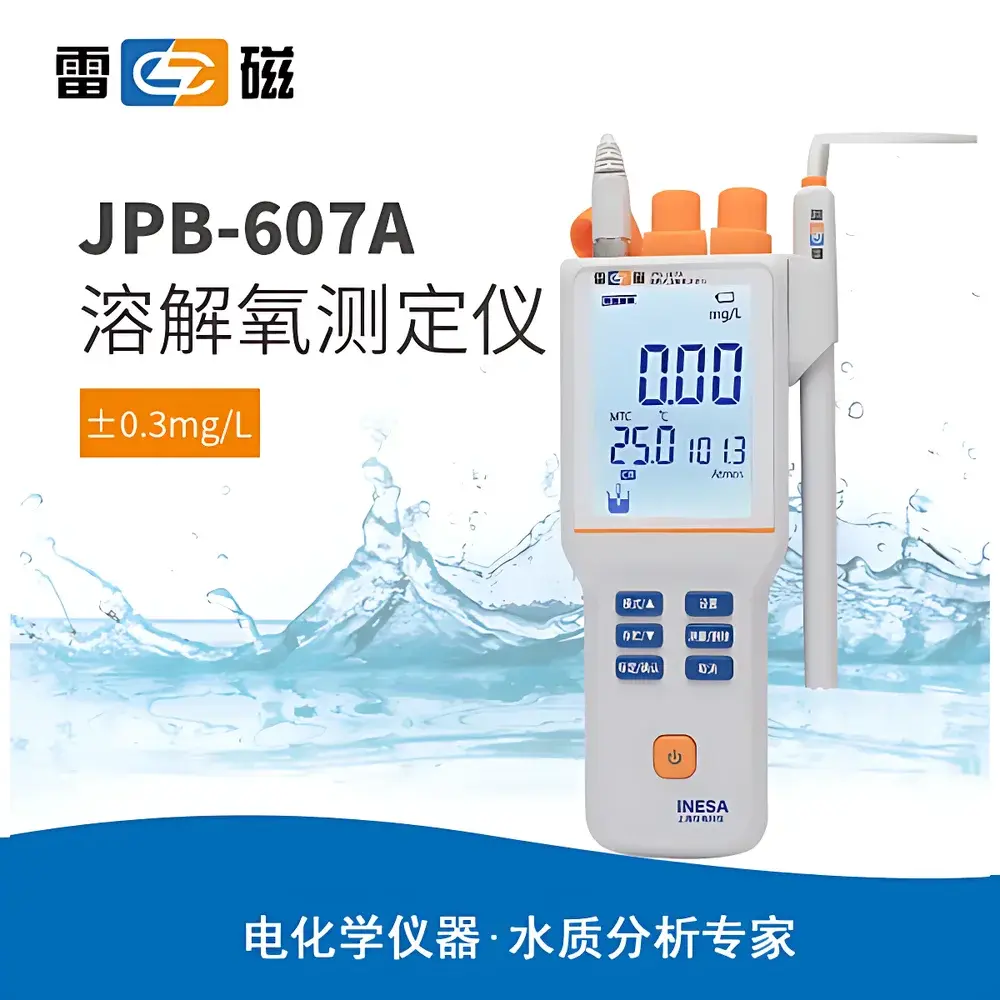
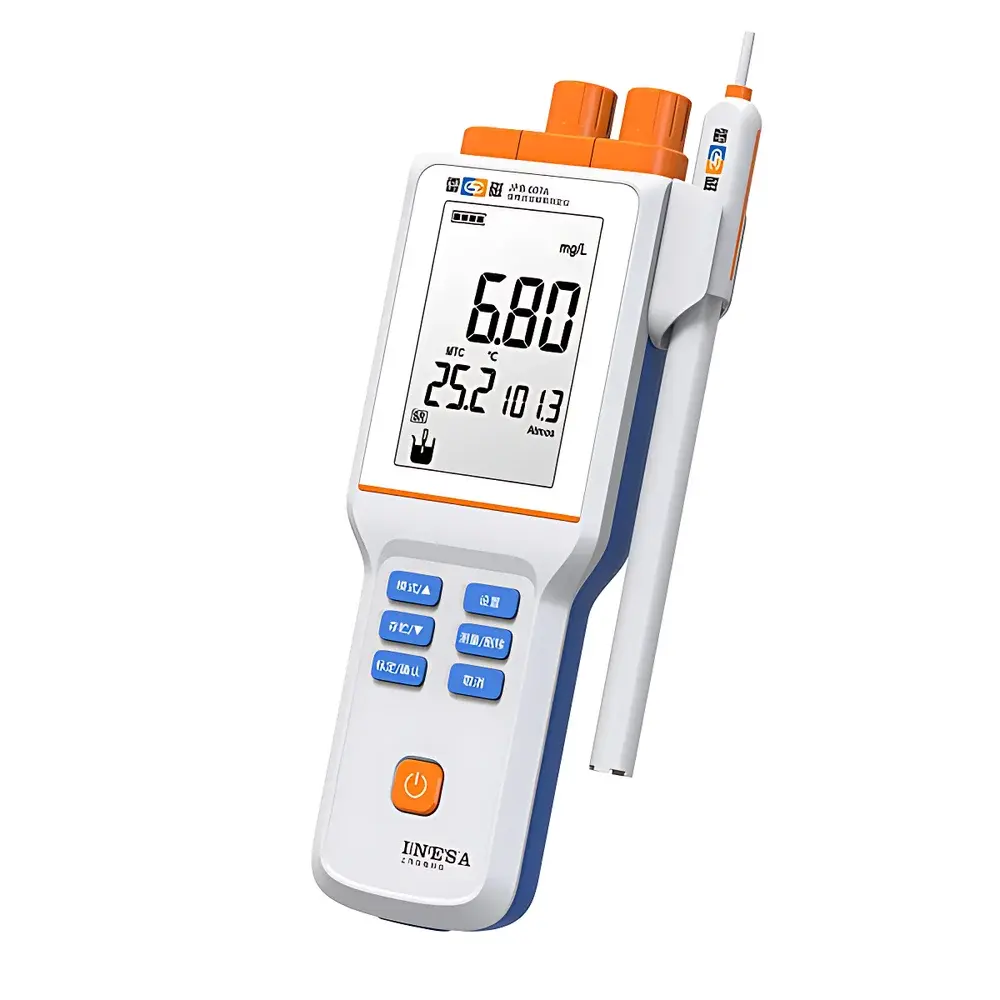
Leici JPB-607A Portable Dissolved Oxygen Analyzer
| Brand | Leici |
|---|---|
| Origin | Shanghai, China |
| Model | JPB-607A |
| Instrument Type | Portable |
| Measurement Principle | Fluorescence-based (Optical) |
| Dissolved Oxygen Range | 0.00–20.00 mg/L |
| Resolution | 0.01 mg/L |
| Accuracy (DO) | ±0.30 mg/L |
| Saturation Range | 0.0–200.0 % |
| Saturation Accuracy | ±10.0 % |
| Temperature Range | −5.0 to 110.0 °C |
| Temperature Accuracy | ±0.4 °C (0.0–60.0 °C), ±1.0 °C (elsewhere) |
| Response Time (90%) | ≤45 s at 20.0 °C |
| Salt Compensation Error | ±2% |
| IP Rating | IP65 |
| Data Storage Capacity | 200 sets |
| Power Supply | Rechargeable Li-ion battery |
| Dimensions | 80 × 225 × 35 mm |
| Weight | 0.4 kg |
Overview
The Leici JPB-607A Portable Dissolved Oxygen Analyzer is an optical, fluorescence-based instrument engineered for field-deployable water quality assessment in environmental monitoring, wastewater treatment, aquaculture, and limnological research. Unlike traditional electrochemical (Clark-type or polarographic) sensors, the JPB-607A employs a solid-state luminescent oxygen sensor that measures the dynamic quenching of fluorescent dye by molecular oxygen—offering inherent stability, zero oxygen consumption, no electrolyte maintenance, and immunity to flow-rate dependency or stirring artifacts. This principle ensures high reproducibility across repeated measurements and eliminates the need for frequent membrane replacement or electrolyte refills. The analyzer is calibrated using two-point optical standardization (zero-oxygen and air-saturated water), with automatic temperature compensation (ATC) applied in real time via an integrated NTC thermistor. Designed for rugged outdoor use, it complies with IP65 ingress protection standards for dust resistance and low-pressure water jet resilience—making it suitable for deployment in rain, humid forests, riverbanks, and wastewater outfalls.
Key Features
- Fluorescence-based DO sensing technology: Non-consumptive, membrane-free, and electrolyte-free operation with long-term signal stability
- High-resolution display: Backlit LCD with adjustable brightness for visibility under direct sunlight or low-light conditions
- Dual measurement modes: Equilibrium mode (auto-endpoint detection) and continuous monitoring mode for real-time trend analysis
- Comprehensive environmental compensation: Automatic temperature compensation (−5.0 to 110.0 °C); manual salinity compensation (0–50 g/L range); and manual barometric pressure adjustment (60–110 kPa)
- Robust data integrity architecture: 200-measurement internal memory with timestamp, temperature, DO value, saturation %, and calibration status metadata
- Extended field autonomy: Integrated rechargeable lithium-ion battery supporting >12 hours of continuous operation; USB-C compatible charging from power banks or laboratory adapters
- User-configurable safety alerts: Low-battery warning, charging status indicator, and over-range/under-range notification
Sample Compatibility & Compliance
The JPB-607A is validated for use with natural waters (freshwater, estuarine, seawater), treated effluents, surface runoff, groundwater, and process streams in municipal and industrial water systems. It meets general requirements for field-portable instrumentation under ISO 5814:2012 (Water quality — Determination of dissolved oxygen — Electrochemical probe method) and supports alignment with ASTM D888-22 (Standard Test Methods for Dissolved Oxygen in Water) when used with appropriate calibration protocols. While not certified for GLP or FDA 21 CFR Part 11 compliance out-of-the-box, its audit-ready data log (with user ID placeholder, time/date stamp, and calibration history) facilitates integration into validated environmental QA/QC workflows. The optical sensor head is chemically resistant to common aquatic contaminants including H₂S, chlorine residuals, and humic substances—reducing fouling-related drift during extended deployments.
Software & Data Management
Data export is supported via USB interface to Windows/macOS platforms using Leici’s proprietary PC utility software (v3.2+), which enables CSV export, calibration report generation, and batch visualization of DO vs. temperature profiles. Each stored record includes full contextual metadata: measurement ID, UTC timestamp, ambient temperature, salinity setting, barometric pressure entry, calibration type (zero/full), and operator notes field. The firmware supports factory reset, password-protected configuration lock, and firmware upgrade via signed binary files—ensuring traceability and version control in multi-user environments. No cloud connectivity or mobile app is provided; all data handling remains local and offline to preserve data sovereignty and regulatory compliance in sensitive jurisdictions.
Applications
- Regulatory field surveys: EPA Region-specific surface water monitoring programs (e.g., NPDES discharge verification, TMDL assessments)
- Aquaculture health management: Real-time DO profiling in hatcheries, recirculating aquaculture systems (RAS), and pond management
- Wastewater process control: Aeration basin optimization, activated sludge respiration rate estimation, and effluent compliance verification
- Ecological research: Benthic oxygen demand studies, sediment-water interface flux characterization, and hypolimnetic monitoring
- Educational laboratories: Undergraduate environmental science field labs requiring rugged, intuitive instrumentation with pedagogical calibration transparency
FAQ
Does the JPB-607A require membrane replacement or electrolyte refilling?
No—the optical fluorescence sensor contains no consumable membranes or liquid electrolytes, eliminating routine maintenance associated with polarographic probes.
Can the instrument be used in seawater with high salinity?
Yes, but manual salinity compensation must be entered prior to measurement; accuracy degrades beyond ±2% saturation error if salinity is misconfigured.
What is the recommended calibration frequency for field use?
Daily two-point calibration (zero-O₂ and air-saturation) is advised for regulatory reporting; weekly calibration suffices for trend monitoring under stable thermal conditions.
Is the device compatible with third-party data logging software?
Only Leici’s official PC utility is supported; no SDK, API, or Modbus protocol is published or enabled.
How is temperature measured and compensated?
An integrated NTC thermistor co-located with the optical sensor provides real-time temperature reading; ATC applies a polynomial correction curve per ISO 5814 Annex B.
Related Products







