
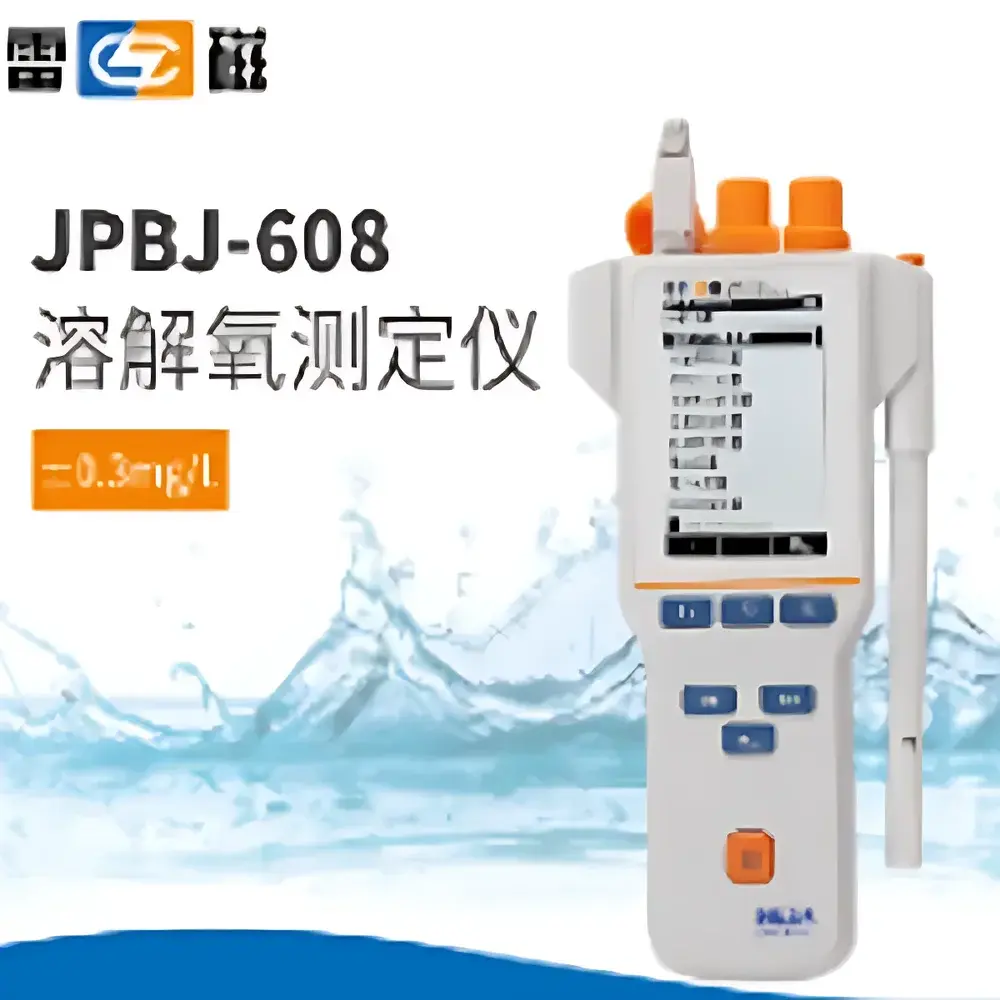
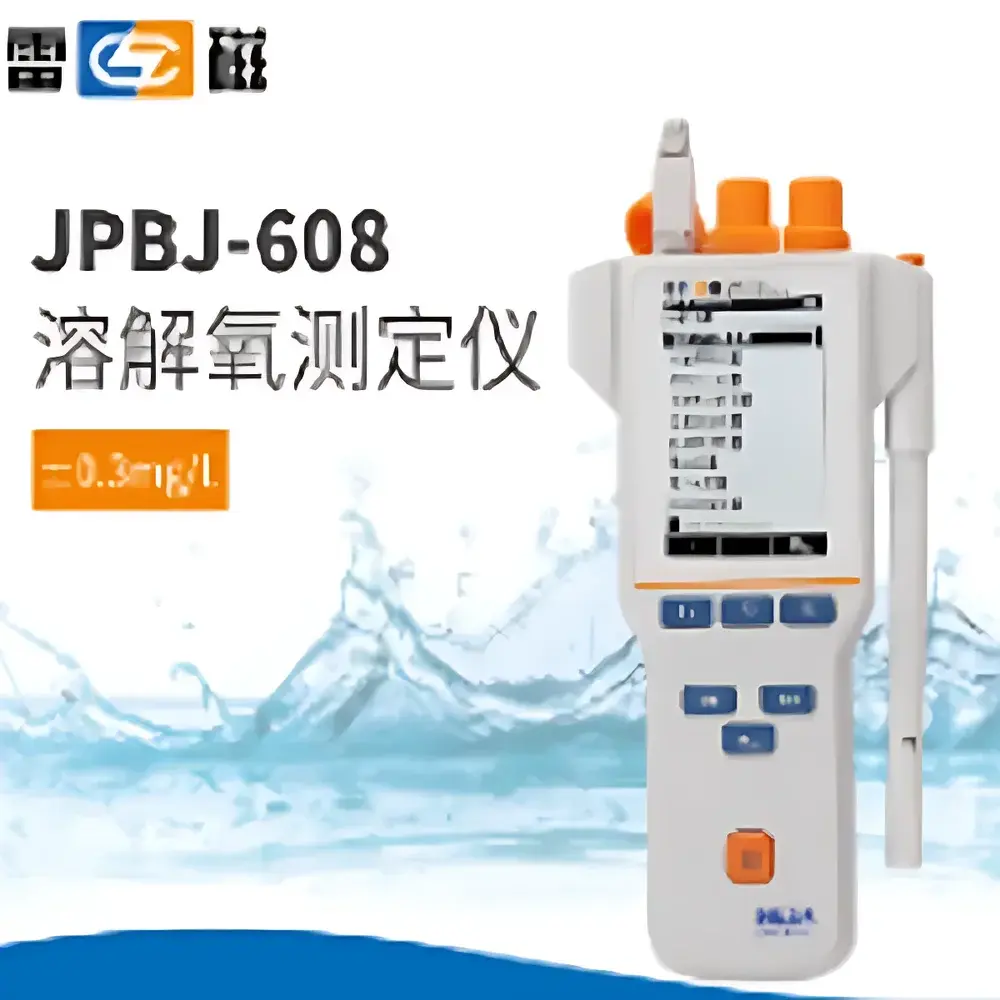
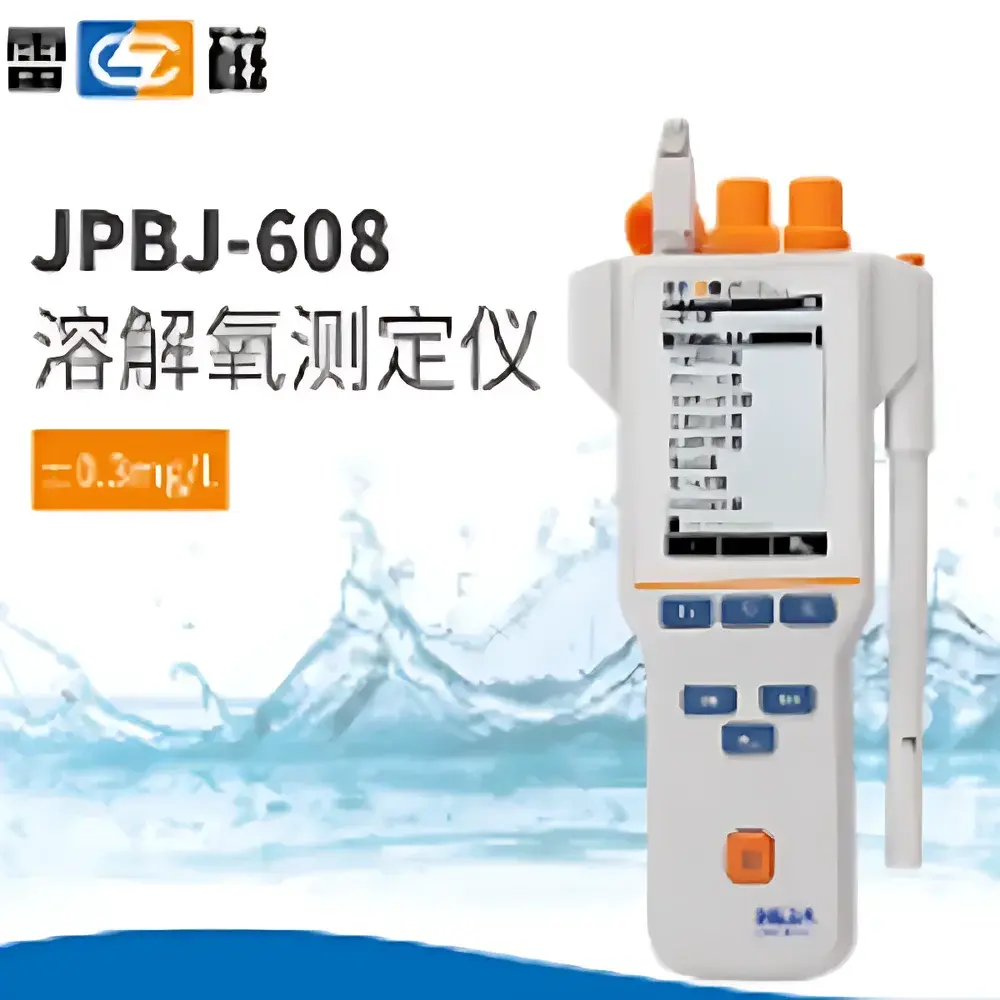
Leici JPBJ-608 Portable Dissolved Oxygen Meter
| Brand | Leici |
|---|---|
| Origin | Shanghai, China |
| Model | JPBJ-608 |
| Instrument Type | Portable |
| Measurement Principle | Polarographic Electrochemical Probe |
| Measurement Range | (0.00–50.00) mg/L |
| Accuracy | ±0.30 mg/L for values ≤20.00 mg/L |
| IP Rating | IP65 |
| Data Storage Capacity | 500 measurement sets |
| Temperature Compensation | Automatic (user-selectable units: °C or °F) |
| Atmospheric Pressure Compensation | Automatic (kPa, mmHg, atm selectable) |
| Calibration | Zero-oxygen and saturated-oxygen (full-scale) calibration supported |
| Salt Compensation | Manual input |
| Connectivity | RS-232 printer port, USB interface for PC communication |
| Power Supply | Rechargeable lithium-ion battery with low-voltage and charging-status indicators |
| Backlight | Adjustable |
Overview
The Leici JPBJ-608 Portable Dissolved Oxygen Meter is a field-deployable electrochemical analyzer engineered for precise, on-site quantification of dissolved oxygen (DO) concentration in aqueous environmental samples. It operates on the polarographic principle—utilizing a Clark-type membrane-covered amperometric sensor where oxygen diffuses through a selective gas-permeable membrane and undergoes reduction at a polarized cathode, generating a current proportional to the partial pressure of dissolved O₂. This signal is converted to concentration units (mg/L) via built-in algorithms that apply simultaneous temperature, atmospheric pressure, and salinity corrections. Designed for regulatory compliance and routine monitoring, the JPBJ-608 meets the functional requirements of field-based water quality assessment under ISO 5814:2012 (Water quality — Determination of dissolved oxygen — Electrochemical probe method) and ASTM D888-22 (Standard Test Methods for Dissolved Oxygen in Water). Its robust architecture supports rapid deployment across rivers, lakes, wastewater outfalls, aquaculture systems, and drinking water distribution networks.
Key Features
- High-resolution LCD display with adjustable backlight for readability under variable ambient lighting conditions
- Automatic endpoint detection with multiple read modes: auto-hold, timed reading, interval logging, and manual sampling
- Integrated dual-point calibration workflow—zero-oxygen (via sodium sulfite solution) and full-scale saturation (via air-saturated water or Winkler reference)—with real-time validation feedback
- Comprehensive environmental compensation: automatic temperature compensation (0–40 °C), selectable pressure units (kPa, mmHg, atm), and user-input salinity correction (0–45 g/kg)
- IP65-rated enclosure ensuring dust-tight operation and resistance to low-pressure water jets—suitable for outdoor use in rain, humidity, or splashing environments
- Onboard data management system storing up to 500 complete measurement records, each timestamped and tagged with temperature, pressure, salinity, and calibration status
- Firmware-upgradable architecture enabling future protocol alignment (e.g., enhanced GLP metadata tagging or expanded compliance reporting)
Sample Compatibility & Compliance
The JPBJ-608 is validated for use with freshwater, seawater, wastewater, and process water matrices. Its polarographic sensor exhibits minimal interference from common ions (Cl⁻, NO₃⁻, SO₄²⁻) and low sensitivity to flow rate variations above 10 cm/s—critical for consistent readings in streams or open-channel applications. The instrument complies with Good Laboratory Practice (GLP) requirements through audit-trail-capable data logging: each stored record includes operator ID (optional), calibration history, ambient conditions, and time/date stamps. While not certified for FDA 21 CFR Part 11 compliance out-of-the-box, its export-ready USB/RS-232 interfaces support integration into validated laboratory information management systems (LIMS) when paired with compliant software and procedural controls.
Software & Data Management
Data transfer is facilitated via standard USB interface using Leici’s proprietary PC communication software (Windows-compatible), which enables batch export to CSV or Excel formats with column headers aligned to ISO/IEC 17025 traceability templates. RS-232 output supports direct connection to serial printers for field-generated hardcopy reports—configurable print layouts include minimal-field (DO, temp, date) or full-compliance mode (calibration logs, operator ID, uncertainty flags). All stored entries are non-volatile and retained during battery replacement or firmware updates. The device implements secure data deletion protocols: “Clear All” requires dual confirmation and overwrites memory sectors to prevent forensic recovery.
Applications
- Regulatory surface water monitoring programs (e.g., EPA Region 10 or EU WFD reporting)
- Aquaculture pond DO profiling for feed optimization and hypoxia risk mitigation
- Wastewater treatment plant aeration basin control and effluent compliance verification
- Drinking water distribution system integrity checks (e.g., stagnation-induced DO depletion)
- Educational field labs requiring rugged, student-safe instrumentation with intuitive calibration workflows
- Emergency response teams assessing DO depletion following chemical spills or algal bloom events
FAQ
What calibration standards are required for routine operation?
Zero-oxygen calibration uses freshly prepared 1% w/v sodium sulfite (Na₂SO₃) solution; full-scale calibration employs air-saturated water equilibrated at ambient temperature and pressure—or, for higher accuracy, a certified Winkler titration reference sample.
Does the instrument support multi-point calibration?
No—the JPBJ-608 implements a two-point (zero and span) calibration model per ISO 5814. Nonlinearity outside this range is corrected algorithmically based on sensor polarization characteristics and temperature-dependent diffusion coefficients.
Can the device operate continuously while connected to external power?
Yes: the lithium-ion battery charges passively during USB or DC adapter connection, allowing uninterrupted measurements without runtime interruption or internal battery cycling stress.
Is sensor replacement user-serviceable?
Yes—the polarographic DO probe is a field-replaceable module with standardized BNC connector and O-ring seal; replacement electrodes include pre-installed membranes and electrolyte, requiring only zero/full calibration post-installation.
How does atmospheric pressure compensation improve accuracy at elevation?
Since DO saturation concentration varies inversely with barometric pressure, the JPBJ-608 applies real-time correction using its integrated pressure sensor—reducing typical high-altitude errors (e.g., ±1.2 mg/L at 2,500 m) to within ±0.15 mg/L at 20 °C.







